Ch.19 - Free Energy & Thermodynamics
Tro - Chemistry: A Molecular Approach 5th Edition
Tro5th EditionChemistry: A Molecular ApproachISBN: 9780134874371Not the one you use?Change textbook
Chapter 19, Problem 62

For each reaction, calculate ΔH°_rxn, ΔS°_rxn, and ΔG°_rxn at 25°C and determine whether the reaction is spontaneous. If the reaction is not spontaneous, could a change in temperature make it spontaneous? If so, should the temperature be increased or decreased from 25°C? b. 2 NH3(g) → N2H4(g) + H2(g)

Verified step by step guidance
1
insert step 1: Write the balanced chemical equation for the reaction: 2 \(\text{NH}\)_3(g) \(\rightarrow\) \(\text{N}\)_2\(\text{H}\)_4(g) + \(\text{H}\)_2(g)
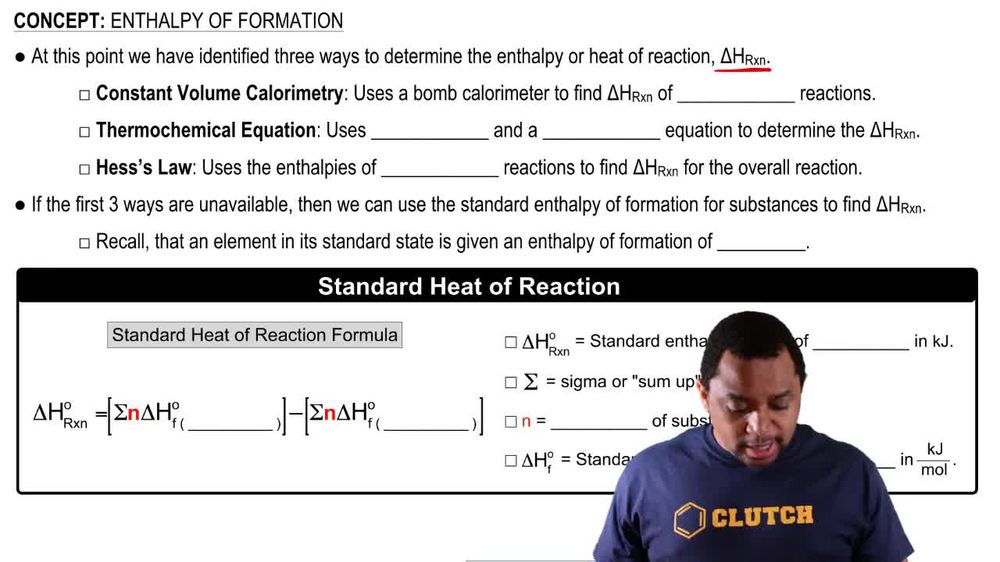
insert step 2: Use standard enthalpies of formation (\(\Delta\) H^\(\circ\)_f) to calculate \(\Delta\) H^\(\circ\)_{rxn}. The formula is \(\Delta\) H^\(\circ\)_{rxn} = \(\sum\) \(\Delta\) H^\(\circ\)_f(\(\text{products}\)) - \(\sum\) \(\Delta\) H^\(\circ\)_f(\(\text{reactants}\)).
insert step 3: Use standard molar entropies (S^\(\circ\)) to calculate \(\Delta\) S^\(\circ\)_{rxn}. The formula is \(\Delta\) S^\(\circ\)_{rxn} = \(\sum\) S^\(\circ\)(\(\text{products}\)) - \(\sum\) S^\(\circ\)(\(\text{reactants}\)).
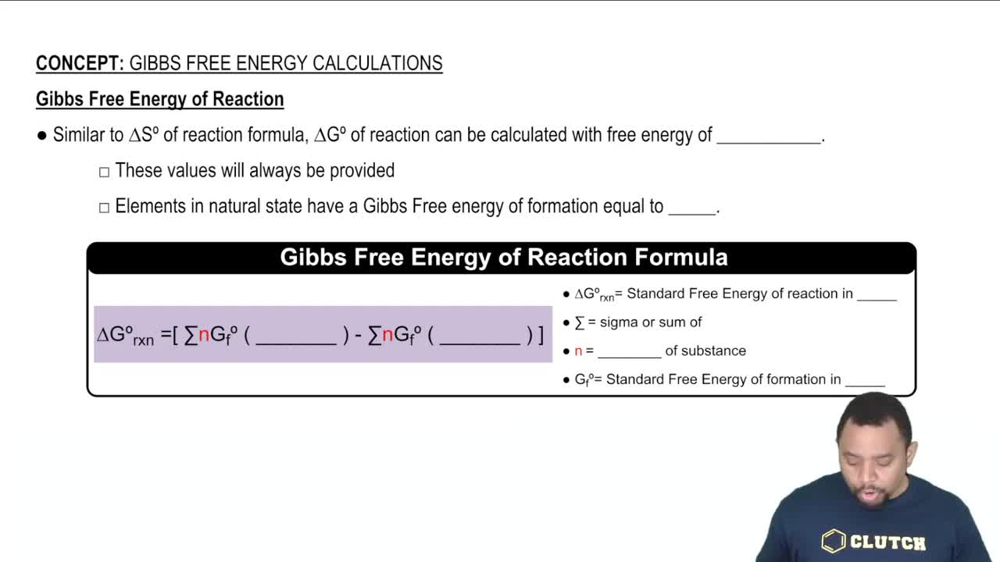
insert step 4: Calculate \(\Delta\) G^\(\circ\)_{rxn} using the Gibbs free energy equation: \(\Delta\) G^\(\circ\)_{rxn} = \(\Delta\) H^\(\circ\)_{rxn} - T\(\Delta\) S^\(\circ\)_{rxn}, where T is the temperature in Kelvin (298 K for 25^\(\circ\) C).
insert step 5: Determine spontaneity by checking the sign of \(\Delta\) G^\(\circ\)_{rxn}. If \(\Delta\) G^\(\circ\)_{rxn} < 0, the reaction is spontaneous. If \(\Delta\) G^\(\circ\)_{rxn} > 0, consider how temperature affects spontaneity: if \(\Delta\) H^\(\circ\)_{rxn} > 0 and \(\Delta\) S^\(\circ\)_{rxn} > 0, increasing temperature may make the reaction spontaneous.

Key Concepts

Here are the essential concepts you must grasp in order to answer the question correctly.

Enthalpy (ΔH°)

Enthalpy, represented as ΔH°, is a measure of the total heat content of a system at constant pressure. It indicates whether a reaction is exothermic (releases heat, ΔH° < 0) or endothermic (absorbs heat, ΔH° > 0). Understanding ΔH° is crucial for predicting the energy changes during a chemical reaction and assessing its feasibility.
Recommended video:
Guided course
02:34
Enthalpy of Formation

Entropy (ΔS°)

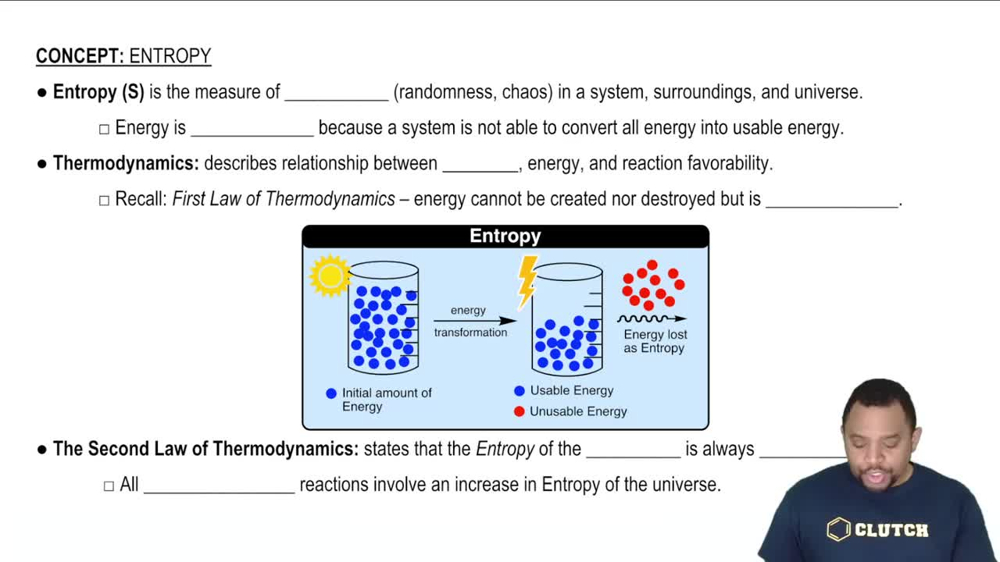
Entropy, denoted as ΔS°, quantifies the degree of disorder or randomness in a system. A positive ΔS° indicates an increase in disorder, while a negative ΔS° suggests a decrease. The change in entropy is essential for determining the spontaneity of a reaction, as reactions tend to favor states of higher entropy.
Recommended video:
Guided course
02:46
Entropy in Thermodynamics

Gibbs Free Energy (ΔG°)

Gibbs Free Energy, represented as ΔG°, combines enthalpy and entropy to determine the spontaneity of a reaction at constant temperature and pressure. A negative ΔG° indicates that a reaction is spontaneous, while a positive ΔG° suggests it is non-spontaneous. The relationship ΔG° = ΔH° - TΔS° helps predict how changes in temperature can affect spontaneity.
Recommended video:
Guided course
01:51
Gibbs Free Energy of Reactions
Related Practice
Textbook Question

For each reaction, calculate ΔH°rxn, ΔS°rxn, and ΔG°rxn at 25 °C and state whether or not the reaction is spontaneous. If the reaction is not spontaneous, would a change in temperature make it spontaneous? If so, should the temperature be raised or lowered from 25 °C? a. N2O4(g) → 2 NO2(g)

731
views
Textbook Question

For each reaction, calculate ΔH°rxn, ΔS°rxn, and ΔG°rxn at 25 °C and state whether or not the reaction is spontaneous. If the reaction is not spontaneous, would a change in temperature make it spontaneous? If so, should the temperature be raised or lowered from 25 °C? d. N2(g) + 3 H2(g) → 2 NH3(g)

1011
views
Textbook Question

For each reaction, calculate ΔH°rxn, ΔS°rxn, and ΔG°rxn at 25 °C and state whether or not the reaction is spontaneous. If the reaction is not spontaneous, would a change in temperature make it spontaneous? If so, should the temperature be raised or lowered from 25 °C? a. 2 CH4(g) → C2H6(g) + H2(g)

741
views
Textbook Question

For each reaction, calculate ΔH°rxn, ΔS°rxn, and ΔG°rxn at 25 °C and state whether or not the reaction is spontaneous. If the reaction is not spontaneous, would a change in temperature make it spontaneous? If so, should the temperature be raised or lowered from 25 °C? c. N2(g) + O2(g) → 2 NO(g)

1485
views
1
rank
Textbook Question

For each reaction, calculate ΔH°rxn, ΔS°rxn, and ΔG°rxn at 25 °C and state whether or not the reaction is spontaneous. If the reaction is not spontaneous, would a change in temperature make it spontaneous? If so, should the temperature be raised or lowered from 25 °C? d. 2 KClO3(s) → 2 KCl(s) + 3 O2(g)

452
views