Fill in the missing particles in each nuclear equation. a. 24195Am → 23793Np + ____
Ch.21 - Radioactivity & Nuclear Chemistry
Chapter 21, Problem 36c
Fill in the missing particles in each nuclear equation. c. 23793Np → _____ + 42He
Verified step by step guidance1
Identify the type of nuclear reaction. In this case, the presence of a helium nucleus (\( ^4_2\text{He} \)) indicates an alpha decay.
In alpha decay, the parent nucleus loses 2 protons and 2 neutrons, which means the atomic number decreases by 2 and the mass number decreases by 4.
Write the general equation for alpha decay: \( ^A_Z\text{X} \rightarrow ^{A-4}_{Z-2}\text{Y} + ^4_2\text{He} \).
Apply the changes to the given nucleus \( ^{237}_{93}\text{Np} \): the new mass number is \( 237 - 4 = 233 \) and the new atomic number is \( 93 - 2 = 91 \).
Determine the element with atomic number 91, which is Protactinium (Pa), so the missing particle is \( ^{233}_{91}\text{Pa} \).

Verified video answer for a similar problem:
This video solution was recommended by our tutors as helpful for the problem above.
Video duration:
56sWas this helpful?
Key Concepts
Here are the essential concepts you must grasp in order to answer the question correctly.
Nuclear Reactions
Nuclear reactions involve changes in an atom's nucleus and can result in the transformation of one element into another. These reactions often include the emission or absorption of particles, such as alpha particles (helium nuclei), beta particles, or gamma rays. Understanding the type of nuclear reaction is crucial for predicting the products formed during the process.
Recommended video:
Guided course
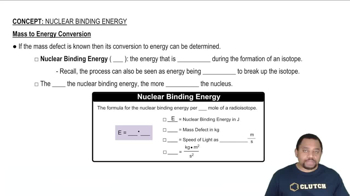
Nuclear Binding Energy
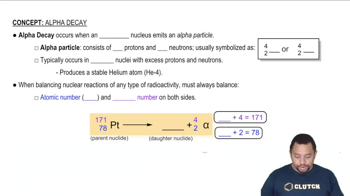
Alpha Decay
Alpha decay is a type of radioactive decay in which an unstable nucleus emits an alpha particle, consisting of two protons and two neutrons. This process decreases the atomic number by two and the mass number by four, resulting in the formation of a new element. Recognizing the characteristics of alpha decay is essential for completing nuclear equations accurately.
Recommended video:
Guided course
Alpha Decay
Balancing Nuclear Equations
Balancing nuclear equations requires ensuring that both the mass number and atomic number are conserved during the reaction. This means that the sum of the mass numbers and the sum of the atomic numbers on both sides of the equation must be equal. Mastery of this principle is vital for identifying missing particles in nuclear equations.
Recommended video:
Guided course
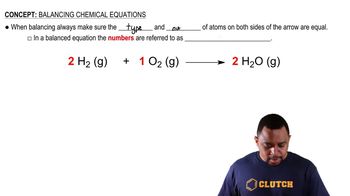
Balancing Chemical Equations
Related Practice
Textbook Question
563
views
Textbook Question
Fill in the missing particles in each nuclear equation. d. 7535Br → ____ + 0+1e
392
views
Textbook Question
The first six elements of the first transition series have the following number of stable isotopes:
Element Number of Stable Isotopes
Sc 1
Ti 5
V 1
Cr 3
Mn 1
Fe 4
Explain why Sc, V, and Mn each have only one stable isotope while the other elements have several.
798
views
Textbook Question
Fill in the missing particles in each nuclear equation. b. _____ → 23392U + 0-1e
488
views
Textbook Question
Fill in the missing particles in each nuclear equation.
a. ____ → 21785At + 42He
b. 24194Pu → 24195Am + ____
c. 1911Ne → 1910Ne + ____
d. 7534Se + _____ → 7533As
842
views
Textbook Question
Determine whether or not each nuclide is likely to be stable. State your reasons. a. Mg-26 b. Ne-25 c. Co-51
515
views