A chemist wants to make 5.5 L of a 0.300 M CaCl2 solution. What mass of CaCl2 (in g) should the chemist use?
Ch.5 - Introduction to Solutions and Aqueous Solutions
Chapter 5, Problem 31
To what volume should you dilute 50.0 mL of a 12 M stock HNO3 solution to obtain a 0.100 M HNO3 solution?
Verified step by step guidance1
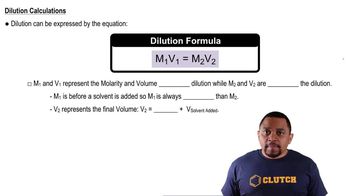
Identify the dilution formula: \( C_1V_1 = C_2V_2 \), where \( C_1 \) and \( V_1 \) are the concentration and volume of the stock solution, and \( C_2 \) and \( V_2 \) are the concentration and volume of the diluted solution.
Substitute the known values into the formula: \( 12 \text{ M} \times 50.0 \text{ mL} = 0.100 \text{ M} \times V_2 \).
Rearrange the equation to solve for \( V_2 \): \( V_2 = \frac{12 \text{ M} \times 50.0 \text{ mL}}{0.100 \text{ M}} \).
Calculate the value of \( V_2 \) to find the total volume of the diluted solution.
The result will give you the volume to which you need to dilute the stock solution to achieve the desired concentration.

Verified video answer for a similar problem:
This video solution was recommended by our tutors as helpful for the problem above.
Video duration:
1mWas this helpful?
Key Concepts
Here are the essential concepts you must grasp in order to answer the question correctly.
Dilution Principle
The dilution principle states that when a solution is diluted, the number of moles of solute remains constant. This can be expressed mathematically as C1V1 = C2V2, where C1 and V1 are the concentration and volume of the stock solution, and C2 and V2 are the concentration and volume of the diluted solution.
Recommended video:
Guided course
Dilution Equation
Molarity (M)
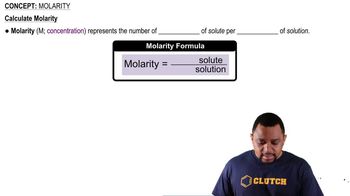
Molarity is a measure of concentration defined as the number of moles of solute per liter of solution. It is expressed in moles per liter (mol/L). Understanding molarity is crucial for calculating how much of a stock solution is needed to achieve a desired concentration in a diluted solution.
Recommended video:
Guided course
Molarity Concept
Volume Calculation
Volume calculation involves determining the final volume of a solution after dilution. In the context of the dilution principle, once the initial volume and concentration are known, the final volume can be calculated using the rearranged formula V2 = (C1V1) / C2, allowing for the preparation of solutions with specific concentrations.
Recommended video:
Guided course
Constant-Volume Calorimetry
Related Practice
Textbook Question
2579
views
Textbook Question
What is the molarity of ZnCl2 that forms when 25.0 g of zinc completely reacts with CuCl2 according to the following reaction? Assume a final volume of 275 mL. Zn(s) + CuCl2(aq) → ZnCl2(aq) + Cu(s)
2834
views
1
rank
Textbook Question
If 123 mL of a 1.1 M glucose solution is diluted to 500.0 mL, what is the molarity of the diluted solution?
1850
views
Textbook Question
A 25.0-mL sample of a 1.20 M potassium chloride solution is mixed with 15.0 mL of a 0.900 M lead(II) nitrate solution and this precipitation reaction occurs: 2 KCl(aq) + Pb(NO3)2(aq) → PbCl2(s) + 2 KNO3(aq) The solid PbCl2 is collected, dried, and found to have a mass of 2.45 g. Determine the the percent yield.
3560
views
Textbook Question
If 3.5 L of a 4.8 M SrCl2 solution is diluted to 45 L, what is the molarity of the diluted solution?
1131
views