
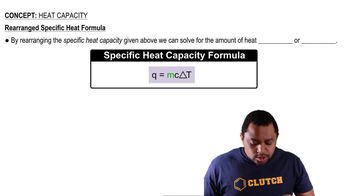
Use standard enthalpies of formation to calculate the standard change in enthalpy for the melting of ice. (The ΔH°f for H2O(s) is –291.8 kJ/mol.) Use this value to calculate the mass of ice required to cool 355 mL of a beverage from room temperature (25.0 °C) to 0.0 °C. Assume that the specific heat capacity and density of the beverage are the same as those of water.
Ch.7 - Thermochemistry
Chapter 7, Problem 97b
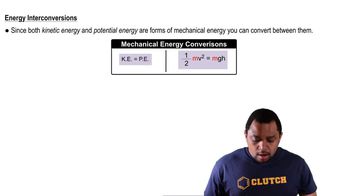
The kinetic energy of a rolling billiard ball is given by KE = 1/2 mv2. Suppose a 0.17-kg billiard ball is rolling down a pool table with an initial speed of 4.5 m/s. As it travels, it loses some of its energy as heat. The ball slows down to 3.8 m/s and then collides head-on with a second billiard ball of equal mass. The first billiard ball completely stops and the second one rolls away with a velocity of 3.8 m/s. Assume the first billiard ball is the system. Calculate q.
Verified step by step guidance1
Identify the initial kinetic energy (KE_initial) of the first billiard ball using the formula KE = \(\frac{1}{2}\)mv^2, where m is the mass and v is the initial velocity.
Calculate the initial kinetic energy: KE_initial = \(\frac{1}{2}\) \(\times\) 0.17 \(\text{ kg}\) \(\times\) (4.5 \(\text{ m/s}\))^2.
Identify the final kinetic energy (KE_final) of the first billiard ball just before the collision using the same formula with the final velocity.
Calculate the final kinetic energy: KE_final = \(\frac{1}{2}\) \(\times\) 0.17 \(\text{ kg}\) \(\times\) (3.8 \(\text{ m/s}\))^2.
Determine the heat lost (q) by the system, which is the difference between the initial and final kinetic energies: q = KE_initial - KE_final.

Verified video answer for a similar problem:
This video solution was recommended by our tutors as helpful for the problem above.
Video duration:
4mWas this helpful?
Key Concepts
Here are the essential concepts you must grasp in order to answer the question correctly.
Kinetic Energy
Kinetic energy (KE) is the energy an object possesses due to its motion, calculated using the formula KE = 1/2 mv², where m is the mass and v is the velocity of the object. In this scenario, the billiard ball's kinetic energy changes as it slows down and eventually transfers its energy during a collision.
Recommended video:
Guided course
Kinetic & Potential Energy
Conservation of Momentum
The principle of conservation of momentum states that in a closed system, the total momentum before an event must equal the total momentum after the event. In this case, the momentum of the first billiard ball is transferred to the second ball during the collision, allowing us to analyze the system's behavior before and after the impact.
Recommended video:
Guided course
Law of Conservation of Mass
Heat Transfer (q)
Heat transfer, denoted as q, refers to the energy that is transferred from one system to another due to a temperature difference. In this problem, as the first billiard ball slows down, some of its kinetic energy is converted into heat, which can be quantified to understand the energy lost during its motion.
Recommended video:
Guided course
Heat Capacity
Related Practice
Textbook Question
4255
views
1
rank
Textbook Question
Determine the mass of CO2 produced by burning enough of each fuel to produce 1.00×10² kJ of heat. a. CH4(g) + 2 O2(g) → CO2(g) + 2 H2O(g) ΔH°rxn = –802.3 kJ
3776
views
1
rank
Textbook Question
Use standard enthalpies of formation to calculate the standard change in enthalpy for the melting of ice. (The ΔH°f for H2O(s) is –291.8 kJ/mol.)
1855
views
Textbook Question
In a sunny location, sunlight has a power density of about 1 kW/m2. Photovoltaic solar cells can convert this power into electricity with 15% efficiency. If a typical home uses 385 kWh of electricity per month, how many square meters of solar cells are required to meet its energy requirements? Assume that electricity can be generated from the sunlight for 8 hours per day.
685
views
