A compound composed of only carbon and chlorine is 85.5% chlorine by mass. Propose a Lewis structure for the compound.
Ch.10 - Chemical Bonding I: The Lewis Model
Chapter 10, Problem 108
The azide ion, N3-, is a symmetrical ion, all of whose contributing resonance structures have formal charges. Draw three important contributing structures for this ion.
Verified step by step guidance1
Identify the total number of valence electrons in the azide ion, \( \text{N}_3^- \). Nitrogen has 5 valence electrons, and there are three nitrogen atoms, plus one extra electron due to the negative charge, giving a total of 16 valence electrons.
Distribute the electrons to form bonds between the nitrogen atoms. Start by connecting the three nitrogen atoms in a linear arrangement: \( \text{N} - \text{N} - \text{N} \).
Assign electrons to form double or triple bonds between the nitrogen atoms to satisfy the octet rule for each atom, while keeping the total number of electrons at 16.
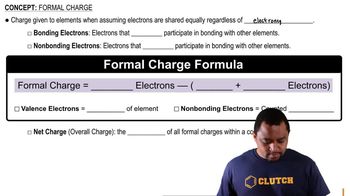
Calculate the formal charge for each nitrogen atom in each resonance structure using the formula: \( \text{Formal Charge} = \text{Valence Electrons} - \text{Non-bonding Electrons} - \frac{1}{2} \times \text{Bonding Electrons} \).
Draw the three resonance structures, ensuring that the sum of the formal charges equals the overall charge of the ion, which is -1.

Verified video answer for a similar problem:
This video solution was recommended by our tutors as helpful for the problem above.
Video duration:
4mWas this helpful?
Key Concepts
Here are the essential concepts you must grasp in order to answer the question correctly.
Resonance Structures
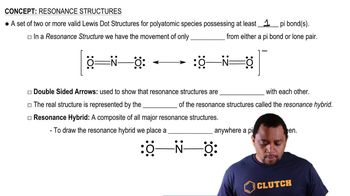
Resonance structures are different ways of drawing a molecule or ion that represent the same arrangement of atoms but differ in the distribution of electrons. For the azide ion (N3-), these structures help illustrate how the electrons can be delocalized across the molecule, contributing to its overall stability. Each resonance structure must obey the rules of valence and maintain the same number of electrons.
Recommended video:
Guided course
Resonance Structures
Formal Charge
Formal charge is a theoretical charge assigned to an atom in a molecule, calculated based on the number of valence electrons, the number of non-bonding electrons, and half the number of bonding electrons. It helps in determining the most stable resonance structure, as structures with formal charges closer to zero are generally more favorable. In the case of the azide ion, understanding formal charges is crucial for drawing accurate resonance structures.
Recommended video:
Guided course
Formal Charge
Symmetry in Ions
Symmetry in ions refers to the uniform distribution of charge and structure, which can influence the stability and reactivity of the ion. The azide ion (N3-) is symmetrical, meaning its resonance structures will reflect this symmetry, leading to equivalent contributions from each structure. Recognizing symmetry helps predict the behavior of the ion in chemical reactions and its interactions with other species.
Recommended video:
Guided course
Ion Formation
Related Practice
Textbook Question
2478
views
Textbook Question
Calculate the heat of atomization (see previous problem) of C2H3Cl, using the average bond energies in Table 10.3.
Textbook Question
If hydrogen were used as a fuel, it could be burned according to this reaction: H2(g) + 1/2 O2(g) → H2O(g) Which fuel yields more energy per gram?
828
views
Textbook Question
A compound composed of only carbon and hydrogen is 7.743% hydrogen by mass. Propose a Lewis structure for the compound.
995
views
Textbook Question
Draw the Lewis structure for each compound. c. H3AsO4
1206
views
Textbook Question
Calculate ΔHrxn for the combustion of octane (C8H18), a component of gasoline, by using average bond energies and then calculate it using enthalpies of formation from Appendix IIB. What is the percent difference between your results? Which result would you expect to be more accurate?
2412
views