
Pearson+ LogoPearson+ Logo
Ch. 8 - Genetic Analysis and Mapping in Bacteria and Bacteriophages
Klug - Essentials of Genetics 10th Edition
Klug10th EditionEssentials of GeneticsISBN: 9780135588789Not the one you use?Change textbook
Chapter 8, Problem 11

Describe the temporal sequence of the bacteriophage life cycle.

Verified step by step guidance
1
Begin by identifying the initial stage of the bacteriophage life cycle, which is attachment (or adsorption), where the phage recognizes and binds specifically to receptors on the surface of the bacterial host cell.
Next, describe the penetration stage, during which the bacteriophage injects its genetic material (DNA or RNA) into the bacterial cytoplasm, leaving the protein coat outside the cell.
Then, explain the biosynthesis phase, where the phage genome directs the host's cellular machinery to replicate phage nucleic acids and synthesize phage proteins, including structural components.
After biosynthesis, outline the assembly (or maturation) stage, where newly synthesized phage components are assembled into complete, infectious virions inside the host cell.
Finally, describe the release stage, where the host cell undergoes lysis (breakdown), releasing the mature phage particles to infect new bacterial cells, thus completing the cycle.

Key Concepts

Here are the essential concepts you must grasp in order to answer the question correctly.

Bacteriophage Life Cycle Stages

The bacteriophage life cycle includes distinct stages: attachment, penetration, biosynthesis, maturation, and release. Each stage represents a step in the infection process, from the virus attaching to the bacterial cell to the release of new phage particles.
Recommended video:
Guided course
04:29
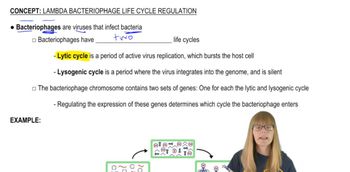
Bacteriophage Life Cycle

Lytic vs. Lysogenic Cycles

Bacteriophages can follow two main pathways: the lytic cycle, where the virus replicates rapidly and lyses the host cell, and the lysogenic cycle, where the phage DNA integrates into the host genome and replicates passively until induced to enter the lytic cycle.
Recommended video:
Guided course
08:04
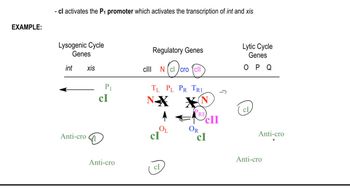
Decision Between Lytic and Lysogenic Cycles

Temporal Regulation of Gene Expression

During the bacteriophage life cycle, gene expression is temporally regulated into early, middle, and late phases. Early genes typically encode proteins for DNA replication, middle genes for genome replication, and late genes for structural proteins and assembly.
Recommended video:
Guided course
02:09
Penetrance and Expressivity