 Back
BackAdvanced Mendelian Genetics: Combinations, Probability, and Multigene Crosses
Study Guide - Smart Notes
 Tailored notes based on your materials, expanded with key definitions, examples, and context.
Mendelian Genetics: Advanced Concepts
Review of Mendel's Laws
Mendel's foundational principles—segregation and independent assortment—explain how alleles are distributed into gametes and how traits are inherited across generations. These laws form the basis for predicting genetic outcomes in crosses involving one or more genes.
Law of Segregation: Each individual possesses two alleles for each gene, which segregate during gamete formation so that each gamete receives only one allele.
Law of Independent Assortment: Genes located on different chromosomes (or far apart on the same chromosome) assort independently during gamete formation.
Random Fertilization: The union of gametes is a random process, further contributing to genetic variation.
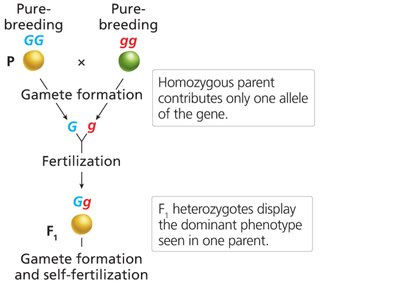
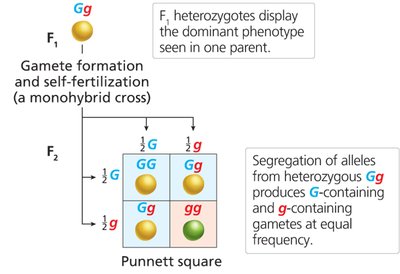
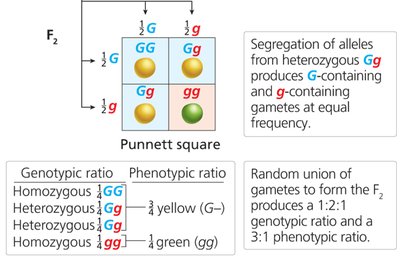
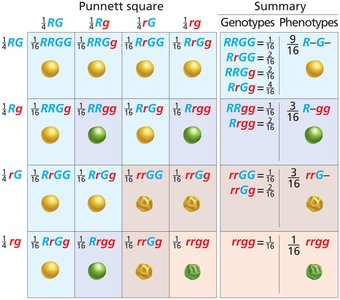
Combinations in Multigene Crosses
Predicting Gamete and Offspring Genotypes
When analyzing crosses involving multiple genes (dihybrid, trihybrid, tetrahybrid, etc.), the number of possible gamete types and offspring genotypes increases exponentially. The forked-line method and probability rules simplify these calculations.
Number of Gamete Types: For n heterozygous gene pairs, the number of possible gametes is .
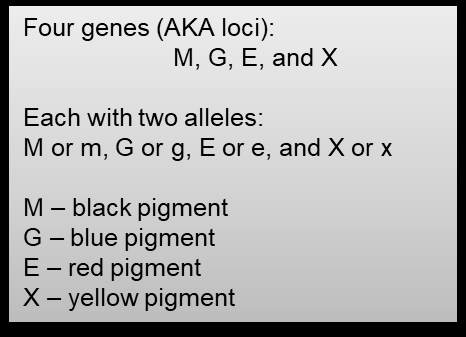
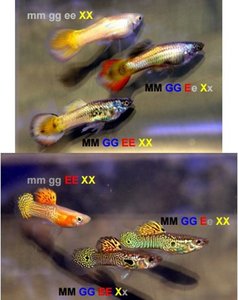
Example: A tetrahybrid (four genes, each with two alleles) produces types of gametes.
Application: Used in animal breeding to predict phenotypic ratios and select for valuable traits.
Probability in Genetics
Rules of Probability
Probability theory is essential for predicting the outcomes of genetic crosses, especially when dealing with multiple genes. The three main rules are the product rule, sum rule, and conditional probability.
Product Rule (AND Rule)
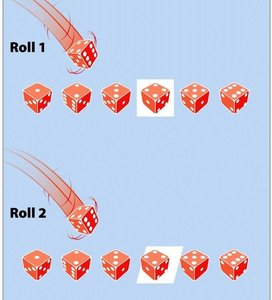
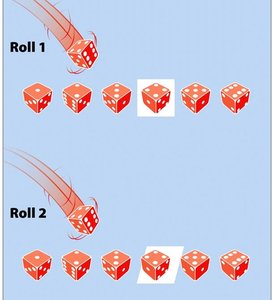
The probability of two or more independent events occurring together is the product of their individual probabilities.
Formula:
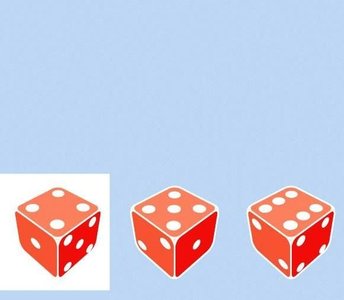
Example: Probability of rolling a 4 on two dice:
Sum Rule (OR Rule)
The probability of any one of two or more mutually exclusive events occurring is the sum of their individual probabilities.
Formula:
Example: Probability of rolling a 3 or a 4 on a die:

Conditional Probability
Conditional probability is used when the outcome of one event affects the probability of another. In genetics, this often applies when considering only a subset of possible outcomes (e.g., among yellow peas, what proportion are heterozygous?).
Formula:
Example: Among yellow peas (G_), the probability of being heterozygous (Gg) is .
Genotypic and Phenotypic Assortment Ratios
Calculating Ratios in Multigene Crosses
Genotypic and phenotypic ratios can be derived for crosses involving multiple genes by multiplying the ratios for each gene (assuming independent assortment).
Genotypic Ratio for Dihybrid Cross (AaBb x AaBb):
Phenotypic Ratio for Dihybrid Cross:
Forked-Line Method: A systematic way to list all possible combinations and their probabilities.
Example Table: Dihybrid Cross (AaBb x AaBb)
Genotype | Frequency |
|---|---|
RRGG | 1/16 |
RRGg | 2/16 |
RRgg | 1/16 |
RrGG | 2/16 |
RrGg | 4/16 |
Rrgg | 2/16 |
rrGG | 1/16 |
rrGg | 2/16 |
rrgg | 1/16 |
Example Table: Phenotypic Ratios
Phenotype | Frequency |
|---|---|
R_G_ | 9/16 |
R_gg | 3/16 |
rrG_ | 3/16 |
rrgg | 1/16 |
Solving Multigene Crosses: Strategies and Examples
Stepwise Approach
For complex crosses (trihybrid, tetrahybrid, etc.), break down the problem into single-gene probabilities and use the product rule to combine them. The forked-line method is especially useful for visualizing all possible combinations.
Example: For a cross of AaBbCC x AABbCc, calculate the number of gamete types and the expected phenotypic ratios using and the product rule.
Application: Predicting the proportion of progeny with a specific genotype or phenotype in animal breeding or plant genetics.
Summary of Key Concepts
Use the forked-line method for combinations in multigene crosses.
Start with single-gene ratios and apply the product rule for genotypic and phenotypic ratios.
Use the sum rule for mutually exclusive events and conditional probability for subset analysis.
These methods are valid when events are random and independent (genes on different chromosomes or far apart on the same chromosome).
Practice Problems and Applications
Calculate gamete frequencies for parents with multiple heterozygous loci.
Predict genotype and phenotype ratios for dihybrid, trihybrid, and tetrahybrid crosses.
Apply probability rules to determine the likelihood of specific genetic outcomes.
Example Problem Solutions
How many different gamete genotypes can AaBbCC produce? (since only A and B are heterozygous).
Expected phenotypic ratio in AaBbCC x AABbCc: Use product rule for each gene, considering dominance and heterozygosity.
Probability of a specific genotype (e.g., MmGGeeXx in guppies): Multiply the individual probabilities for each gene.
