 Back
BackChromosomal Structural Variations: Deletions, Duplications, Inversions, and Translocations
Study Guide - Smart Notes
 Tailored notes based on your materials, expanded with key definitions, examples, and context.
Chromosomal Structural Variations
Introduction to Chromosome Structure and Classification
Chromosomes can undergo various structural changes that impact genetic information and phenotype. Understanding the types and consequences of these changes is essential in genetics, particularly in the context of heredity, disease, and evolution.
Euploidy: The presence of one or more complete sets of chromosomes.
Aneuploidy: The presence of an abnormal number of chromosomes, either missing or extra chromosomes.
Monoploidy: Loss of an entire set of chromosomes.
Nullisomy: Loss of both homologous chromosomes (2N-2).
Monosomy: Loss of a single chromosome (2N-1).
Trisomy: Gain of an extra chromosome (2N+1).
Tetrasomy: Gain of an extra pair of homologous chromosomes (2N+2).
Chromosome Morphology
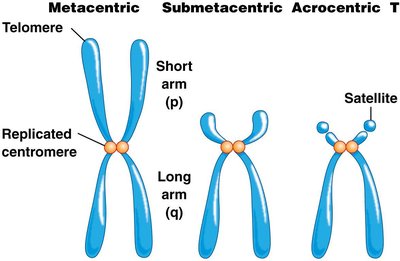
Chromosomes are classified based on the position of the centromere, which affects their shape and behavior during cell division.
Metacentric: Centromere is in the middle, arms are of equal length.
Submetacentric: Centromere is off-center, creating a short (p) and long (q) arm.
Acrocentric: Centromere is near one end, producing a very short p arm and a satellite structure.
Types of Chromosomal Structural Changes
Overview
Structural changes in chromosomes can result in loss, gain, or rearrangement of genetic material. These mutations can be large enough to detect microscopically or may require molecular techniques for identification.
Deletion
Duplication
Inversion
Translocation
Deletions
Definition and Types
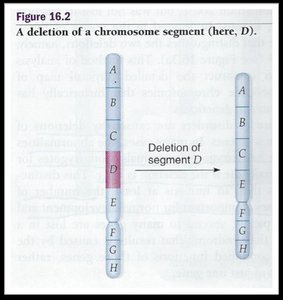
A deletion is the loss of a chromosome segment, resulting in a deficiency of genetic material. Deletions can be classified as:
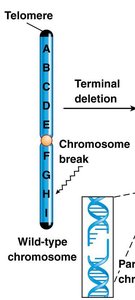
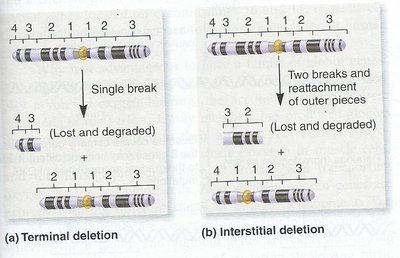
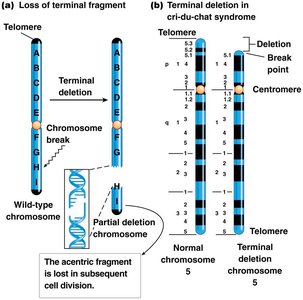
Terminal Deletion: Loss of a chromosome segment from the end (telomere).
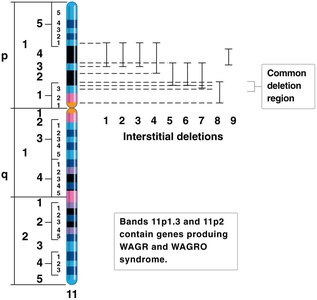
Interstitial Deletion: Loss of an internal segment, requiring two breaks and rejoining of the outer pieces.
Mechanism and Consequences
Deletions can occur due to chromosome breakage at specific points, called breakpoints.
The acentric fragment (lacking a centromere) is usually lost during cell division.
Deletions can cause severe phenotypic effects due to gene dosage imbalance.
Clinical Examples
Cri-du-chat syndrome: Caused by a terminal deletion on chromosome 5, leading to developmental abnormalities.
WAGR syndrome: Caused by interstitial deletions on chromosome 11, resulting in Wilms tumor, aniridia, genitourinary abnormalities, and mental retardation.
Duplications
Definition and Types
A duplication is a chromosomal mutation resulting in the doubling of a chromosome segment. Duplications can be classified as:
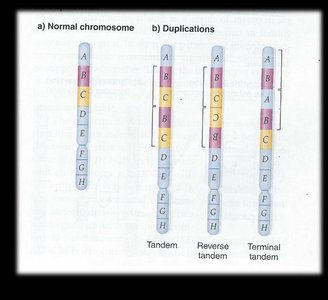
Tandem Duplication: Duplicated segments are adjacent and in the same order as the original.
Reverse Tandem Duplication: Duplicated segments are adjacent but in the reverse order.
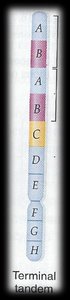
Terminal Tandem Duplication: Duplicated segments are at the end of the chromosome.
Mechanism and Consequences
Duplications can arise from unequal crossing over during meiosis.
They may result in gene dosage effects, which can be beneficial, neutral, or deleterious.
Example
Williams-Beuren syndrome is associated with partial duplication and deletion due to unequal crossover involving the PMS gene on chromosome 7.
Inversions
Definition and Types
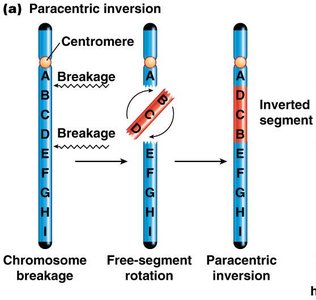
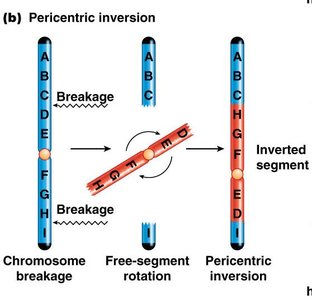
An inversion occurs when a chromosome segment is excised and reintegrated in the opposite orientation (180 degrees from the original).
Paracentric Inversion: The centromere is outside the inverted region.
Pericentric Inversion: The centromere is within the inverted region.
Genetic Implications
Inversion heterozygotes (one normal and one inverted homolog) form inversion loops during meiosis.
Crossing over within the inversion loop can result in recombinant chromosomes with duplications and deletions, often leading to nonviable gametes.
Inversions can suppress recombination in the inverted region (crossover suppression).
Translocations
Definition and Types
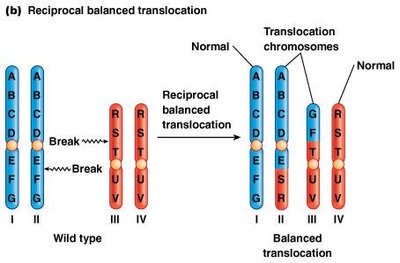
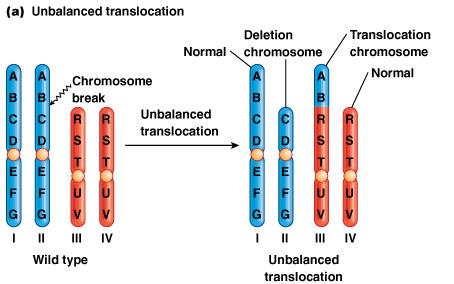
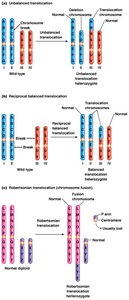
A translocation is a chromosomal mutation involving the movement of a chromosome segment to a new location, often on a nonhomologous chromosome.
Unbalanced Translocation: A segment is transferred in a one-way event, leading to gene dosage imbalance.
Reciprocal Balanced Translocation: Segments from two nonhomologous chromosomes are exchanged without loss of genetic material.
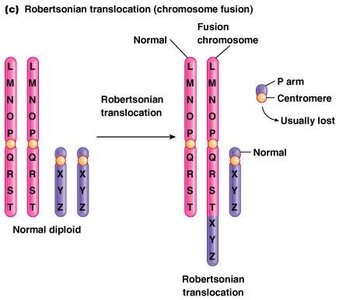
Robertsonian Translocation (Chromosome Fusion): Fusion of two acrocentric chromosomes, reducing chromosome number.
Genetic and Evolutionary Implications
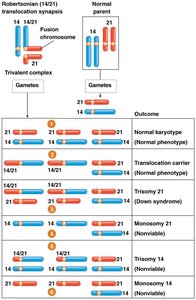
Translocation heterozygotes may be phenotypically normal if no genes are disrupted, but can experience reduced fertility due to abnormal segregation during meiosis.
Robertsonian translocations can explain differences in chromosome number between related species (e.g., humans and chimpanzees).
Familial Down syndrome is caused by a Robertsonian translocation involving chromosome 21 and another acrocentric chromosome (often 14).
Summary Table: Types of Chromosomal Structural Changes
Type | Description | Example/Consequence |
|---|---|---|
Deletion | Loss of a chromosome segment | Cri-du-chat syndrome, WAGR syndrome |
Duplication | Doubling of a chromosome segment | Gene dosage effects, Williams-Beuren syndrome |
Inversion | Reversal of a chromosome segment | Crossover suppression, altered fertility |
Translocation | Movement of a segment to a nonhomologous chromosome | Familial Down syndrome, evolutionary changes |
Key Concepts and Equations
Gene Dosage: The number of copies of a gene present in the cell or nucleus. Changes in gene dosage can lead to phenotypic abnormalities.
Chromosome Number Notation:
Normal diploid:
Nullisomic:
Monosomic:
Trisomic:
Tetrasomic:
Conclusion
Structural changes in chromosomes—deletions, duplications, inversions, and translocations—play a significant role in genetic diversity, disease, and evolution. Understanding these mechanisms is fundamental for genetic analysis, diagnosis, and research in molecular genetics.
