 Back
BackChromosome Mapping in Eukaryotes: Linkage, Recombination, and Genetic Mapping
Study Guide - Smart Notes
 Tailored notes based on your materials, expanded with key definitions, examples, and context.
Chromosome Mapping in Eukaryotes
Introduction to Linkage and Chromosome Mapping
Chromosome mapping is a fundamental technique in genetics that allows researchers to estimate the relative positions of genes on chromosomes. Because there are more genes than chromosomes, many genes are physically linked and inherited together, a phenomenon known as genetic linkage. Understanding linkage and recombination is essential for predicting inheritance patterns and constructing genetic maps.
Linkage and Independent Assortment
Genes located on different chromosomes assort independently, while genes on the same chromosome may be linked and inherited together. Linkage affects the formation of gametes and the ratios observed in genetic crosses.
Independent Assortment: Genes on different chromosomes segregate independently during meiosis, producing four types of gametes in equal proportions.
Complete Linkage: Genes located very close together on the same chromosome are inherited together, producing only parental (noncrossover) gametes.
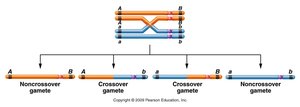
Linkage with Crossing Over: If crossing over occurs between linked genes, both parental and recombinant (crossover) gametes are produced, increasing genetic variability.
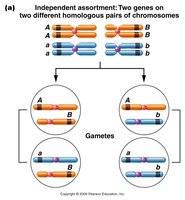
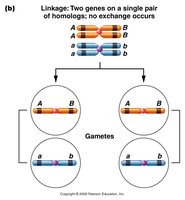
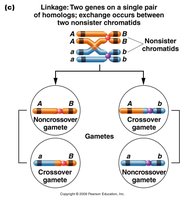
Mechanism of Crossing Over
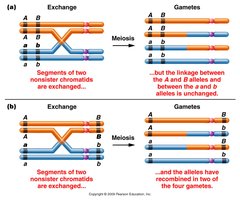
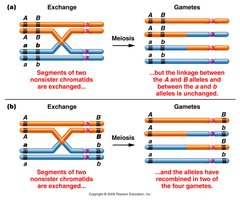
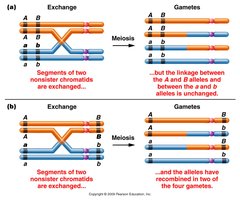
Crossing over occurs during meiosis when homologous chromosomes pair and exchange genetic material at points called chiasmata. This process results in recombinant chromatids and increases genetic diversity.
Chiasmata: Physical sites where chromatids exchange genetic material.
Recombinant Chromatids: Chromatids that have exchanged segments, resulting in new allele combinations.
Interlocus Distance: The closer two genes are, the less likely crossing over will occur between them; the farther apart, the more likely recombination will occur.
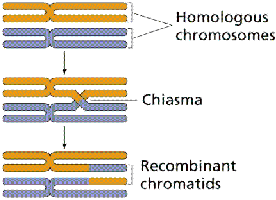
Genetic Crosses and Linkage Analysis
Genetic crosses can reveal linkage relationships and recombination frequencies. For example, a cross between AAbb and aaBB can demonstrate complete linkage if no crossing over occurs, resulting in only parental genotypes in the F1 and F2 generations.
Parental Types: Progeny with the same phenotype as one of the parents.
Recombinants: Progeny with phenotypes different from either parent due to crossing over.
Phenotypic Ratios: Complete linkage produces a 1:2:1 ratio in the F2 generation, while independent assortment produces a 9:3:3:1 ratio.
Chromosome Mapping and Recombination Frequency
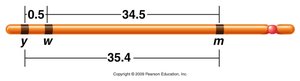
The frequency of recombination between linked genes is used to estimate their relative distance on a chromosome. Recombination frequencies are additive and help determine gene order.
Map Unit (mu) or Centimorgan (cM): One map unit equals 1% recombination between two genes.
Gene Order Prediction: By comparing recombination frequencies between pairs of genes, the order and distance can be inferred.
Single and Double Crossovers
A single crossover (SCO) alters linkage between two genes only if the crossover occurs between them. Double crossovers can further refine mapping accuracy.
Single Crossover: Produces recombinant gametes if the crossover occurs between the genes of interest.
Double Crossover: Involves two exchanges and can produce double-recombinant gametes.
Calculating Recombination Frequency
If a single crossover occurs 100% of the time between two linked genes, recombination is observed in 50% of the gametes. The recombination frequency is calculated as:
Formula:
In-Class Assignment: Predicting Phenotypic Ratios
Testcrosses can be used to predict phenotypic ratios under different linkage scenarios:
Separate Autosomes: Independent assortment, 1:1:1:1 ratio.
Linked, Far Apart: Crossover always occurs, 1:1:1:1 ratio.
Linked, Close Together: Crossover rarely occurs, mostly parental types.
Linked, 10 mu Apart: 10% recombinants, 90% parental types.
Why Didn’t Gregor Mendel Find Linkage?
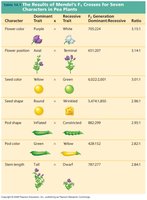
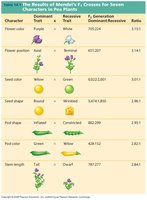
Mendel studied seven genes in peas, and the pea plant has seven chromosomes. The genes Mendel studied were either on different chromosomes or so far apart on the same chromosome that linkage was not detected.
Gene Location: Genes on the same chromosome but distantly located do not show linkage.
Historical Context: Mendel’s results were consistent with independent assortment due to the physical arrangement of the genes he studied.
Summary Table: Linkage vs. Independent Assortment
Condition | Gamete Types | Phenotypic Ratio |
|---|---|---|
Independent Assortment | AB, Ab, aB, ab | 1:1:1:1 |
Complete Linkage | AB, ab | 1:2:1 (F2) |
Linkage with Crossing Over | Parental + Recombinant | Depends on recombination frequency |
Key Terms and Definitions
Linkage: The tendency of genes located on the same chromosome to be inherited together.
Recombination: The process by which genetic material is exchanged between chromatids during meiosis.
Chiasma: The site of crossing over between homologous chromosomes.
Map Unit (mu): A unit of measurement for genetic distance, equivalent to 1% recombination.
Centimorgan (cM): Another term for map unit.
Additional info:
Gene mapping is a foundational tool in genetics for understanding inheritance, disease loci, and evolutionary relationships.
Modern techniques use molecular markers and genome sequencing to refine genetic maps.
