 Back
BackDNA Replication: Mechanisms and Molecular Basis
Study Guide - Smart Notes
 Tailored notes based on your materials, expanded with key definitions, examples, and context.
DNA Replication: Mechanisms and Molecular Basis
Overview of DNA Replication
DNA replication is a fundamental process in genetics, ensuring the accurate transmission of genetic information from one generation to the next. It occurs during the S phase of the cell cycle and involves the duplication of chromosomes, followed by their segregation during cell division.
Key Point 1: DNA replication ensures progeny cells inherit identical genetic material.
Key Point 2: The process is highly regulated and involves multiple enzymes and proteins.
Example: Replication occurs in both prokaryotic and eukaryotic cells, but with distinct features.
Structure of DNA
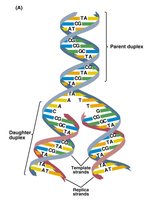
The structure of DNA was elucidated by Watson and Crick in 1953, based on data from Chargaff and Franklin. DNA is a right-handed double helix with a sugar-phosphate backbone on the outside and complementary base pairs (A-T, G-C) on the inside.
Key Point 1: DNA strands are antiparallel and held together by hydrogen bonds.
Key Point 2: Complementary base pairing is central to the copying mechanism.
Example: Each strand serves as a template for the synthesis of a new strand.
Models of DNA Replication
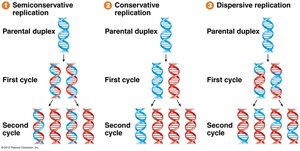
Three models were proposed for DNA replication: semi-conservative, conservative, and dispersive. The semi-conservative model, supported by the Meselson-Stahl experiment, states that each daughter DNA molecule consists of one old strand and one newly synthesized strand.
Key Point 1: Semi-conservative replication is the mechanism used in cells.
Key Point 2: The Meselson-Stahl experiment used isotopes of nitrogen to distinguish old and new DNA strands.
Example: After one round of replication, DNA is half heavy and half light, ruling out conservative replication.

Mechanism of DNA Replication
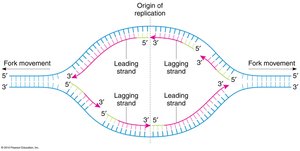
DNA replication begins at specific origins of replication. The double helix is unwound, and each strand serves as a template for the synthesis of a new strand. DNA polymerases catalyze the formation of phosphodiester bonds, adding nucleotides in a 5' to 3' direction.
Key Point 1: DNA polymerases require a template and a primer with a free 3' OH group.
Key Point 2: DNA synthesis is continuous on the leading strand and discontinuous on the lagging strand (Okazaki fragments).
Example: DNA ligase joins Okazaki fragments to form a complete strand.
Enzymatic Activities of DNA Polymerases
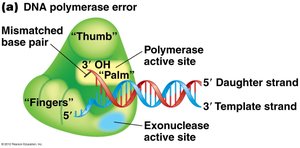
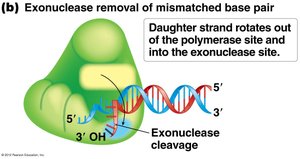
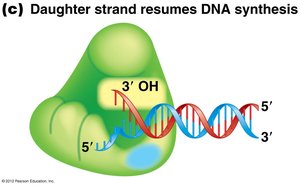
DNA polymerases not only synthesize DNA but also possess proofreading activity. They can remove incorrectly paired bases via their 3' to 5' exonuclease activity, ensuring high fidelity during replication.
Key Point 1: Proofreading reduces the error rate in DNA replication.
Key Point 2: DNA polymerases add nucleotides only to the 3' end of a growing strand.
Example: A mismatched base pair is excised and replaced with the correct nucleotide.
Replication in Prokaryotes vs. Eukaryotes
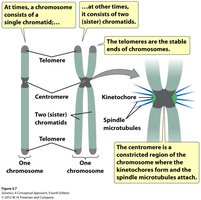
Prokaryotic genomes are typically single, circular chromosomes, while eukaryotic genomes consist of multiple linear chromosomes. Eukaryotic chromosomes have multiple origins of replication and special structures called telomeres at their ends.
Key Point 1: Replication in E. coli starts at a single origin (oriC) and proceeds bidirectionally.
Key Point 2: Eukaryotic chromosomes face the 'end problem' due to their linear nature.
Example: Telomerase extends telomeres to prevent loss of genetic information.
Telomeres and Telomerase
Telomeres are repetitive DNA sequences at the ends of eukaryotic chromosomes that protect against DNA loss during replication. Telomerase is an enzyme that adds these repeats, using an RNA template to extend the chromosome ends.
Key Point 1: Telomerase activity is essential for maintaining chromosome integrity.
Key Point 2: Loss of telomere repeats can lead to chromosome instability and cellular aging.
Example: Human chromosomes have thousands of telomere repeats, maintained by telomerase.
Summary Table: DNA Replication Models
Model | First Cycle | Second Cycle | Key Feature |
|---|---|---|---|
Semi-conservative | Hybrid DNA | Hybrid + Light DNA | Each daughter has one old and one new strand |
Conservative | Heavy + Light DNA | Heavy + Light DNA | Parent strands stay together |
Dispersive | Hybrid DNA | Hybrid DNA | DNA is a mix of old and new segments |
Key Equations
Phosphodiester bond formation:
Base pairing:
Additional info:
These notes expand upon the lecture slides and images, providing context for the molecular mechanisms of DNA replication, the role of telomeres, and the enzymatic activities involved. The Meselson-Stahl experiment is a classic demonstration of the semi-conservative nature of DNA replication.
