 Back
BackGene Mutation, DNA Repair, and Homologous Recombination: Study Notes for Genetics Students
Study Guide - Smart Notes
 Tailored notes based on your materials, expanded with key definitions, examples, and context.
Gene Mutation, DNA Repair, and Homologous Recombination
Mutation: Definition, Rarity, and Randomness
Mutations are rare, random events that alter DNA sequence and are fundamental to genetic variation and evolution. The mutation rate is measured by counting mutations affecting a phenotype and determining the frequency per base pair. Rates vary by organism and context, with phenotypic mutation rates ranging from to , and DNA-level rates around per replicated base pair.
Mutation hotspots: Genes with elevated mutation rates, often due to large gene size (e.g., DYS gene in Duchenne muscular dystrophy).
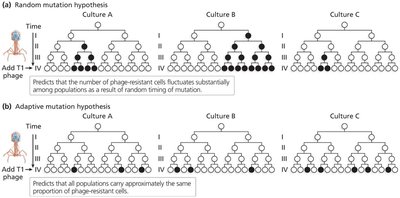
Random mutation hypothesis: Supported by Luria and Delbrück’s fluctuation test, which showed variable numbers of resistant bacteria across cultures.
Types of Mutations
Mutations can occur in germ-line cells (heritable) or somatic cells (non-heritable). Most gene mutations involve substitution, addition, or deletion of DNA base pairs.
Point mutations: Localized changes at specific positions in a gene.
Coding-sequence mutations: Affect protein coding regions.
Regulatory mutations: Affect gene expression without altering protein sequence.
Point Mutation Types and Consequences
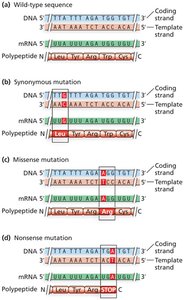
Synonymous: No amino acid change.
Missense: Changes one amino acid.
Nonsense: Creates a stop codon, terminating translation.
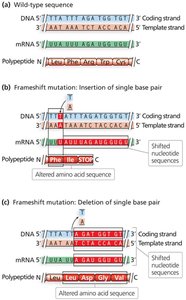
Frameshift: Alters the reading frame, producing incorrect amino acid sequence.
Regulatory Mutations
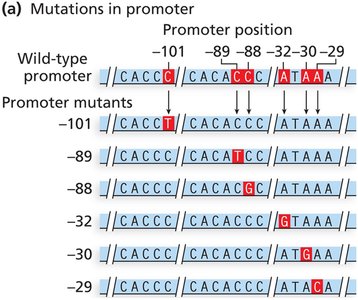
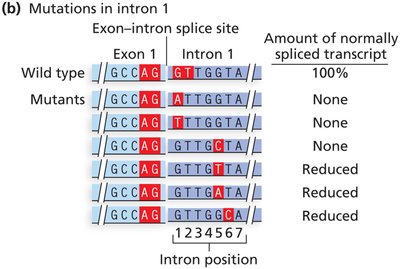
Regulatory mutations affect gene expression by altering promoters, polyadenylation signals, or splice sites.
Promoter mutations: Change timing or amount of transcription.
Splice site mutations: Cause improper retention or exclusion of exons/introns.
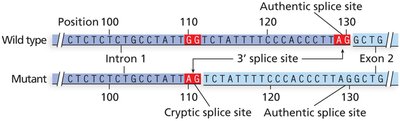
Cryptic splice sites: New splice sites compete with authentic sites, leading to abnormal mRNA.
Polyadenylation mutations: Affect mRNA processing and stability.
Mutation Reversion
Mutations can revert to wild-type or near wild-type by various mechanisms:
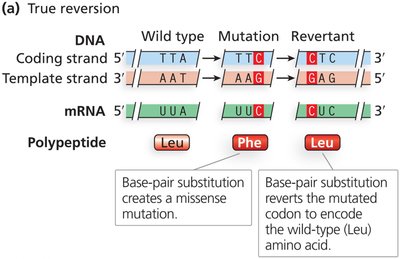
True reversion: Second mutation restores original codon.
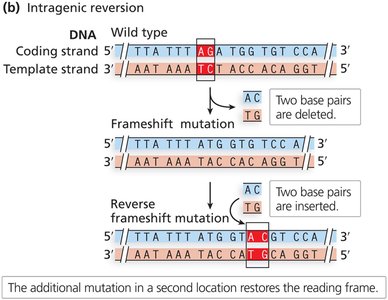
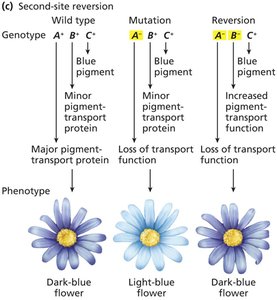
Intragenic reversion: Second mutation elsewhere in the same gene restores function.
Second-site reversion (suppressor mutation): Mutation in a different gene compensates for the original mutation.
Sources of Mutation
Spontaneous Mutations
Spontaneous mutations arise without external mutagens, primarily due to errors in DNA replication or spontaneous chemical changes.
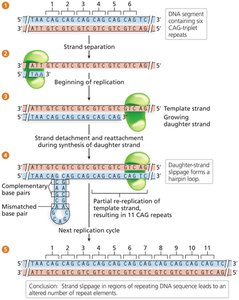
Strand slippage: DNA polymerase dissociates, leading to repeat expansion.
Trinucleotide repeat expansion disorders: Diseases caused by excessive repeat expansion (e.g., Huntington disease).
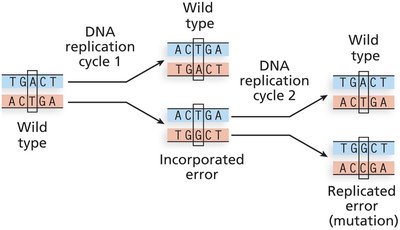
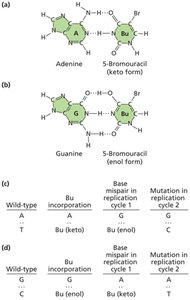
Non-Watson-Crick base pairing: Mispairing during replication can lead to incorporated and replicated errors.
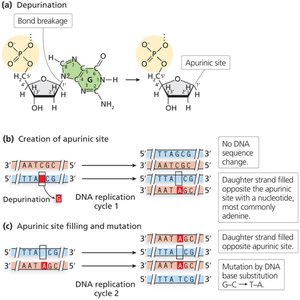
Depurination: Loss of purine base creates apurinic sites.
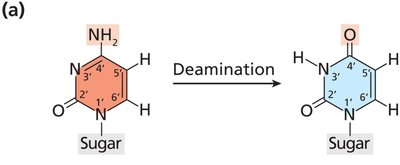
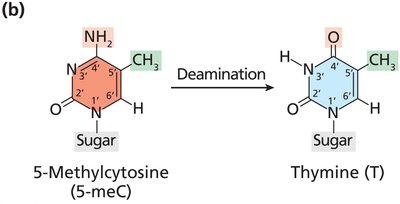
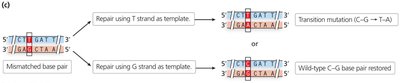
Deamination: Loss of amino group from bases, converting cytosine to uracil or methylated cytosine to thymine.
Induced Mutations
Mutagens are agents that cause DNA damage leading to mutations. Chemical mutagens are classified by their mode of action:
Nucleotide base analogs: Mimic normal bases, causing mispairing (e.g., 5-bromodeoxyuridine).
Deaminating agents: Remove amino groups (e.g., nitrous acid).
Alkylating agents: Add bulky groups, distorting DNA (e.g., EMS).
Hydroxylating agents: Add hydroxyl groups (e.g., hydroxylamine).
Intercalating agents: Insert between base pairs, causing frameshift mutations (e.g., proflavin).
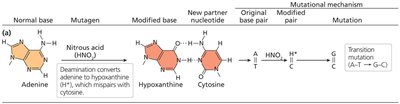
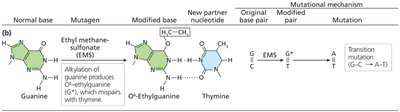
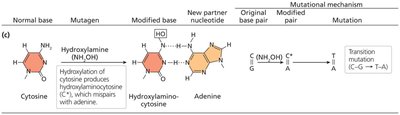
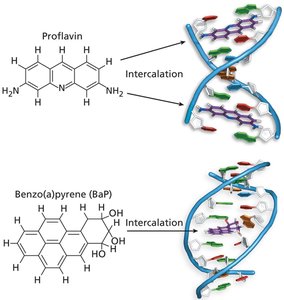
Radiation-Induced DNA Damage
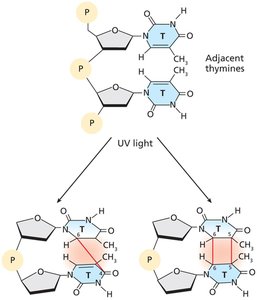
UV irradiation causes photoproducts such as thymine dimers and 6-4 photoproducts, which disrupt DNA replication and are associated with skin cancer.
Ames Test for Mutagenicity
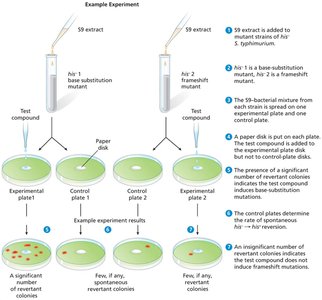
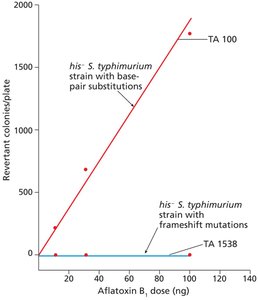
The Ames test assesses whether a compound is mutagenic by measuring the reversion rate in bacteria exposed to the compound and liver enzymes.
DNA Repair Systems
Direct Repair Mechanisms
Organisms use multiple repair systems to maintain DNA integrity:
Photoreactive repair: Photolyase reverses UV-induced photoproducts using visible light.
Base excision repair (BER): DNA glycosylases remove damaged bases, AP endonuclease creates a nick, and DNA polymerase/ligase fill and seal the gap.
Nucleotide excision repair (NER): Removes damaged strand segments and replaces them with new DNA.
Mismatch repair: Corrects base-pair mismatches using methylation to distinguish strands.
Base Excision Repair
Nucleotide Excision Repair
Mismatch Repair in E. coli
MutH, MutS, and MutL proteins coordinate to excise mismatched nucleotides and resynthesize the correct sequence.
DNA Damage Signaling and p53 Pathway
Key molecules such as BRCA1 and ATM signal DNA damage and activate the p53 pathway, which can pause the cell cycle or induce apoptosis. Mutations in repair genes increase cancer susceptibility.
Repair of Double-Strand Breaks and Homologous Recombination
Translesion DNA Synthesis and SOS Repair
Translesion DNA polymerases allow replication across damaged DNA, but are error-prone.
Double-Strand Break Repair Mechanisms
Nonhomologous end joining (NHEJ): Error-prone repair before replication, involving trimming and ligation of DNA ends.
Synthesis-dependent strand annealing (SDSA): Error-free repair after replication, using Rad51-mediated strand invasion and D loop formation.
Homologous Recombination
Homologous recombination exchanges genetic material between homologous DNA molecules, initiated by programmed double-strand breaks (e.g., Spo11 in yeast).
Holliday model: Early model of recombination, now superseded by double-strand break models.
RecBCD pathway: Bacterial system for homologous recombination.
Double-strand break model: Current model involving Spo11, Rad51, Dmc1, and formation/resolution of Holliday junctions.
Transposable Genetic Elements
Transposition Mechanisms and Effects
Transposable elements move within the genome by excision/insertion or duplication/insertion. All have terminal inverted repeats and are bracketed by flanking direct repeats.
DNA transposons: Move as DNA, either replicative (copy-and-paste) or nonreplicative (cut-and-paste).
Retrotransposons: Move via RNA intermediate, reverse transcribed to DNA.
Mutagenic effects: Insertional inactivation can cause disease or phenotypic changes.
Transposable Elements in Bacterial and Eukaryotic Genomes
Insertion sequences (ISs): Simple elements with transposase gene.
Composite transposons: Carry transposase and additional genes.
Noncomposite transposons: Additional genes but no IS elements.
Transposable Elements in Eukaryotes
Ac/Ds elements in maize: Discovered by Barbara McClintock, cause colorless sectors in kernels.
P elements in Drosophila: Cause hybrid dysgenesis and sterility in certain crosses.
Retrotransposons: Related to retroviruses, carry pol and sometimes gag genes, flanked by LTRs.
LINEs and SINEs: Abundant in human genome, cause mutations (e.g., L1 and Alu elements).
Ty elements in yeast and copia elements in Drosophila: Cause insertional mutations, flanked by LTRs.
Type of Mutation | Definition | Example/Consequence |
|---|---|---|
Synonymous | No amino acid change | Silent mutation |
Missense | One amino acid changed | Sickle cell anemia |
Nonsense | Stop codon created | Truncated protein |
Frameshift | Reading frame altered | Nonfunctional protein |
Promoter | Transcription altered | Reduced gene expression |
Splice site | Improper mRNA splicing | Mutant protein |
Polyadenylation | mRNA processing altered | Reduced protein |
DNA Repair System | Mechanism |
|---|---|
Photoreactive repair | Photolyase reverses UV-induced photoproducts |
Base excision repair (BER) | Removes damaged base, fills gap |
Nucleotide excision repair (NER) | Removes damaged strand segment, replaces with new DNA |
Mismatch repair | Excises mismatched segment, resynthesizes correct sequence |
Additional info: These notes expand on brief points with academic context, definitions, and examples to ensure completeness and clarity for genetics students.
