 Back
BackGenetics Exam II Study Guide: DNA as Genetic Material, Chromosome Structure, and Mapping
Study Guide - Smart Notes
 Tailored notes based on your materials, expanded with key definitions, examples, and context.
DNA as the Genetic Material
Historical Experiments and Key Scientists
The identification of DNA as the genetic material was established through a series of pivotal experiments and discoveries by several scientists:
Walter Sutton & Theodor Boveri: Proposed the Chromosome Theory of Inheritance, linking Mendelian genetics to chromosome behavior during meiosis.
Friedrich Miescher (1868): Isolated cell nuclei, discovering "nuclein" (now known as DNA).
Phoebus Levene (1910): Proposed the tetranucleotide hypothesis, suggesting DNA contained equal amounts of four nucleotides.
Frederick Griffith: Demonstrated transformation in Streptococcus pneumoniae, showing that bacteria could acquire genetic traits from other bacteria.
Avery, MacLeod, and McCarty: Identified DNA as the "transforming principle" responsible for heredity.
Hershey and Chase: Used radioisotopes to show that DNA, not protein, is the genetic material in T2 bacteriophage.
James Watson & Francis Crick (1953): Elucidated the double helical structure of DNA, building on work by Linus Pauling, Maurice Wilkins, Erwin Chargaff, and Rosalind Franklin.
Rosalind Franklin: Used X-ray diffraction to reveal the helical structure of DNA.
Erwin Chargaff: Discovered base pairing regularities (Chargaff's rules: %A = %T, %C = %G).
Criteria for Genetic Material
For a molecule to serve as genetic material, it must:
Store Information: Contain all instructions necessary for organismal development and function.
Express Information: Direct cellular processes and phenotype expression.
Transmit Information: Be faithfully passed to offspring during cell division.
Allow Variation: Undergo changes (mutations) to account for phenotypic diversity.
Structure of DNA and RNA
Nucleotides, Nucleosides, and Backbone
Nucleotide: Consists of a nitrogenous base, a five-carbon sugar (deoxyribose in DNA, ribose in RNA), and one or more phosphate groups.
Nucleoside: Contains only a nitrogenous base and a five-carbon sugar (no phosphate).
Phosphodiester Bonds: Link nucleotides between the 5' phosphate and 3' hydroxyl groups, giving DNA/RNA strands directionality (5' to 3').
Backbone: Composed of alternating sugar and phosphate groups; bases project from the backbone.
Double Helix and Base Pairing
DNA forms a right-handed double helix with two antiparallel strands.
Bases pair via hydrogen bonds: Adenine (A) with Thymine (T), Cytosine (C) with Guanine (G).
RNA is typically single-stranded, uses uracil (U) instead of thymine, and contains ribose sugar.
Forms of DNA
B-DNA: The most common, biologically relevant form; right-handed helix.
Z-DNA: A left-handed helix; forms under certain conditions and may play a role in gene regulation.
Chromosome Structure and Types
Types of Chromosomes
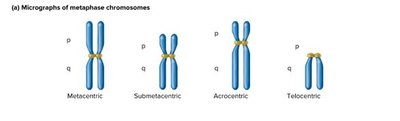
Chromosomes are classified based on the position of the centromere:
Metacentric: Centromere is in the middle, arms are of equal length.
Submetacentric: Centromere is slightly off-center, creating a short (p) and long (q) arm.
Acrocentric: Centromere is near one end, producing a very short p arm.
Telocentric: Centromere is at the very end of the chromosome.
Genetic Mapping and Chromosome Maps
Genetic Mapping Principles
Genetic maps estimate the relative distances between linked genes based on recombination frequencies:
Map Distance Formula:
1 map unit (mu) or centiMorgan (cM) = 1% recombination frequency.
Genes with 50% recombination are considered unlinked (either on different chromosomes or far apart on the same chromosome).
Coefficient of Coincidence:
Interference:
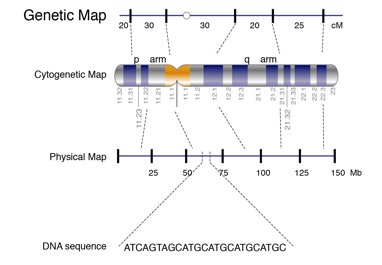
Types of Chromosome Maps
Genetic Map: Based on recombination frequencies (cM).
Cytogenetic Map: Based on banding patterns observed under a microscope.
Physical Map: Based on actual DNA sequence distances (measured in base pairs or megabases).
Linkage and Chromosome Mapping in Eukaryotes
Linkage and Independent Assortment
Genes located close together on the same chromosome are linked and tend to be inherited together.
Linked genes do not assort independently unless separated by crossing over.
Recombination frequency can be used to predict offspring genotypes and phenotypes.
Chromosome Mutations and Abnormalities
Types of Chromosome Abnormalities
Klinefelter Syndrome (47, XXY): Males with an extra X chromosome.
Turner Syndrome (45, X): Females with a single X chromosome.
Triple X Syndrome (47, XXX): Females with an extra X chromosome; often normal phenotype.
Jacobs Syndrome (47, XYY): Males with an extra Y chromosome; typically tall and thin.
Cri-du-chat Syndrome: Deletion on chromosome 5.
Trisomy 21 (Down Syndrome): Three copies of chromosome 21.
Trisomy 13 (Patau Syndrome): Three copies of chromosome 13; severe developmental issues.
Trisomy 18 (Edwards Syndrome): Three copies of chromosome 18; low survival rate.
Forms of Down Syndrome
Trisomy 21: All cells have an extra chromosome 21 (95% of cases).
Translocation: Extra part of chromosome 21 attached to another chromosome (3-4%).
Mosaicism: Only some cells have the extra chromosome (1-2%).
Chromosome Mutations: Structure and Number
Structural Changes: Deletions, duplications, insertions, inversions, and translocations.
Numerical Changes: Variations in chromosome number (aneuploidy, polyploidy).
Euploid: Organisms with complete sets of chromosomes (e.g., diploid = 2n, polyploid = 3n, 4n, etc.).
Aneuploid: Organisms with missing or extra individual chromosomes (e.g., trisomy, monosomy).
Polyploidy: Extra complete sets of chromosomes; common in plants.
Autopolyploidy: Multiple chromosome sets from the same species (errors in meiosis/mitosis).
Allopolyploidy: Chromosome sets from different species (hybridization and chromosome doubling).
Sex Determination and Dosage Compensation
Sex Determination Mechanisms
Humans: Presence of the Y chromosome determines maleness; SRY gene acts as the "signal" for male development.
Drosophila: Sex is determined by the ratio of X chromosomes to sets of autosomes.
Barr Bodies and Dosage Compensation
Dosage Compensation: Mechanism to equalize X-linked gene expression between males (XY) and females (XX).
Barr Body: Inactive, highly condensed X chromosome found in female somatic cells; ensures only one X is active per cell.
