 Back
BackGenetics Study Guide: The Molecular Basis of Heredity, Variation, and Evolution
Study Guide - Smart Notes
 Tailored notes based on your materials, expanded with key definitions, examples, and context.
The Molecular Basis of Heredity, Variation, and Evolution
Course Structure and Objectives
This genetics course is designed to provide students with a comprehensive understanding of the molecular basis of heredity, inheritance patterns, chromosome structure, genetic mapping, transcription, translation, mutation, gene regulation, and evolutionary principles. Active learning and problem-solving are emphasized throughout the course.
Key Objectives:
Understand the molecular basis of genetics and inheritance patterns.
Describe chromosome structure and cellular reproduction.
Explain genetic mapping and linkage analysis.
Detail transcription and translation in prokaryotes and eukaryotes.
Understand mutation occurrence, impact, and repair mechanisms.
Describe gene regulation in bacteria and eukaryotes.
Solve population genetics problems using the Hardy-Weinberg principle.
Fundamental Concepts in Genetics
Genetics is the study of heredity and variation in living organisms. The field explores how traits are passed from parents to offspring and how genetic information is expressed and regulated.
Cell Types:
Eukaryotic cells have membrane-bound organelles, including a nucleus.
Prokaryotic cells lack a nuclear membrane and typically do not have membrane-bound organelles.
Gene: The fundamental unit of heredity, defined as a sequence of DNA that encodes a functional product.
Alleles: Different forms of a gene that can exist at a specific locus.
Phenotype: The observable traits conferred by genes.
Chromosomes and Heredity
Chromosomes are long molecules of double-stranded DNA and protein, containing genes. Sexually reproducing organisms typically have homologous pairs of chromosomes, carrying genes for the same traits.
Homologous chromosomes: Chromosome pairs with genes for the same traits.
Inheritance: Offspring tend to resemble their parents due to the transmission of genetic material.
The Chemical Nature of the Gene
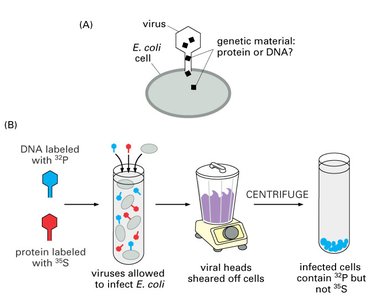
Determining the genetic material was a major milestone in genetics. Early hypotheses considered proteins, DNA, and RNA as candidates. Experiments by Avery, MacLeod, McCarty, and Hershey & Chase established DNA as the genetic material.
Avery, MacLeod, McCarty Experiment: Demonstrated that DNA, not protein or RNA, transforms bacterial strains.
Hershey and Chase Experiment: Used radioactive labeling to show that DNA enters cells during viral infection, confirming DNA as the genetic material.
Nucleic Acid Structure
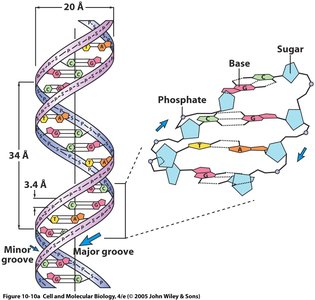
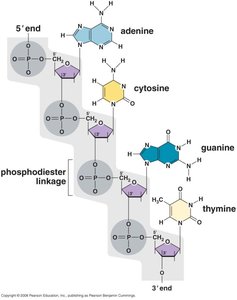
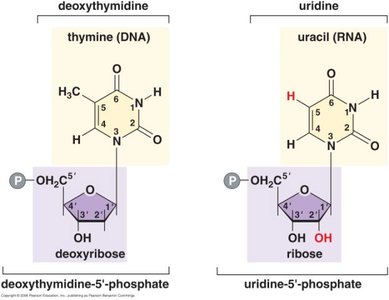
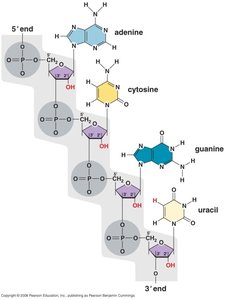
Nucleic acids (DNA and RNA) are polymers of nucleotides, each consisting of a phosphate group, a sugar (ribose or deoxyribose), and a nitrogenous base.
DNA: Contains adenine (A), guanine (G), cytosine (C), and thymine (T).
RNA: Contains adenine (A), guanine (G), cytosine (C), and uracil (U) instead of thymine.
Phosphodiester linkage: Connects nucleotides in a strand.
Chargaff's Rules
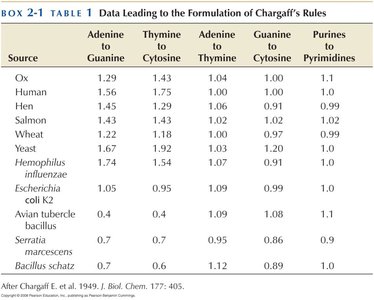
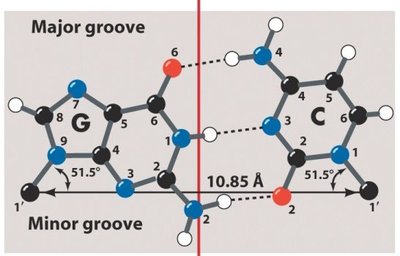
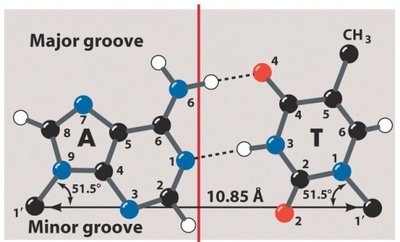
Erwin Chargaff discovered that in DNA, the amount of adenine equals thymine, and the amount of guanine equals cytosine. This led to the concept of complementary base pairing.
Base Pairing:
A pairs with T
C pairs with G
Chargaff's Rule:
Source | A:G | T:C | A:T | G:C | Purines:Pyrimidines |
|---|---|---|---|---|---|
Ox | 1.29 | 1.43 | 1.04 | 1.00 | 1.1 |
Human | 1.56 | 1.14 | 1.00 | 1.00 | 1.0 |
Hen | 1.45 | 1.29 | 1.02 | 0.91 | 0.9 |
Salmon | 1.42 | 1.18 | 1.02 | 0.97 | 0.9 |
Wheat | 1.27 | 1.18 | 1.00 | 0.97 | 0.9 |
Yeast | 1.62 | 1.18 | 1.00 | 0.91 | 1.0 |
Hemophilus influenzae | 1.74 | 0.54 | 1.07 | 0.91 | 1.0 |
Escherichia coli K2 | 0.4 | 0.4 | 1.09 | 1.08 | 1.1 |
Avian tubercle bacillus | 0.7 | 0.7 | 0.95 | 0.86 | 0.9 |
Serratia marcescens | 0.6 | 0.6 | 1.12 | 0.89 | 1.0 |
Bacillus schatz | 0.6 | 0.6 | 1.12 | 0.89 | 1.0 |
The Central Dogma of Molecular Biology
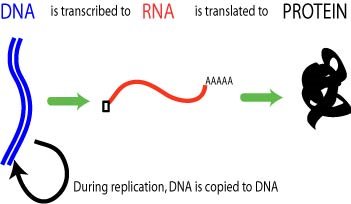
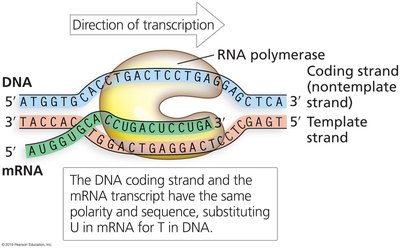
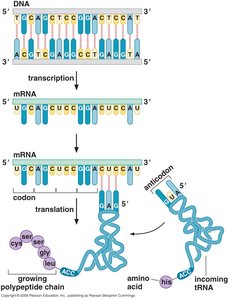
The central dogma describes the flow of genetic information: DNA is transcribed into RNA, which is then translated into protein. This process is fundamental to gene expression.
Transcription: DNA is used as a template to synthesize RNA.
Translation: RNA is used as a template to synthesize proteins.
Replication: DNA is copied to DNA during cell division.

Nucleic Acid Structure: DNA vs. RNA
DNA and RNA are structurally similar but have key differences. DNA contains deoxyribose sugar and thymine, while RNA contains ribose sugar and uracil. RNA is usually single-stranded and has a 2' hydroxyl group.
DNA: Double-stranded, contains thymine, deoxyribose sugar.
RNA: Single-stranded, contains uracil, ribose sugar, 2' hydroxyl group.
Types of RNA
RNA molecules serve various functions in the cell, including coding, regulation, and structural roles.
mRNA (messenger RNA): Carries genetic information from DNA to ribosomes for protein synthesis.
tRNA (transfer RNA): Brings amino acids to the ribosome during translation.
rRNA (ribosomal RNA): Forms the core of ribosome structure and catalyzes protein synthesis.
miRNA (microRNA): Regulates gene expression post-transcriptionally.
piRNA (piwi-interacting RNA): Involved in silencing transposons.
snRNA (small nuclear RNA): Functions in RNA splicing.
lncRNA (long non-coding RNA): Regulates gene expression.
Protein Structure and Function
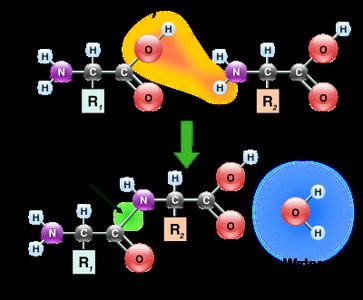
Proteins are polymers of amino acids, each with a unique R-group. The sequence and structure of proteins determine their function in the cell.
Amino acids: Building blocks of proteins, 20 types with different R-groups.
Polypeptide chain: Linear sequence of amino acids linked by peptide bonds.
Multimeric proteins: Composed of multiple polypeptide chains.
Genetics and Evolution
Evolution is driven by genetic variation, which arises from mutations in DNA. Natural selection, genetic drift, and migration shape the genetic makeup of populations.
Variation: Exists in populations and is inherited.
Mutation: Changes in DNA sequence that can lead to new traits.
Natural selection: Favors variants that increase survivorship.
Phylogenetics: Uses DNA markers to study evolutionary relationships.
Summary Table: DNA vs. RNA
Feature | DNA | RNA |
|---|---|---|
Sugar | Deoxyribose | Ribose |
Base | Thymine | Uracil |
Strandedness | Double-stranded | Single-stranded |
2' Hydroxyl | Absent | Present |
Key Equations
Chargaff's Rule:
Central Dogma:
Example Applications
Genetic Disease Prediction: Family history can be used to determine the likelihood of inheriting and passing on genetic diseases.
Antibiotic Resistance: Mutations in bacterial DNA can confer resistance, illustrating evolution in action.
CCR5 Mutation: A rare variant provides resistance to HIV, demonstrating mutation and natural selection.
Additional info:
Active learning and problem-solving are essential for mastering genetics concepts.
Homework and reading assignments are provided for practice but are not graded.
Exam format includes multiple-choice questions and is proctored online.
