 Back
BackMendelian and Non-Mendelian Genetics & Human Disease: Study Guide
Study Guide - Smart Notes
 Tailored notes based on your materials, expanded with key definitions, examples, and context.
Genetics of Human Disease
Monogenic Mendelian Diseases
Monogenic diseases are genetic disorders caused by mutations in a single gene and follow Mendelian inheritance patterns. These patterns include autosomal dominant, autosomal recessive, X-linked dominant, X-linked recessive, and Y-linked inheritance. Understanding these patterns is crucial for predicting disease risk and inheritance in families.
Monogenic Basis: Many genetic disorders are determined by the genotype at a single locus or gene.
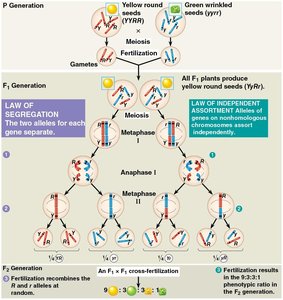
Mendelian Principles: These disorders typically follow Mendel’s laws:
Law of Segregation: The two alleles for each gene separate during gamete formation.
Law of Independent Assortment: Alleles of genes on nonhomologous chromosomes assort independently.
Principle of Dominance: Some alleles are dominant while others are recessive; an organism with at least one dominant allele will display the effect of that allele.
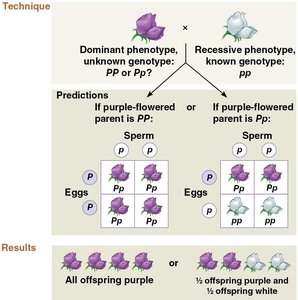
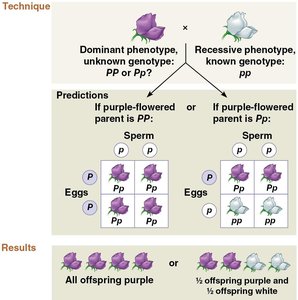
Testcross: Used to determine the genotype of an organism showing a dominant trait by crossing it with a homozygous recessive individual.
Punnett Squares and Pedigree Analysis
Punnett squares are used to predict the results of genetic crosses between individuals of known genotype. In humans, pedigree analysis is used to study inheritance patterns since testcrosses are not feasible.
Punnett Square: Visual tool to show possible combinations of gametes and predict offspring genotypes and phenotypes.
Pedigree: A family tree that describes the inheritance of a trait across generations. Used to determine the mode of inheritance (autosomal dominant, autosomal recessive, X-linked, Y-linked, mitochondrial).
Modes of Mendelian Inheritance
Monogenic traits can be inherited in several distinct patterns, each with characteristic pedigree features.
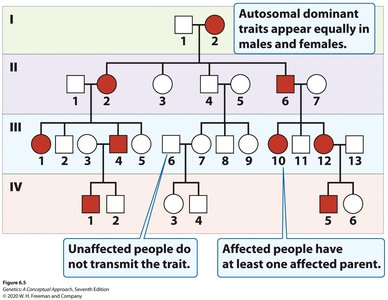
Autosomal Dominant: One mutated copy of the gene is sufficient for a person to be affected. Appears in both sexes equally, does not skip generations, and affected individuals have at least one affected parent.
Autosomal Recessive: Both copies of the gene must be mutated. Tends to skip generations, appears equally in both sexes, and affected offspring are usually born to unaffected carrier parents.
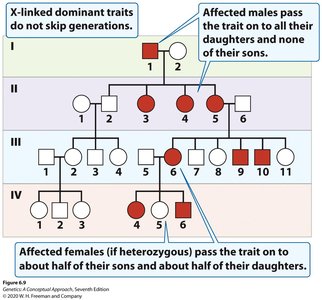
X-linked Dominant: Mutation in one copy of the gene on the X chromosome causes the disorder. Affected fathers cannot pass the trait to sons, but all daughters are affected.
X-linked Recessive: More males than females are affected. Trait is never passed from father to son, and all daughters of affected fathers are carriers.
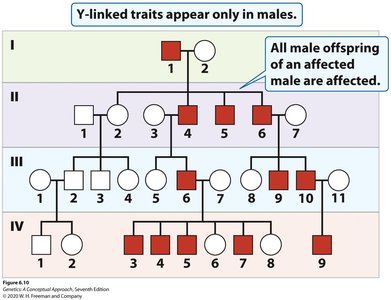
Y-linked: Only males are affected, and the trait is passed from father to all sons.
Inheritance Pattern | Key Features |
|---|---|
Autosomal Dominant | Both sexes equally affected, does not skip generations, affected offspring have affected parent |
Autosomal Recessive | Both sexes equally affected, tends to skip generations, affected offspring from carrier parents |
X-linked Dominant | Both sexes affected, affected fathers pass to all daughters, not sons |
X-linked Recessive | More males affected, never father to son, daughters of affected fathers are carriers |
Y-linked | Only males affected, passed father to all sons |
Carriers and Genetic Counseling
Carriers are heterozygous individuals who carry a recessive allele but are phenotypically normal. Genetic counseling uses pedigree analysis to assess risk for inherited diseases.
Carrier: An individual who has one normal and one mutated allele for a recessive trait.
Genetic Counseling: Provides information about inheritance patterns and risks for offspring.
Non-Mendelian Genetics
Extranuclear Inheritance: Mitochondrial Genetics
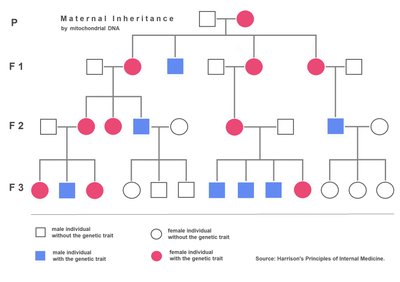
Some genetic traits are inherited through extranuclear DNA, such as mitochondrial DNA (mtDNA). Mitochondrial inheritance is strictly maternal, as mitochondria are inherited from the egg cell.
Mitochondrial Genome: Human mtDNA is about 16 kb and codes for essential RNAs and proteins.
Maternal Inheritance: All children of an affected mother inherit the trait; affected fathers do not pass it on.
Diseases: Mitochondrial dysfunction is implicated in diseases such as anemia, blindness, diabetes, and neurodegenerative disorders.
Polygenic, Complex, and Multifactorial Diseases
Many human traits and diseases are polygenic (influenced by multiple genes) and multifactorial (influenced by both genetic and environmental factors). These traits do not follow simple Mendelian inheritance.
Polygenic Inheritance: Traits governed by more than one gene, such as height, skin color, and eye color.
Quantitative Variation: Polygenic traits show continuous variation within a population.
Multifactorial Diseases: Conditions like type 2 diabetes, hypertension, and many cancers result from the interaction of multiple genes and environmental factors.
Epigenetics and Cancer Genetics
Oncogenes and Tumor-Suppressor Genes
Cancer is a genetic disease involving both genetic and epigenetic changes. Two major classes of cancer-related genes are oncogenes and tumor-suppressor genes.
Oncogenes: Mutated or overexpressed proto-oncogenes that drive excessive cell proliferation. They are dominant in their action; one mutated allele is sufficient to promote cancer.
Tumor-Suppressor Genes: Genes that normally inhibit cell division. Both alleles must be mutated (recessive) to lose function and contribute to cancer.
Model Genetic Organisms
Characteristics and Importance
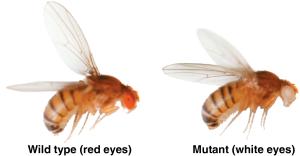
Model organisms are species that are widely used in genetic research due to their advantageous characteristics.
Short generation time
Production of numerous progeny
Ability to carry out controlled genetic crosses
Ease of laboratory rearing
Availability of genetic variants
Extensive genetic knowledge base
Forward and Reverse Genetics
Forward Genetics: Begins with a mutant phenotype and identifies the gene responsible.
Reverse Genetics: Begins with a gene sequence and investigates the resulting phenotype by altering or inhibiting the gene.
Sample Problems and Applications
Probability calculations for Mendelian inheritance (e.g., probability of affected offspring in autosomal recessive or dominant crosses).
Pedigree analysis to determine mode of inheritance.
Genetic counseling scenarios for diseases such as Tay-Sachs, albinism, and brachydactyly.
Summary Table: Common Human Genetic Diseases
Inheritance Pattern | Disease | Gene/Region | Nature of Variants | Estimated Frequency |
|---|---|---|---|---|
Autosomal dominant | Osteogenesis imperfecta | COL1A1, COL1A2 | Missense, nonsense, splicing mutations | 6-7/100,000 |
Autosomal recessive | Cystic fibrosis | CFTR | Many different variants | 1/2,500 in Caucasians |
X-linked recessive | Duchenne muscular dystrophy | DMD | Deletions or duplications | 1/3,500 males |
X-linked dominant | Rett syndrome | MECP2 | Missense, nonsense, splicing mutations | 1/10,000 females |
Y-linked | Y chromosome infertility | USP9Y | Deletions, mutations | Rare |
Key Equations
Probability of affected offspring (autosomal recessive, both parents heterozygous):
Probability of carrier offspring (autosomal recessive, one parent heterozygous, one homozygous normal):
