 Back
BackMendelian Genetics I: Foundations of Transmission Genetics
Study Guide - Smart Notes
 Tailored notes based on your materials, expanded with key definitions, examples, and context.
Mendelian Genetics I: Foundations of Transmission Genetics
Introduction to Mendelian Genetics
Mendelian genetics forms the cornerstone of classical genetics, describing how traits are inherited from one generation to the next. Gregor Mendel's experiments with pea plants established the basic principles of heredity, including the concepts of dominant and recessive alleles, segregation, and independent assortment.
Mendel’s Experimental Methods
Key Innovations in Mendel’s Approach
Pure-breeding strains: Mendel used plants that consistently produced the same phenotype over generations, ensuring genetic consistency.
Simple traits: He selected traits with only two contrasting forms (dichotomous traits), such as round vs. wrinkled seeds.
Controlled crosses: Mendel performed artificial cross-fertilization, carefully controlling which plants were mated.
Replication: He grew and analyzed thousands of plants, introducing the concept of replication in experimental science.
Quantification: Mendel used quantitative summary statistics to analyze his results, allowing for precise ratio calculations.
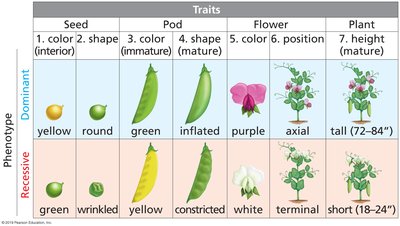
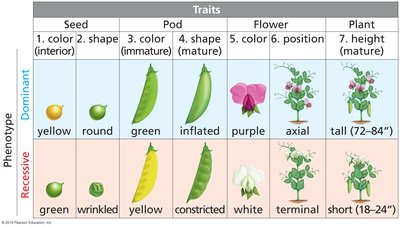
Example: Mendel studied seven traits in peas, each with two forms, such as seed color (yellow/green) and seed shape (round/wrinkled).
Life Cycle and Crosses in Pea Plants
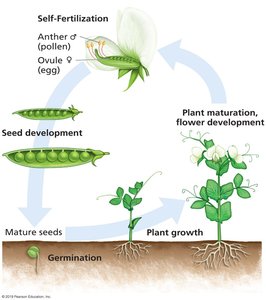
Mendel’s experiments involved self-fertilization and cross-fertilization to track inheritance patterns across generations.
Key Terms in Mendelian Crosses
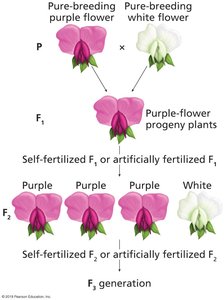
Parental (P) generation: The original pure-breeding plants used in a cross.
First filial (F1) generation: The offspring of the parental cross.
Second filial (F2) generation: The offspring of self-fertilized or intercrossed F1 individuals.
Monohybrid cross: A cross between parents differing in one trait.
Dihybrid cross: A cross between parents differing in two traits.
Test cross: A cross between an individual with an unknown genotype and a homozygous recessive individual to determine the unknown genotype.
Reciprocal cross: Two crosses in which the sexes of the parents are reversed to test for sex-linked inheritance.
Mendel’s First Law: The Principle of Segregation
Monohybrid Crosses and Segregation
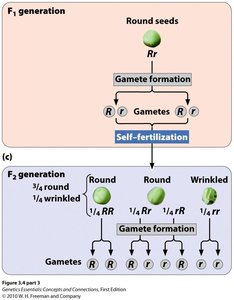
Mendel’s monohybrid crosses revealed that traits do not blend but are inherited as discrete units (alleles). Each individual carries two alleles for each gene, which segregate during gamete formation so that each gamete receives only one allele.
Dominant and recessive traits: In F1 hybrids, only the dominant trait is expressed; the recessive trait reappears in the F2 generation.
Genotypic ratio in F2: 1:2:1 (e.g., 1 GG : 2 Gg : 1 gg)
Phenotypic ratio in F2: 3:1 (e.g., 3 dominant : 1 recessive)
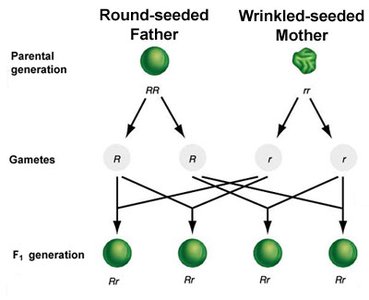
Example: Crossing round-seeded (RR) with wrinkled-seeded (rr) peas yields all round F1, but F2 shows a 3:1 round to wrinkled ratio.
Testing the Hypothesis: Test Crosses
A test cross determines whether an individual with a dominant phenotype is homozygous or heterozygous by crossing it with a homozygous recessive individual. A 1:1 ratio in the offspring indicates heterozygosity.
Mendel’s First Law and Meiosis
The principle of segregation is explained by the separation of homologous chromosomes during meiosis I. Each gamete receives one allele from each gene pair.
Anaphase I: Homologous chromosomes (and thus alleles) separate.
Anaphase II: Sister chromatids separate, ensuring each gamete has one allele per gene.
Mendel’s Second Law: The Principle of Independent Assortment
Dihybrid Crosses and Independent Assortment
Mendel’s dihybrid crosses showed that alleles of different genes assort independently during gamete formation, provided the genes are on different chromosomes or far apart on the same chromosome.
Phenotypic ratio in F2: 9:3:3:1 for two traits (e.g., round/yellow, round/green, wrinkled/yellow, wrinkled/green)
Genotypic ratio: More complex, but can be derived using Punnett squares or the product rule.
Example: Crossing plants heterozygous for two traits (RrYy x RrYy) yields four phenotypic classes in a 9:3:3:1 ratio.
Meiotic Basis of Independent Assortment
During metaphase I of meiosis, homologous chromosome pairs align independently, leading to random combinations of alleles in gametes. This is a major source of genetic variation.
Summary Table: Mendel’s Crosses and Ratios
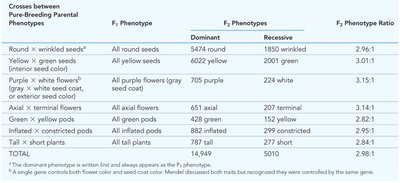
Cross | F1 Phenotype | F2 Phenotype Ratio |
|---|---|---|
Round x Wrinkled Seeds | All round | 2.96:1 |
Yellow x Green Seeds | All yellow | 3.01:1 |
Purple x White Flowers | All purple | 3.15:1 |
Axial x Terminal Flowers | All axial | 3.14:1 |
Green x Yellow Pods | All green | 2.82:1 |
Inflated x Constricted Pods | All inflated | 2.96:1 |
Tall x Short Plants | All tall | 2.84:1 |
Practice Problems and Applications
Monohybrid Cross Example
Cross: BB x Bb
Genotype ratio: 1 BB : 1 Bb
Phenotype ratio: 100% dominant phenotype
Test Cross Example
Cross: Bb x bb
Genotype ratio: 1 Bb : 1 bb
Phenotype ratio: 1 dominant : 1 recessive
Common True/False Statements
A test cross between a heterozygous and a homozygous recessive parent yields a 1:1 ratio (True).
Reciprocal crosses that produce identical results demonstrate pure-breeding (False; test crosses do).
A heterozygous individual produces 50% gametes with each allele, not 75% (True statement: 50%).
Summary
Mendel’s experiments established the laws of segregation and independent assortment.
Traits are inherited as discrete units (genes/alleles), not blended.
Monohybrid crosses reveal the 3:1 phenotypic ratio and 1:2:1 genotypic ratio in F2.
Dihybrid crosses reveal the 9:3:3:1 phenotypic ratio, supporting independent assortment.
Meiosis explains the physical basis for Mendel’s laws.
