 Back
BackOrganelle Inheritance and the Evolution of Organelle Genomes
Study Guide - Smart Notes
 Tailored notes based on your materials, expanded with key definitions, examples, and context.
Organelle Inheritance and Extranuclear Genetics
Introduction to Extranuclear Inheritance
Extranuclear inheritance, also known as cytoplasmic inheritance, refers to the transmission of genetic material found in organelles such as mitochondria and chloroplasts, rather than in the nucleus. This mode of inheritance is distinct from Mendelian genetics and plays a crucial role in the heredity of certain traits in eukaryotes.
Organelle chromosomes: Mitochondria and chloroplasts contain their own DNA, separate from nuclear DNA.
Uniparental inheritance: In most eukaryotes, organelle DNA is inherited from one parent, typically the mother.
Biparental inheritance: In some species, both parents contribute organelles to the zygote.
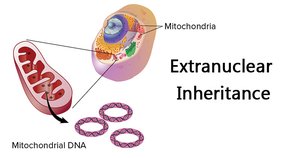
Organelle Inheritance Transmits Genes Carried on Organelle Chromosomes
Organelle inheritance involves the transmission of genes located on mitochondrial and chloroplast chromosomes. This differs from nuclear inheritance, as the cytoplasmic organelles may be contributed by one or both parents, and the number and identity of organelle genes can vary among species.
Multiple organelles per cell: Each cell may contain numerous mitochondria or chloroplasts, each with multiple genome copies.
Influence of nuclear genes: Traits controlled by cytoplasmic inheritance can also be affected by nuclear genes.
Discovery and Patterns of Cytoplasmic Inheritance
The Discovery of Cytoplasmic Inheritance
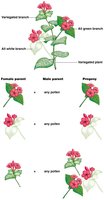
Non-Mendelian inheritance patterns were first observed in plants by Baur and Correns in 1908. Correns' studies on leaf color in the four o’clock plant revealed that progeny always exhibited the phenotype of the female parent, indicating maternal inheritance.
Reciprocal crosses: Crossing plants with different leaf colors showed that the phenotype was determined by the maternal parent.
Maternal inheritance: Transmission occurs through genes in the ovule.
Homoplasmy and Heteroplasmy
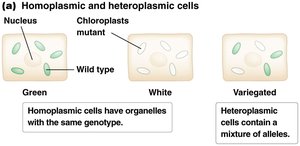
Cells can be homoplasmic or heteroplasmic depending on the uniformity of organelle genomes. Homoplasmic cells have identical organelle genomes, while heteroplasmic cells contain a mixture of different alleles.
Homoplasmy: All organelle genomes are identical.
Heteroplasmy: Organelles contain a mixture of wild-type and mutant alleles.
Maternal Inheritance of Leaf-Color Phenotypes
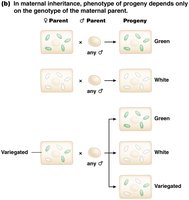
Correns' work demonstrated that ovules from variegated plants could produce progeny with green, white, or variegated leaves, depending on the heteroplasmic state of the chloroplasts.
Heteroplasmic ovules: Can produce progeny with different leaf colors.
Maternal effect: Phenotype depends on the genotype of the maternal parent.
Genome Replication and Segregation in Organelles
Genome Replication in Organelles
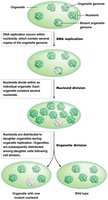
Organelle DNA is organized into nucleoids, which contain multiple genome copies. Replication of organelle genomes is not tightly coupled to the cell cycle, and transmission genetics depends on organelle growth, division, and segregation.
Nucleoid: Protein-DNA complex containing multiple genome copies.
Replication factors: Growth, division, and segregation of organelles and nucleoids.
Replicative Segregation of Organelle Genomes
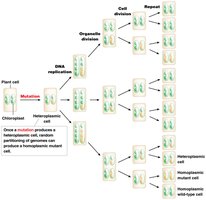
Replicative segregation refers to the random distribution of organelles during cell division. This process can result in homoplasmic or heteroplasmic descendants and affects the proportion of mutant organelle genomes in a cell.
Genetic mosaicism: Organisms may have cells with different proportions of mutant and wild-type organelles.
Penetrance and expressivity: Depend on the ratio of mutant to wild-type alleles in heteroplasmic individuals.
Modes and Consequences of Organelle Inheritance
Modes of Organelle Inheritance
Organelle inheritance can be uniparental or biparental, depending on the organism. The transmission is often biased toward the gamete contributing the bulk of cytoplasm, and selective degradation of organelles from one parent can occur.
Maternal inheritance: Common in mammals and flowering plants.
Paternal inheritance: Occurs in gymnosperms.
Biparental inheritance: Seen in some fungi and algae.
Mitochondrial Inheritance in Mammals
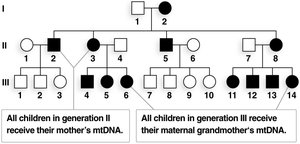
Maternal inheritance of mitochondrial DNA (mtDNA) has several consequences, including prediction of phenotype based on the mother, tracing maternal lineages, and interpreting maternal history of species.
Mother–child identity: All children inherit identical mtDNA from their mother.
Applications: Used in forensic science and genealogy.
Mitochondrial DNA and Species Evolution
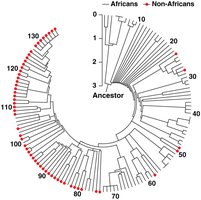
Mitochondrial DNA sequences are valuable tools for studying genealogical history and evolutionary relationships. The Recent African Origin (RAO) model proposes that modern humans evolved from a small African population, supported by mtDNA analysis.
Mitochondrial Eve: The carrier of ancestral mtDNA, estimated to have lived about 200,000 years ago.
Genetic diversity: Greatest in Africa, with non-African diversity being a subset.
Mitochondrial Mutations and Human Disease
Mitochondrial Mutations and Human Genetic Disease
Mitochondrial mutations can cause a variety of human genetic diseases, often with pleiotropic effects. These diseases are strictly maternally transmitted and can affect tissues with high energy demands.
Mutation rate: Mitochondrial genome mutates about 10 times faster than nuclear genome.
Examples: Leber’s hereditary optic neuropathy (LHON), MELAS, MERRF.
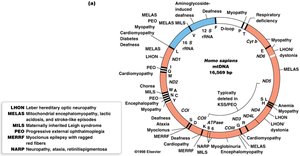
Variable Penetrance of Mitochondrial Mutations
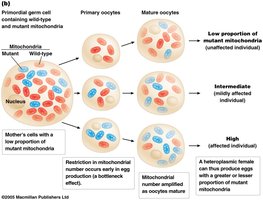
The proportion of mutant mitochondria in egg cells determines the severity of disease symptoms. Restriction in mitochondrial number during egg production can amplify the proportion of mutant mitochondria.
Bottleneck effect: Amplifies mutant mitochondria in oocytes.
Penetrance: Disease symptoms develop only if vulnerable tissues contain a high proportion of mutant mitochondria.
Evolution of Organelle Genomes: Endosymbiosis Theory
The Endosymbiosis Theory
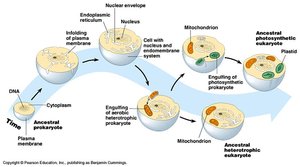
The endosymbiosis theory explains the origin of mitochondria and chloroplasts as descendants of free-living bacteria that established symbiotic relationships with ancestral eukaryotic cells. This theory is supported by structural and genetic evidence.
Double-membrane system: Similar to bacteria.
Organelle DNA: Packaged and replicated like bacterial DNA.
Transcriptional and translational machinery: Resembles that of bacteria.
Continual DNA Transfer from Organelles
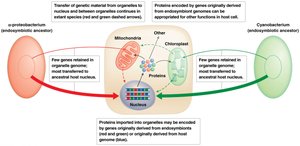
DNA transfer between organelle and nuclear genomes has occurred throughout evolution. Comparative genomics reveals both ancient and recent transfer events, with transferred genes acquiring sequences for correct expression and protein targeting.
Signal sequences: Proteins encoded by transferred genes require amino terminal signal sequences for transport to organelles.
Gene functionality: Transferred genes must be expressed and their products delivered to the correct organelle.
Encoding of Organellar Proteins
Most organelle proteins are encoded in the nucleus and transported into the organelles. Targeting is achieved by signal sequences, and not all nuclear genes originally derived from organelles are now targeted back to those organelles.
Protein targeting: Signal sequences direct proteins to specific locations within organelles.
Gene origin: Some proteins targeted to organelles did not originate from the endosymbiont.
Summary Table: Modes of Organelle Inheritance
Mode | Example Organism | Mechanism |
|---|---|---|
Maternal | Mammals, flowering plants | Organelle DNA inherited from mother |
Paternal | Gymnosperms | Organelle DNA inherited from father |
Biparental | Saccharomyces (yeast) | Organelle DNA inherited from both parents |
Selective degradation | Chlamydomonas | Organelle DNA from one parent is selectively destroyed |
Key Equations and Concepts
Replicative Segregation: Random partitioning of organelles during cell division can be modeled probabilistically.
Mutation Rate: Mitochondrial mutation rate is approximately 10x higher than nuclear genome.
Equation for heteroplasmy proportion:
Equation for maternal inheritance:
Equation for bottleneck effect:
Additional info: These notes expand on the original content by providing definitions, examples, and context for key concepts in organelle inheritance and the endosymbiosis theory, suitable for genetics college students.
