 Back
BackPedigrees: Analysis, Construction, and Genetic Counseling in Human Genetics
Study Guide - Smart Notes
 Tailored notes based on your materials, expanded with key definitions, examples, and context.
Pedigrees in Genetics
Introduction to Pedigrees
Pedigrees are essential tools in genetics for visualizing the inheritance of traits and diseases within families. They allow geneticists to analyze patterns of transmission, distinguish between different modes of inheritance, and calculate probabilities of genotypes and phenotypes in offspring.
Pedigree: A diagram that shows the relationships among family members and the transmission of genetic traits.
Inheritance Patterns: Pedigrees help identify autosomal dominant, autosomal recessive, and sex-linked traits.
Genetic Counseling: Pedigrees are used to assess risk and guide genetic counseling and testing.
How to Read Pedigrees
Pedigree Symbols and Structure
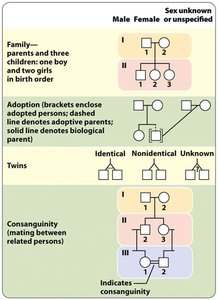
Pedigrees use standardized symbols to represent individuals, their relationships, and their genetic status. Understanding these symbols is crucial for interpreting pedigrees accurately.
Male: Represented by a square.
Female: Represented by a circle.
Affected Individual: Shaded symbol.
Carrier: Half-shaded or dot within the symbol.
Deceased: Symbol with a diagonal line.
Proband: The first affected family member coming to the attention of a geneticist, often marked with a 'P'.
Family Relationships and Generations
Pedigrees are organized by generations, with each generation represented on a separate row. Siblings are listed by birth order, and relationships such as adoption or consanguinity are indicated with specific symbols.
Generations: Labeled with Roman numerals (I, II, III, etc.).
Siblings: Listed left to right by birth order.
Adoption: Brackets enclose adopted individuals; dashed lines denote adoptive parents.
Consanguinity: Double lines indicate mating between related persons.
How to Draw a Pedigree
Steps for Constructing a Pedigree
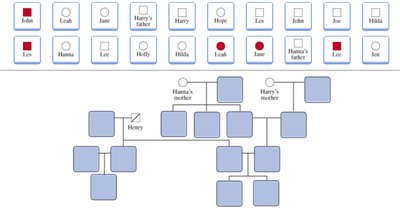
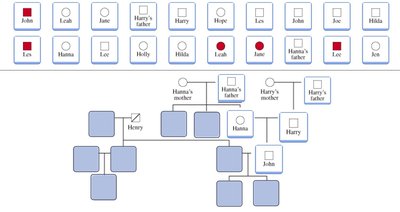
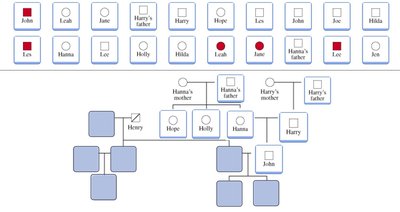
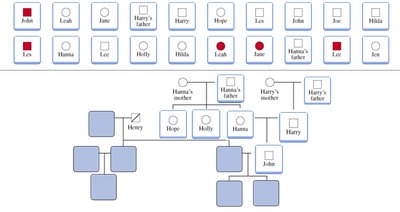
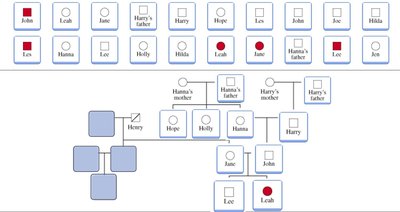
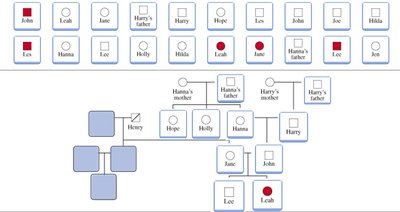
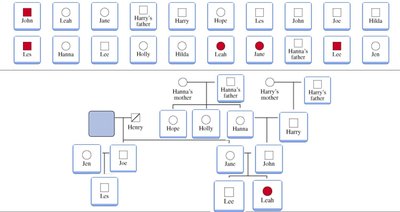
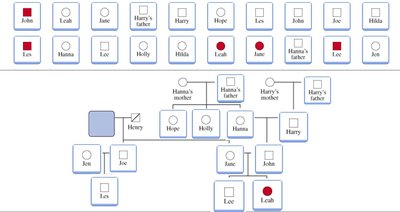
Drawing a pedigree involves placing each family member in the correct generation and relationship, using appropriate symbols to indicate sex, affected status, and other relevant information.
Start with the oldest generation at the top.
List siblings in birth order from left to right.
Use shaded symbols for affected individuals and unshaded for unaffected.
Connect parents to children with vertical lines.
Modes of Inheritance in Pedigrees
Autosomal Recessive Inheritance
Autosomal recessive traits require two copies of the recessive allele for expression. These traits often skip generations and can appear in siblings whose parents are carriers.
Key Clues: Trait may skip generations; affected individuals often have unaffected parents.
Example: Albinism, galactosemia.
Probability Calculation: If both parents are carriers (heterozygous), the probability of an affected child is .
Autosomal Dominant Inheritance
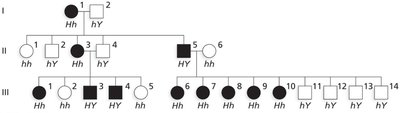
Autosomal dominant traits require only one copy of the dominant allele for expression. These traits do not skip generations; affected individuals have at least one affected parent.
Key Clues: Trait appears in every generation; affected individuals have at least one affected parent.
Example: Huntington's disease.
X-linked Recessive and Dominant Inheritance
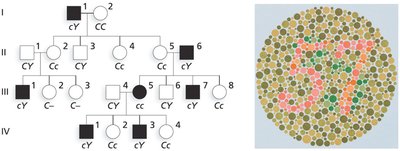
X-linked traits are associated with genes on the X chromosome. X-linked recessive traits are more common in males due to hemizygosity, while X-linked dominant traits affect both sexes but show distinct inheritance patterns.
X-linked Recessive: Sons do not inherit the trait from their father; more common in males.
X-linked Dominant: If the father is affected, all daughters will be affected; not more common in males.
Genetic Counseling
When to See a Genetic Counselor
Genetic counseling is recommended in situations where there is a family history of genetic conditions, previous affected children, advanced maternal age, or exposure to harmful substances during pregnancy.
Previous child with a genetic or chromosome condition
Family history of a genetic or chromosome condition
Advanced maternal age
Fetal exposure to toxic compounds
Prolonged infertility or repeated pregnancy loss
New diagnosis of a genetic or chromosome condition
Goals of Genetic Counseling
Provide comprehensive information about genetic conditions and testing
Explain recurrence risk and genetic mechanisms
Identify beliefs, values, and relationships affected by genetic conditions
Determine appropriate course of action
Provide referrals to support groups or services
Genetic Testing
Newborn Genetic Screening
Newborn genetic screening is mandated in all US states and tests for dozens of treatable, rare genetic diseases. Reports are provided to parents only if a positive finding requires follow-up.
Tests for 35 core hereditary conditions and 26 secondary conditions
Examples: hypothyroidism, congenital adrenal hyperplasia, galactosemia, cystic fibrosis, sickle cell anemia
Carrier Genetic Testing
Carrier testing determines if an individual is a heterozygous carrier for a recessive disease. This is important for assessing risk to offspring, especially in populations with higher prevalence of certain genetic disorders.
Examples: Sickle cell disease, Tay-Sachs disease
Testing is often done in adults, with risk assessed for children
Case Study: Galactosemia
Genetics of Galactosemia
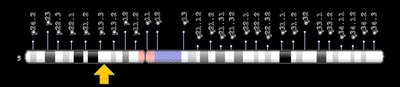
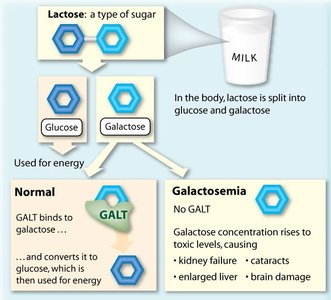
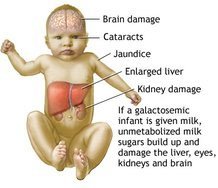
Galactosemia is an autosomal recessive disorder caused by mutations in the GALT gene, located on chromosome 9p. The enzyme galactose-1-phosphate uridylyltransferase is essential for metabolizing galactose.
GALT: Galactose-1-phosphate uridylyltransferase
Location: Chromosome 9p
Function: Converts galactose to glucose for energy

Pedigree Construction for Galactosemia
Constructing a pedigree for a family affected by galactosemia involves placing each member in the correct generation and relationship, using shaded symbols for affected individuals.
Identify affected and unaffected individuals
Use correct symbols for sex and status
List siblings by birth order
Probability Calculations in Pedigrees
Assigning Genotypes and Calculating Risk
Pedigrees allow for the assignment of genotypes based on observed phenotypes and family history. Probabilities can be calculated for offspring inheriting specific traits.
Genotype Assignment: Use allelic symbols (e.g., D for dominant, d for recessive).
Probability Calculation: For autosomal recessive traits, if both parents are carriers, the probability of an affected child is .
Example Calculation: If the probability both parents are heterozygous is each, then the probability both are heterozygous is , and the probability their child is affected is .
Summary Table: Pedigree Symbols
Purpose: Classification of Individuals in Pedigrees
Symbol | Description |
|---|---|
Unshaded square/circle | Unaffected male/female |
Shaded square/circle | Affected male/female |
Half-shaded | Carrier |
Diagonal line | Deceased |
P | Proband |
Key Concepts for Exam Preparation
Match a short family history with a pedigree.
Know the basic symbols typically used in a pedigree.
Create a pedigree from a family history for problem solving.
Identify key clues of different modes of inheritance from pedigrees.
Predict probabilities of inheritance based on family history or pedigree.
Practice Problems and Solutions
Example: Autosomal Recessive Pedigree
Assign genotypes using D (dominant) and d (recessive).
Calculate the probability of an affected child: if both parents are carriers.
Example: Albinism Pedigree
Mode of transmission: Autosomal recessive.
Probability calculation for four children: for any outcome except one child with albinism and three with normal pigmentation.
Summary
Pedigrees are vital for understanding inheritance patterns and calculating genetic risk.
Different modes of inheritance show distinct patterns in pedigrees.
Genetic counseling and testing are informed by pedigree analysis.
Probability calculations are essential for predicting genetic outcomes.
