 Back
BackPopulation Genetics and the Hardy-Weinberg Principle
Study Guide - Smart Notes
 Tailored notes based on your materials, expanded with key definitions, examples, and context.
Population Genetics
Introduction to Population Genetics
Population genetics is the study of genetic variation within populations and involves the examination of allele and genotype frequencies and how they change over time. This field provides the foundation for understanding evolutionary processes and the genetic structure of populations.
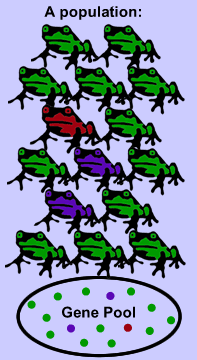
Population: A local group of organisms belonging to a single species, sharing a common gene pool.
Gene pool: The complete set of alleles present in a population for a given gene.
Populations can be described by age structure, geography, birth and death rates, and allele frequencies.
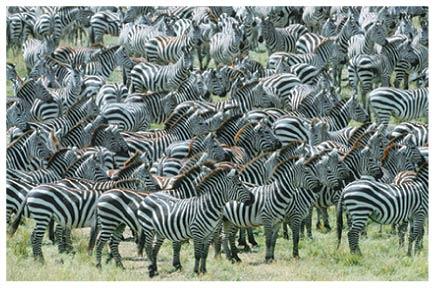
Genetic Variation in Populations
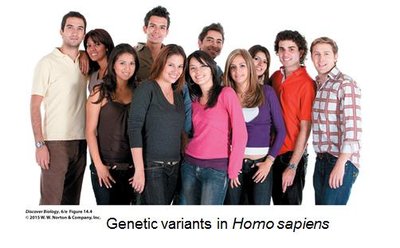
Genetic variation refers to differences in the traits found among individuals in a population. This variation is essential for evolution and adaptation.
All individuals vary in their traits due to genetic differences.
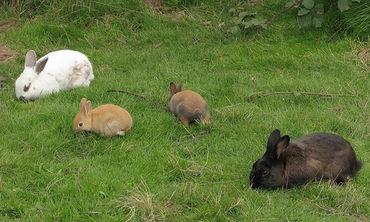
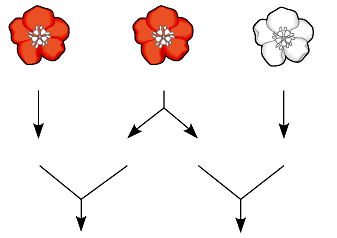
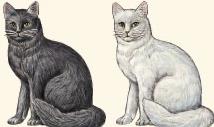
Examples include coat color in rabbits and leaf patterns in lilies.

Sources of Genetic Diversity
Population diversity is created by several evolutionary mechanisms:
Mutation: The ultimate source of genetic variation, introducing new alleles into a population.
Migration (Gene Flow): Movement of alleles between populations.
Genetic Drift: Random changes in allele frequencies, especially significant in small populations.
Natural Selection: Differential survival and reproduction of individuals based on genetic traits.
A population can carry all the alleles for a trait, but each individual carries only two alleles per gene locus.
Allele and Genotype Frequencies
Understanding Allele Frequency
Allele frequency is the proportion of a specific allele among all alleles for a gene in a population. Changes in allele frequency can lead to evolutionary change.
Allele Frequency Formula:
Each diploid individual has one genotype made up of two alleles.
Direct Calculation of Allele and Genotype Frequencies
If all genotypes are known, allele frequencies can be measured directly. For example, in a population of flowers with genotypes RR, Rr, and rr:
64 RR, 32 Rr, 4 rr (total 100 individuals)
R allele frequency:
r allele frequency:
Genotype frequencies: RR = 0.64, Rr = 0.32, rr = 0.04
Applications to Human Populations
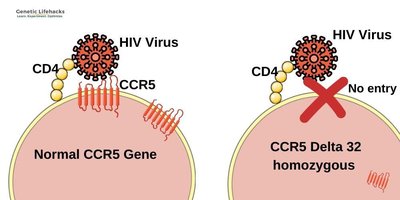
Allele frequency calculations are important in human genetics, such as studying the CCR5 gene and its role in HIV resistance.
The CCR5-Δ32 allele provides resistance to HIV-1 infection.
Genotype frequencies can be used to estimate the proportion of resistant individuals in a population.
The Hardy-Weinberg Principle
Hardy-Weinberg Law
The Hardy-Weinberg Law provides a mathematical model to describe allele and genotype frequencies in a non-evolving population. It states that allele frequencies will remain constant from generation to generation if certain conditions are met.
Assumptions: infinitely large population, no migration, no mutation, random mating, and equal fitness among genotypes (no selection).
Allele frequency equation:
Genotype frequency equation:


Using Hardy-Weinberg Equilibrium
Hardy-Weinberg equilibrium allows prediction of genotype frequencies from allele frequencies and detection of evolutionary change if observed frequencies deviate from expected values.
Estimate frequencies of dominant and recessive alleles.
Detect shifts in allele frequencies (evolution).
Measure frequency of heterozygous carriers for genetic disorders.
Calculating Allele and Genotype Frequencies
For a population with two alleles (B and b):
Frequency of bb (recessive phenotype) =
Frequency of b allele =
Frequency of B allele =
Genotype frequencies: BB = , Bb = , bb =
Testing for Hardy-Weinberg Equilibrium
To test if a population is in Hardy-Weinberg equilibrium, the Chi-square test is used:
Calculate observed allele frequencies.
Calculate expected genotype frequencies and numbers.
Calculate Chi-square value:
Calculate degrees of freedom:
Compare to critical value to accept or reject equilibrium.
Hardy-Weinberg for X-Linked Traits
For X-linked traits, males (XY) have only one allele, so the frequency of the trait in males equals the allele frequency. Females (XX) follow the standard Hardy-Weinberg formula.
Frequency of X-linked recessive trait in males = q
Female genotype frequencies: , ,
Hardy-Weinberg for Multiple Alleles
For genes with more than two alleles, the Hardy-Weinberg equation expands:
For three alleles:
Example: ABO blood types (IA, IB, i)
Mechanisms of Evolutionary Change
Mutation
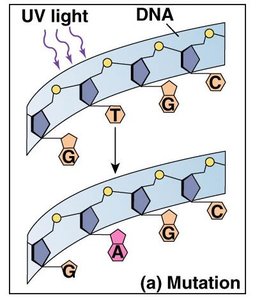
Mutations are random changes in DNA sequences that introduce new genetic variation. They can be caused by errors in replication, UV light, X-rays, or chemicals. Most mutations are rare but can be inherited if they occur in germ cells.
Gene Flow (Migration)
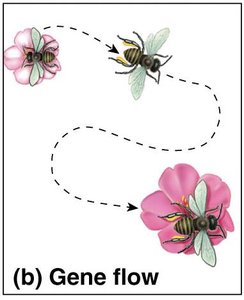
Gene flow is the movement of alleles between populations due to migration. It introduces new alleles and increases genetic diversity.
Genetic Drift
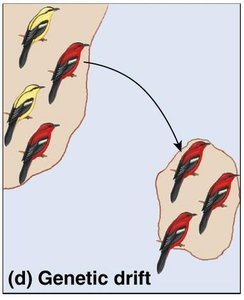
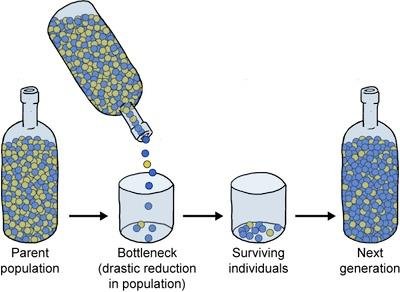
Genetic drift is the random fluctuation of allele frequencies, especially in small populations. It can lead to the loss or fixation of alleles and is not driven by natural selection.
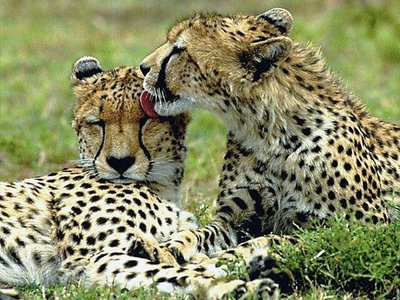
Bottleneck Effect: A drastic reduction in population size reduces genetic diversity.
Founder Effect: A small group establishes a new population with different allele frequencies from the original population.
Non-Random Mating
Non-random mating occurs when individuals select mates based on specific traits, leading to changes in genotype frequencies but not necessarily allele frequencies. Examples include assortative mating and sexual selection.
Natural Selection
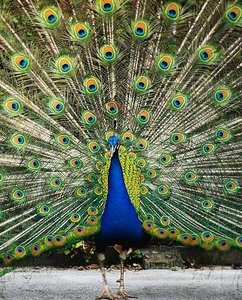
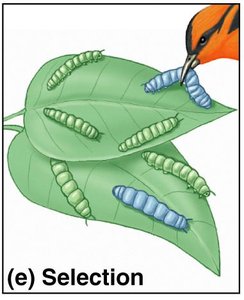
Natural selection is the differential survival and reproduction of individuals based on genetic traits. It is the primary mechanism driving evolution and can increase the frequency of advantageous alleles.
Fitness (W): The relative reproductive success of a genotype, ranging from 0 to 1.
Genotypes with higher fitness contribute more to the next generation.
Heterozygote Advantage
In some cases, heterozygotes have higher fitness than either homozygote. For example, individuals heterozygous for the sickle-cell allele are resistant to malaria, leading to the maintenance of the allele in certain populations.
Summary Table: Hardy-Weinberg Equilibrium Equations
Parameter | Equation | Description |
|---|---|---|
Allele frequency (2 alleles) | p = dominant allele, q = recessive allele | |
Genotype frequency (2 alleles) | p2 = homozygous dominant, 2pq = heterozygote, q2 = homozygous recessive | |
Multiple alleles | For three alleles | |
Chi-square test | Test for equilibrium |
