
Pearson+ LogoPearson+ Logo
Ch. 12 - The Genetic Code and Transcription
Klug - Essentials of Genetics 10th Edition
Klug10th EditionEssentials of GeneticsISBN: 9780135588789Not the one you use?Change textbook
Chapter 12, Problem 21

One form of posttranscriptional modification of most eukaryotic pre-mRNAs is the addition of a poly-A sequence at the 3' end. The absence of a poly-A sequence leads to rapid degradation of the transcript. Poly-A sequences of various lengths are also added to many bacterial RNA transcripts where, instead of promoting stability, they enhance degradation. In both cases, RNA secondary structures, stabilizing proteins, or degrading enzymes interact with poly-A sequences. Considering the activities of RNAs, what might be general functions of 3'-polyadenylation?

Verified step by step guidance
1
Step 1: Understand the context of 3'-polyadenylation by recognizing that it is a posttranscriptional modification where a sequence of adenine nucleotides (poly-A tail) is added to the 3' end of an RNA molecule.
Step 2: Note the contrasting roles of poly-A tails in eukaryotes and bacteria: in eukaryotes, the poly-A tail generally increases mRNA stability and aids in translation, while in bacteria, polyadenylation often marks RNA for degradation.
Step 3: Consider the molecular interactions involved, such as how RNA secondary structures, stabilizing proteins, or degrading enzymes bind to the poly-A tail, influencing the RNA's fate.
Step 4: Analyze how the poly-A tail can protect eukaryotic mRNA from rapid degradation by preventing exonuclease access and facilitating nuclear export and translation initiation.
Step 5: Contrast this with bacterial RNA, where polyadenylation can serve as a signal for degradation by recruiting enzymes that break down RNA, thus regulating RNA turnover.

Verified video answer for a similar problem:

This video solution was recommended by our tutors as helpful for the problem above.
Video duration:
2m
Was this helpful?

Key Concepts

Here are the essential concepts you must grasp in order to answer the question correctly.

Posttranscriptional Modification and Polyadenylation

Posttranscriptional modification refers to changes made to RNA transcripts after synthesis. One common modification in eukaryotes is the addition of a poly-A tail at the 3' end, which protects mRNA from degradation and aids in nuclear export and translation. This modification is crucial for mRNA stability and function.
Recommended video:
Guided course
04:30
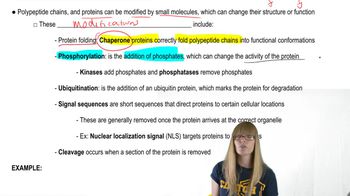
Post Translational Modifications

Differences in Polyadenylation between Eukaryotes and Prokaryotes

In eukaryotes, polyadenylation generally stabilizes mRNA, enhancing its lifespan and translation efficiency. In contrast, many bacterial RNAs receive poly-A tails that signal for degradation, marking transcripts for rapid breakdown. This highlights how the same modification can have opposite effects depending on the organism.
Recommended video:
Guided course
10:14
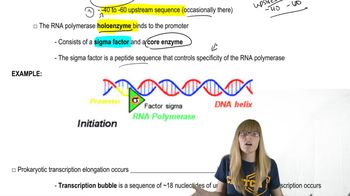
Prokaryotic Transcription

Role of RNA Secondary Structures and Protein Interactions

RNA secondary structures and associated proteins influence the fate of polyadenylated transcripts. Stabilizing proteins can bind poly-A tails to protect RNA, while degrading enzymes recognize these tails to initiate decay. These interactions determine whether polyadenylation leads to RNA stability or degradation.
Recommended video:
Related Practice
Textbook Question

Describe the structure of RNA polymerase in bacteria. What is the core enzyme? What is the role of the σ subunit?

875
views
Textbook Question

Write a paragraph describing the abbreviated chemical reactions that summarize RNA polymerase-directed transcription.

534
views
Textbook Question

Messenger RNA molecules are very difficult to isolate in bacteria because they are rather quickly degraded in the cell. Can you suggest a reason why this occurs? Eukaryotic mRNAs are more stable and exist longer in the cell than do bacterial mRNAs. Is this an advantage or a disadvantage for a pancreatic cell making large quantities of insulin?

615
views
Textbook Question

In a mixed copolymer experiment, messages were created with either 4/5C:1/5A or 4/5A:1/5C. These messages yielded proteins with the following amino acid compositions.

Using these data, predict the most specific coding composition for each amino acid.

929
views
Textbook Question

Shown here are the amino acid sequences of the wild-type and three mutant forms of a short protein.

___________________________________________________

Wild-type: Met-Trp-Tyr-Arg-Gly-Ser-Pro-Thr

Mutant 1: Met-Trp

Mutant 2: Met-Trp-His-Arg-Gly-Ser-Pro-Thr

Mutant 3: Met-Cys-Ile-Val-Val-Val-Gln-His                 _


Use this information to answer the following questions:

Using the genetic coding dictionary, predict the type of mutation that led to each altered protein.

1047
views
Textbook Question

Shown here are the amino acid sequences of the wild-type and three mutant forms of a short protein.

___________________________________________________

Wild-type: Met-Trp-Tyr-Arg-Gly-Ser-Pro-Thr

Mutant 1: Met-Trp

Mutant 2: Met-Trp-His-Arg-Gly-Ser-Pro-Thr

Mutant 3: Met-Cys-Ile-Val-Val-Val-Gln-Hi

___________________________________________________

Use this information to answer the following questions:

For each mutant protein, determine the specific ribonucleotide change that led to its synthesis.

478
views