Pearson+ LogoPearson+ Logo
Ch. 12 - The Genetic Code and Transcription
Klug - Essentials of Genetics 10th Edition
Klug10th EditionEssentials of GeneticsISBN: 9780135588789Not the one you use?Change textbook
Chapter 12, Problem 23a

Shown here are the amino acid sequences of the wild-type and three mutant forms of a short protein.
___________________________________________________
Wild-type: Met-Trp-Tyr-Arg-Gly-Ser-Pro-Thr
Mutant 1: Met-Trp
Mutant 2: Met-Trp-His-Arg-Gly-Ser-Pro-Thr
Mutant 3: Met-Cys-Ile-Val-Val-Val-Gln-His                 _


Use this information to answer the following questions:
Using the genetic coding dictionary, predict the type of mutation that led to each altered protein.

Verified step by step guidance
1
Step 1: Understand the wild-type amino acid sequence and the mutant sequences given. The wild-type sequence is Met-Trp-Tyr-Arg-Gly-Ser-Pro-Thr, and the mutants show changes in length and amino acid composition.
Step 2: Recall that mutations can be classified as nonsense, missense, frameshift, or silent mutations. Nonsense mutations introduce a premature stop codon, truncating the protein. Missense mutations change one amino acid to another. Frameshift mutations result from insertions or deletions that shift the reading frame, altering downstream amino acids. Silent mutations do not change the amino acid sequence.
Step 3: Analyze Mutant 1, which has only Met-Trp compared to the full wild-type sequence. Since the protein is truncated early, this suggests a nonsense mutation that introduced a premature stop codon after the second amino acid.
Step 4: Analyze Mutant 2, which has Met-Trp-His-Arg-Gly-Ser-Pro-Thr. Compared to the wild-type, the third amino acid is His instead of Tyr, but the rest of the sequence is unchanged and the length is the same. This suggests a missense mutation where a single nucleotide change altered one codon, changing Tyr to His.
Step 5: Analyze Mutant 3, which has a completely different sequence: Met-Cys-Ile-Val-Val-Val-Gln-His. The sequence is different in multiple amino acids and length, indicating a frameshift mutation caused by an insertion or deletion that shifted the reading frame, changing all downstream amino acids.

Verified video answer for a similar problem:

This video solution was recommended by our tutors as helpful for the problem above.
Video duration:
1m
Was this helpful?

Key Concepts

Here are the essential concepts you must grasp in order to answer the question correctly.

Types of Mutations

Mutations are changes in the DNA sequence that can alter the resulting protein. Common types include point mutations (single nucleotide changes), insertions or deletions (which can cause frameshifts), and nonsense mutations (introducing premature stop codons). Understanding these helps predict how the amino acid sequence changes.
Recommended video:
Guided course
10:48
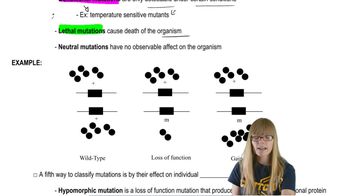
Mutations and Phenotypes

Genetic Code and Codon Translation

The genetic code translates nucleotide triplets (codons) into amino acids. Each codon corresponds to a specific amino acid or a stop signal. Using the genetic code dictionary allows prediction of amino acid sequences from DNA or mRNA sequences and helps identify how mutations affect protein sequences.
Recommended video:
Guided course
11:43
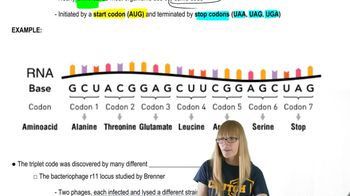
The Genetic Code

Effects of Mutations on Protein Structure

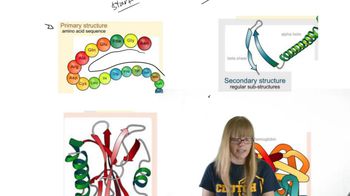
Mutations can lead to truncated proteins, altered amino acid sequences, or extended proteins, affecting function. For example, a nonsense mutation causes early termination, while a frameshift changes downstream amino acids. Recognizing these effects aids in classifying mutations based on observed protein changes.
Recommended video:
Related Practice
Textbook Question

Messenger RNA molecules are very difficult to isolate in bacteria because they are rather quickly degraded in the cell. Can you suggest a reason why this occurs? Eukaryotic mRNAs are more stable and exist longer in the cell than do bacterial mRNAs. Is this an advantage or a disadvantage for a pancreatic cell making large quantities of insulin?

615
views
Textbook Question

One form of posttranscriptional modification of most eukaryotic pre-mRNAs is the addition of a poly-A sequence at the 3' end. The absence of a poly-A sequence leads to rapid degradation of the transcript. Poly-A sequences of various lengths are also added to many bacterial RNA transcripts where, instead of promoting stability, they enhance degradation. In both cases, RNA secondary structures, stabilizing proteins, or degrading enzymes interact with poly-A sequences. Considering the activities of RNAs, what might be general functions of 3'-polyadenylation?

568
views
Textbook Question

In a mixed copolymer experiment, messages were created with either 4/5C:1/5A or 4/5A:1/5C. These messages yielded proteins with the following amino acid compositions.

Using these data, predict the most specific coding composition for each amino acid.

929
views
Textbook Question

Shown here are the amino acid sequences of the wild-type and three mutant forms of a short protein.

___________________________________________________

Wild-type: Met-Trp-Tyr-Arg-Gly-Ser-Pro-Thr

Mutant 1: Met-Trp

Mutant 2: Met-Trp-His-Arg-Gly-Ser-Pro-Thr

Mutant 3: Met-Cys-Ile-Val-Val-Val-Gln-Hi

___________________________________________________

Use this information to answer the following questions:

For each mutant protein, determine the specific ribonucleotide change that led to its synthesis.

478
views
Textbook Question

Shown here are the amino acid sequences of the wild-type and three mutant forms of a short protein.

__________________________________________________

Wild-type: Met-Trp-Tyr-Arg-Gly-Ser-Pro-Thr

Mutant 1: Met-Trp

Mutant 2: Met-Trp-His-Arg-Gly-Ser-Pro-Thr

Mutant 3: Met -Cys-Ile-Val-Val-Val-Gln-His

______________________________________________

Use this information to answer the following questions:

The wild-type RNA consists of nine triplets. What is the role of the ninth triplet?

500
views
Textbook Question

Shown here are the amino acid sequences of the wild-type and three mutant forms of a short protein.

___________________________________________________

Wild-type: Met-Trp-Tyr-Arg-Gly-Ser-Pro-Thr

Mutant 1: Met-Trp

Mutant 2: Met-Trp-His-Arg-Gly-Ser-Pro-Thr

Mutant 3: Met-Cys-Ile-Val-Val-Val-Gln-Hi

___________________________________________________

Use this information to answer the following questions:

Of the first eight wild-type triplets, which, if any, can you determine specifically from an analysis of the mutant proteins? In each case, explain why or why not.

566
views