Pearson+ LogoPearson+ Logo
Ch. 13 - Translation and Proteins
Klug - Essentials of Genetics 10th Edition
Klug10th EditionEssentials of GeneticsISBN: 9780135588789Not the one you use?Change textbook
Chapter 13, Problem 22

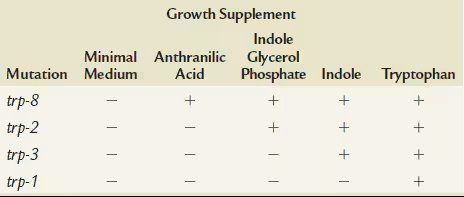
A series of mutations in the bacterium Salmonella typhimurium results in the requirement of either tryptophan or some related molecule in order for growth to occur. From the data shown here, suggest a biosynthetic pathway for tryptophan.
Table showing growth of Salmonella typhimurium mutants on media with various supplements indicating tryptophan biosynthesis steps.

Verified step by step guidance
1
Step 1: Analyze the growth pattern of each mutant on different supplements. Note which mutants grow (+) or do not grow (−) on minimal medium, anthranilic acid, indole glycerol phosphate, indole, and tryptophan.
Step 2: Identify the position of each mutation in the biosynthetic pathway by determining the earliest supplement that restores growth. For example, if a mutant grows when anthranilic acid is added but not on minimal medium, the mutation likely affects a step before anthranilic acid synthesis.
Step 3: Arrange the compounds in order based on the mutants' growth patterns. Since trp-8 grows with anthranilic acid, indole glycerol phosphate, indole, and tryptophan, but not on minimal medium, anthranilic acid must be upstream of the mutation in trp-8.
Step 4: Use the pattern of growth restoration to infer the sequence of intermediates in the tryptophan biosynthesis pathway. For example, if trp-3 grows only when indole, indole glycerol phosphate, or tryptophan is added, but not with anthranilic acid, then indole glycerol phosphate is downstream of the mutation in trp-3.
Step 5: Summarize the biosynthetic pathway by ordering the intermediates from anthranilic acid to indole glycerol phosphate to indole to tryptophan, placing the mutations accordingly to reflect the block in the pathway.

Key Concepts

Here are the essential concepts you must grasp in order to answer the question correctly.

Biosynthetic Pathways

Biosynthetic pathways are sequences of enzymatic reactions that convert simple molecules into complex products, such as amino acids. Understanding these pathways helps identify the order of intermediate compounds and the enzymes involved. Mutations blocking specific steps cause accumulation or requirement of intermediates, revealing pathway structure.
Recommended video:
Guided course
05:44
Repair Pathways

Genetic Mutations and Auxotrophy

Mutations in genes encoding enzymes of a biosynthetic pathway can cause auxotrophy, where an organism requires an external supply of a nutrient it normally synthesizes. By analyzing which supplements restore growth in mutants, one can infer the position of the mutation in the pathway and the intermediates involved.
Recommended video:
Guided course
10:48
Mutations and Phenotypes

Use of Growth Supplementation Tests

Growth supplementation tests involve providing mutants with various pathway intermediates to determine which compounds rescue growth. This method helps map the biosynthetic pathway by identifying the earliest compound that restores growth, indicating the step at which the mutation blocks synthesis.
Recommended video:
Guided course
09:46
Mitosis Steps
Related Practice
Textbook Question

Three independently assorting genes (A, B, and C) are known to control the following biochemical pathway that provides the basis for flower color in a hypothetical plant:

Three homozygous recessive mutations are also known, each of which interrupts a different one of these steps. Determine the phenotypic results in the F1 and F2 generations resulting from the P1 crosses of true-breeding plants listed here:

yellow (AAbbCC) × green (AABBcc)

529
views
Textbook Question

Three independently assorting genes (A, B, and C) are known to control the following biochemical pathway that provides the basis for flower color in a hypothetical plant:

Three homozygous recessive mutations are also known, each of which interrupts a different one of these steps. Determine the phenotypic results in the F1 and F2 generations resulting from the P1 crosses of true-breeding plants listed here:

colorless (aaBBCC) × green (AABBcc)

676
views
Textbook Question

How would the results vary in cross (a) of Problem 32 if genes A and B were linked with no crossing over between them? How would the results of cross (a) vary if genes A and B were linked and 20 map units (mu) apart?

758
views
Textbook Question

Many antibiotics are effective as drugs to fight off bacterial infections because they inhibit protein synthesis in bacterial cells. Using the information provided in the following table that highlights several antibiotics and their mode of action, discuss which phase of translation is inhibited: initiation, elongation, or termination. What other components of the translational machinery could be targeted to inhibit bacterial protein synthesis?

843
views