Pearson+ LogoPearson+ Logo
Ch. 13 - Translation and Proteins
Klug - Essentials of Genetics 10th Edition
Klug10th EditionEssentials of GeneticsISBN: 9780135588789Not the one you use?Change textbook
Chapter 13, Problem 11

Hemoglobin is a tetramer consisting of two α and two β chains. What level of protein structure is described in this statement?

Verified step by step guidance
1
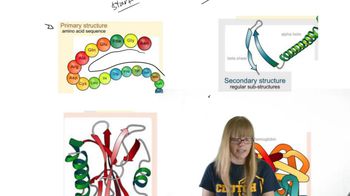
Identify the four levels of protein structure: primary, secondary, tertiary, and quaternary.
Recall that the primary structure refers to the linear sequence of amino acids in a single polypeptide chain.
Understand that the secondary structure involves local folding patterns such as alpha helices and beta sheets within a single chain.
Recognize that the tertiary structure is the overall three-dimensional shape of a single polypeptide chain.
Note that the quaternary structure describes the assembly of multiple polypeptide chains (subunits) into a functional protein complex, such as hemoglobin's two α and two β chains.

Key Concepts

Here are the essential concepts you must grasp in order to answer the question correctly.

Protein Structure Levels

Proteins have four structural levels: primary (amino acid sequence), secondary (local folding like alpha-helices and beta-sheets), tertiary (3D folding of a single polypeptide), and quaternary (assembly of multiple polypeptide chains). Understanding these levels helps identify the organization described in a protein.
Recommended video:

Quaternary Structure

Quaternary structure refers to the arrangement and interaction of multiple polypeptide chains (subunits) in a multi-subunit protein. Hemoglobin’s composition of two α and two β chains exemplifies quaternary structure, where separate polypeptides form a functional complex.
Recommended video:
Guided course
03:49
Ribosome Structure

Hemoglobin Structure

Hemoglobin is a classic example of a protein with quaternary structure, composed of four subunits: two alpha and two beta globin chains. This multi-subunit arrangement allows cooperative oxygen binding, illustrating the functional importance of quaternary structure.
Recommended video:
Guided course
03:49
Ribosome Structure