Pearson+ LogoPearson+ Logo
Ch. 15 - Regulation of Gene Expression in Bacteria
Klug - Essentials of Genetics 10th Edition
Klug10th EditionEssentials of GeneticsISBN: 9780135588789Not the one you use?Change textbook
Chapter 15, Problem 14

A bacterial operon is responsible for the production of the biosynthetic enzymes needed to make the hypothetical amino acid tisophane (tis). The operon is regulated by a separate gene, R. The deletion of R causes the loss of enzyme synthesis. In the wild-type condition, when tis is present, no enzymes are made; in the absence of tis, the enzymes are made. Mutations in the operator gene (O⁻) result in repression regardless of the presence of tis. Is the operon under positive or negative control? Propose a model for:
(a) Repression of the genes in the presence of tis in wild-type cells
(b) The mutations.

Verified step by step guidance
1
Step 1: Understand the system and terminology. The operon produces enzymes for making the amino acid tisophane (tis). The regulatory gene R controls the operon. In wild-type cells, enzymes are made only when tis is absent, and not made when tis is present. This suggests that the presence of tis turns off enzyme production.
Step 2: Determine the type of control (positive or negative). Since the presence of tis prevents enzyme synthesis, and deletion of R causes loss of enzyme synthesis, R likely acts as an activator that is active only when tis is absent. This indicates positive control, where the regulator R activates transcription in the absence of the effector (tis).
Step 3: Model repression in wild-type cells. In the absence of tis, R is active and binds to the operator to promote transcription of the enzymes. When tis is present, it binds to R, causing R to lose its ability to activate transcription, leading to repression of enzyme synthesis.
Step 4: Analyze the effect of operator mutations (O⁻). Mutations in the operator cause repression regardless of tis presence, meaning the operon is always off. This suggests that the mutated operator prevents R from binding or functioning properly, blocking activation and thus transcription.
Step 5: Summarize the model. (a) In wild-type, R activates transcription when tis is absent; tis binding to R inhibits this activation, repressing the operon. (b) In O⁻ mutants, the operator mutation prevents R-mediated activation, causing constant repression regardless of tis.

Verified video answer for a similar problem:

This video solution was recommended by our tutors as helpful for the problem above.
Video duration:
38s
Was this helpful?

Key Concepts

Here are the essential concepts you must grasp in order to answer the question correctly.

Operon Model and Gene Regulation

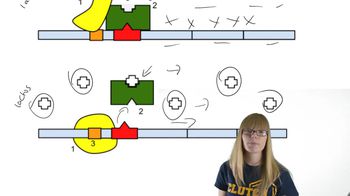
An operon is a cluster of genes under the control of a single promoter and operator, allowing coordinated regulation of gene expression. Regulatory proteins bind to the operator to either block or promote transcription. Understanding how operons function is essential to explain how enzyme synthesis is controlled in response to environmental signals.
Recommended video:
Guided course
06:55
Lac Operon Regulation

Negative vs. Positive Control of Gene Expression

Negative control involves a repressor protein binding to the operator to inhibit transcription, while positive control involves an activator protein enhancing transcription. Determining whether the operon is under negative or positive control depends on how the regulatory protein and effector molecules influence RNA polymerase binding and gene expression.
Recommended video:
Guided course
07:
Positional Cloning

Role of Regulatory Genes and Mutations in Operon Function

Regulatory genes encode proteins that control operon activity, such as repressors or activators. Mutations in regulatory elements like the operator (O⁻) can disrupt normal regulation, causing constitutive repression or expression. Analyzing these mutations helps model how gene expression is altered in mutant strains compared to wild-type.
Recommended video:
Guided course
08:26
Functional Genomics