Pearson+ LogoPearson+ Logo
Ch. 15 - Regulation of Gene Expression in Bacteria
Klug - Essentials of Genetics 10th Edition
Klug10th EditionEssentials of GeneticsISBN: 9780135588789Not the one you use?Change textbook
Chapter 15, Problem 12

Describe the role of attenuation in the regulation of tryptophan biosynthesis.

Verified step by step guidance
1
Understand that attenuation is a regulatory mechanism used by bacteria to control gene expression, particularly in operons like the tryptophan (trp) operon, which is involved in tryptophan biosynthesis.
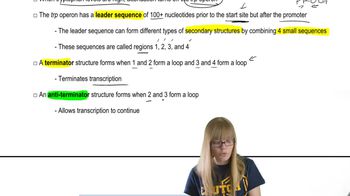
Recognize that attenuation occurs at the level of transcription termination, where the formation of specific secondary structures in the mRNA leader sequence determines whether transcription proceeds or terminates prematurely.
Identify that the trp operon leader sequence contains a leader peptide coding region with consecutive tryptophan codons, which acts as a sensor for tryptophan availability through the ribosome's translation process.
Explain that when tryptophan levels are high, the ribosome quickly translates the leader peptide, allowing the formation of a terminator hairpin structure in the mRNA that causes RNA polymerase to stop transcription (attenuation).
Conversely, when tryptophan is scarce, the ribosome stalls at the tryptophan codons, leading to the formation of an alternative anti-terminator hairpin structure that allows transcription of the downstream genes necessary for tryptophan synthesis.

Verified video answer for a similar problem:

This video solution was recommended by our tutors as helpful for the problem above.
Video duration:
2m
Was this helpful?

Key Concepts

Here are the essential concepts you must grasp in order to answer the question correctly.

Attenuation Mechanism

Attenuation is a regulatory mechanism in prokaryotes where transcription is prematurely terminated based on the formation of specific RNA secondary structures. It allows fine-tuning of gene expression in response to metabolite levels, such as amino acids, by controlling whether RNA polymerase continues transcription.
Recommended video:
Guided course
09:11
Trp Attenuation

Tryptophan Operon Structure

The tryptophan operon contains genes needed for tryptophan synthesis and includes a leader sequence with a short peptide coding region. This leader region plays a critical role in attenuation by sensing tryptophan levels through ribosome stalling during translation of the leader peptide.
Recommended video:
Guided course
09:11
Trp Attenuation

Coupling of Transcription and Translation

In bacteria, transcription and translation occur simultaneously, allowing the ribosome translating the leader peptide to influence RNA secondary structure formation. When tryptophan is abundant, the ribosome quickly translates the leader peptide, causing formation of a terminator hairpin and halting transcription; when scarce, ribosome stalling leads to an anti-terminator structure, allowing gene expression.
Recommended video:
Guided course
07:58
Translation initiation
Related Practice
Textbook Question

What properties demonstrate that the lac repressor is a protein? Describe the evidence that it indeed serves as a repressor within the operon system.

819
views
Textbook Question

Predict the effect on the inducibility of the lac operon of a mutation that disrupts the function of:

(a) The CRP gene, which encodes the CAP protein

(b) The CAP-binding site within the promoter.

951
views
Textbook Question

Erythritol, a natural sugar abundant in fruits and fermenting foods, is about 65 percent as sweet as table sugar and has about 95 percent fewer calories. It is 'tooth friendly' and generally devoid of negative side effects as a human consumable product. Pathogenic Brucella strains that catabolize erythritol contain four closely spaced genes, all involved in erythritol metabolism. One of the four genes (eryD) encodes a product that represses the expression of the other three genes. Erythritol catabolism is stimulated by erythritol. Present a simple regulatory model to account for the regulation of erythritol catabolism in Brucella. Does this system appear to be under inducible or repressible control?

554
views
Textbook Question

A bacterial operon is responsible for the production of the biosynthetic enzymes needed to make the hypothetical amino acid tisophane (tis). The operon is regulated by a separate gene, R. The deletion of R causes the loss of enzyme synthesis. In the wild-type condition, when tis is present, no enzymes are made; in the absence of tis, the enzymes are made. Mutations in the operator gene (O⁻) result in repression regardless of the presence of tis. Is the operon under positive or negative control? Propose a model for:

(a) Repression of the genes in the presence of tis in wild-type cells

(b) The mutations.

1011
views