Ch. 16 - Regulation of Gene Expression in Eukaryotes

Klug10th EditionEssentials of GeneticsISBN: 9780135588789
Not the one you use?Change textbookSelect a different textbook
Table of contents
- Ch. 1 - Introduction to Genetics16
- Ch. 2 - Mitosis and Meiosis28
- Ch. 3 - Mendelian Genetics37
- Ch. 4 - Modification of Mendelian Ratios53
- Ch. 5 - Sex Determination and Sex Chromosomes32
- Ch. 6 - Chromosome Mutations: Variation in Number and Arrangement37
- Ch. 7 - Linkage and Chromosome Mapping in Eukaryotes36
- Ch. 8 - Genetic Analysis and Mapping in Bacteria and Bacteriophages24
- Ch. 9 - DNA Structure and Analysis38
- Ch. 10 - DNA Replication29
- Ch. 11 - Chromosome Structure and DNA Sequence Organization22
- Ch. 12 - The Genetic Code and Transcription36
- Ch. 13 - Translation and Proteins27
- Ch. 14 - Gene Mutation, DNA Repair, and Transposition34
- Ch. 15 - Regulation of Gene Expression in Bacteria22
- Ch. 16 - Regulation of Gene Expression in Eukaryotes37
- Ch. 17 - Recombinant DNA Technology27
- Ch. 18 - Genomics, Bioinformatics, and Proteomics30
- Ch. 19 - The Genetics of Cancer21
- Ch. 20 - Quantitative Genetics and Multifactorial Traits37
- Ch. 21 - Population and Evolutionary Genetics45

Chapter 16, Problem 26
The proteasome is a multi-subunit machine that unfolds and degrades proteins. How is its activity regulated such that it only degrades certain proteins?
 Verified step by step guidance
1
Understand that the proteasome degrades proteins that are specifically marked for destruction, rather than degrading proteins randomly.
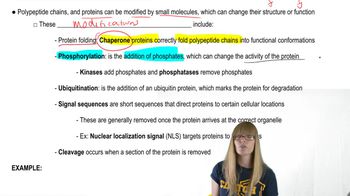
Learn about the role of ubiquitin, a small protein that tags other proteins for degradation by the proteasome. This process is called ubiquitination.
Recognize that proteins destined for degradation are covalently attached to chains of ubiquitin molecules, which serve as a signal for the proteasome to recognize and bind these proteins.
Explore how the proteasome has regulatory particles that recognize ubiquitin tags, unfold the tagged proteins, and translocate them into the proteolytic core for degradation.
Note that the regulation of proteasome activity depends on the specificity of ubiquitin ligases (enzymes that attach ubiquitin) and the presence of deubiquitinating enzymes that can remove ubiquitin, thus controlling which proteins are targeted.
Key Concepts
Here are the essential concepts you must grasp in order to answer the question correctly.
Ubiquitin-Proteasome System
The ubiquitin-proteasome system tags proteins destined for degradation with ubiquitin molecules. This tagging acts as a signal for the proteasome to recognize and selectively degrade these proteins, ensuring specificity in protein turnover.
Recommended video:
Guided course
 04:30
04:30
Post Translational Modifications
Protein Ubiquitination
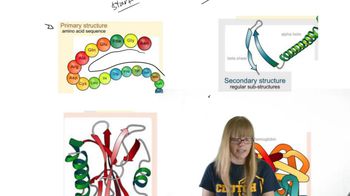
Ubiquitination is the process where ubiquitin proteins are covalently attached to a substrate protein. This modification marks proteins for degradation, alters their cellular location, or affects their activity, playing a key role in regulating proteasome targeting.
Recommended video:
Guided course
 05:05
05:05Proteins
Proteasome Structure and Function
The proteasome is a large protein complex with a core particle that degrades proteins and regulatory particles that recognize ubiquitinated substrates. Its activity is tightly controlled to prevent unwanted protein degradation and maintain cellular protein homeostasis.
Recommended video:
Guided course
 08:26
08:26Functional Genomics
Related Practice