Ch. 16 - Regulation of Gene Expression in Eukaryotes
Klug10th EditionEssentials of GeneticsISBN: 9780135588789
Not the one you use?Change textbookSelect a different textbook
Table of contents
- Ch. 1 - Introduction to Genetics16
- Ch. 2 - Mitosis and Meiosis28
- Ch. 3 - Mendelian Genetics37
- Ch. 4 - Modification of Mendelian Ratios53
- Ch. 5 - Sex Determination and Sex Chromosomes32
- Ch. 6 - Chromosome Mutations: Variation in Number and Arrangement37
- Ch. 7 - Linkage and Chromosome Mapping in Eukaryotes36
- Ch. 8 - Genetic Analysis and Mapping in Bacteria and Bacteriophages24
- Ch. 9 - DNA Structure and Analysis38
- Ch. 10 - DNA Replication29
- Ch. 11 - Chromosome Structure and DNA Sequence Organization22
- Ch. 12 - The Genetic Code and Transcription36
- Ch. 13 - Translation and Proteins27
- Ch. 14 - Gene Mutation, DNA Repair, and Transposition34
- Ch. 15 - Regulation of Gene Expression in Bacteria22
- Ch. 16 - Regulation of Gene Expression in Eukaryotes37
- Ch. 17 - Recombinant DNA Technology27
- Ch. 18 - Genomics, Bioinformatics, and Proteomics30
- Ch. 19 - The Genetics of Cancer21
- Ch. 20 - Quantitative Genetics and Multifactorial Traits37
- Ch. 21 - Population and Evolutionary Genetics45

Chapter 16, Problem 27
When challenged with a low oxygen environment, known as hypoxia, the body produces a hormone called erythropoietin (EPO), which then stimulates red blood cell production to carry more oxygen. Transcription of the gene encoding EPO is dependent upon the hypoxia-inducible factor (HIF), which is a transcriptional activator. However, HIF alone is not sufficient to activate EPO. For example, Wang et al. (2010. PLOS ONE 5: e10002) showed that HIF recruits another protein called p300 to an enhancer for the EPO gene. Furthermore, deletion of p300 significantly impaired transcription of the EPO gene in response to hypoxia. Given that p300 is a type of histone acetyl transferase, how might p300 influence transcription of the EPO gene?
 Verified step by step guidance
1
Understand the role of p300 as a histone acetyl transferase (HAT), which means it adds acetyl groups to histone proteins around DNA.
Recall that acetylation of histones by HATs like p300 generally reduces the positive charge on histones, decreasing their affinity for negatively charged DNA, leading to a more relaxed chromatin structure.
Recognize that a relaxed or open chromatin structure allows transcription factors and the transcriptional machinery better access to the DNA, facilitating gene transcription.
Connect that p300, recruited by HIF to the EPO gene enhancer, likely acetylates histones in that region, promoting chromatin remodeling and enhancing transcriptional activation of the EPO gene.
Conclude that without p300's histone acetylation activity, the chromatin remains more condensed, hindering transcription factor access and thus impairing EPO gene transcription in response to hypoxia.
Key Concepts
Here are the essential concepts you must grasp in order to answer the question correctly.
Hypoxia-Inducible Factor (HIF)
HIF is a transcription factor activated under low oxygen conditions (hypoxia). It binds to specific DNA sequences called hypoxia response elements to initiate transcription of target genes like EPO. HIF’s activity is crucial for cellular adaptation to hypoxia by promoting genes that increase oxygen delivery.
Recommended video:
Guided course
 04:29
04:29
Induced Mutations
Role of p300 as a Histone Acetyltransferase
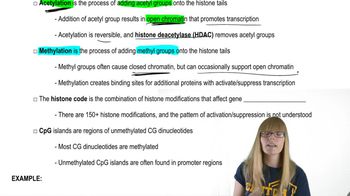
p300 is an enzyme that adds acetyl groups to histone proteins, loosening chromatin structure and making DNA more accessible for transcription. By modifying histones near gene enhancers or promoters, p300 facilitates the recruitment of transcriptional machinery, enhancing gene expression such as that of EPO.
Recommended video:
Guided course
 07:55
07:55Histone Protein Modifications
Transcriptional Co-activation and Enhancer Function
Transcriptional co-activators like p300 do not bind DNA directly but are recruited by factors like HIF to enhancers. Enhancers increase gene transcription by looping DNA to promoters and recruiting RNA polymerase II. The cooperation between HIF and p300 at the EPO enhancer is essential for robust gene activation under hypoxia.
Recommended video:
Guided course
 08:26
08:26Functional Genomics
Related Practice