Pearson+ LogoPearson+ Logo
Ch. 18 - Genomics, Bioinformatics, and Proteomics
Klug - Essentials of Genetics 10th Edition
Klug10th EditionEssentials of GeneticsISBN: 9780135588789Not the one you use?Change textbook
Chapter 18, Problem 12

The Human Genome Project has demonstrated that in humans of all races and nationalities approximately 99.9 percent of the genome sequence is the same, yet different individuals can be identified by DNA fingerprinting techniques. What is one primary variation in the human genome that can be used to distinguish different individuals? Briefly explain your answer.

Verified step by step guidance
1
Understand that although the human genome is about 99.9% identical across all individuals, the small 0.1% variation is what allows us to distinguish between people genetically.
Identify the main type of genetic variation used in DNA fingerprinting: these are called Short Tandem Repeats (STRs) or Variable Number Tandem Repeats (VNTRs), which are sequences of DNA where a short sequence of bases is repeated multiple times in a row.
Explain that the number of repeats at these STR or VNTR loci varies greatly among individuals, making these regions highly polymorphic and useful for identification.
Note that DNA fingerprinting analyzes multiple STR loci across the genome to create a unique genetic profile for each individual, since the combination of repeat numbers at different loci is highly unlikely to be the same in two unrelated people.
Summarize that the primary variation used to distinguish individuals in DNA fingerprinting is the difference in the number of tandem repeats at specific loci in the genome.

Verified video answer for a similar problem:

This video solution was recommended by our tutors as helpful for the problem above.
Video duration:
1m
Was this helpful?

Key Concepts

Here are the essential concepts you must grasp in order to answer the question correctly.

Human Genome Similarity

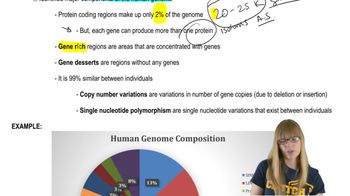
The human genome is remarkably similar across all individuals, with about 99.9% of the DNA sequence being identical. This high similarity reflects shared genetic heritage and common biological functions, but the small differences account for individual uniqueness.
Recommended video:
Guided course
06:51
Human Genome Composition

Genetic Variation and Polymorphisms

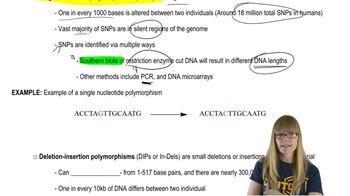
Genetic variation refers to differences in DNA sequences among individuals. Polymorphisms, such as single nucleotide polymorphisms (SNPs) and variable number tandem repeats (VNTRs), are common types of variations that contribute to genetic diversity and can be used to distinguish individuals.
Recommended video:
Guided course
09:28
Genomic Variation

DNA Fingerprinting and Short Tandem Repeats (STRs)

DNA fingerprinting uses specific regions of the genome called short tandem repeats (STRs), which are repeating sequences that vary in length between individuals. These variations in STR patterns provide a unique genetic profile for each person, enabling identification despite overall genome similarity.
Recommended video:
Guided course
09:28
Genomic Variation
Related Practice
Textbook Question

Describe three major goals of the Human Genome Project.

852
views
Textbook Question

Describe the human genome in terms of genome size, the percentage of the genome that codes for proteins, how much is composed of repetitive sequences, and how many genes it contains. Describe two other features of the human genome.

622
views
Textbook Question

Recall that when the HGP was completed, more than 40 percent of the genes identified had unknown functions. The PANTHER database provides access to comprehensive and current functional assignments for human genes (and genes from other species).

Go to http://www.pantherdb.org/data/. In the frame on the left side of the screen locate the 'Quick links' and use the 'Whole genome function views' link to a view of a pie chart of current functional classes for human genes. Mouse over the pie chart to answer these questions. What percentage of human genes encode transcription factors? Cytoskeletal proteins? Transmembrane receptor regulatory/adaptor proteins?

811
views
Textbook Question

Through the Human Genome Project (HGP), a relatively accurate human genome sequence was published from combined samples from multiple individuals. It serves as a reference for a haploid genome. How do results from personal genome projects (PGP) differ from those of the HGP?

704
views
Textbook Question

Explain differences between whole-genome sequencing (WGS) and whole-exome sequencing (WES), and describe advantages and disadvantages of each approach for identifying disease-causing mutations in a genome. Which approach was used for the Human Genome Project?

636
views
Textbook Question

Describe the significance of the Genome 10K project.

495
views