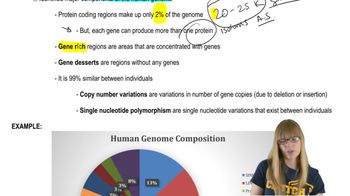
Annotation involves identifying genes and gene-regulatory sequences in a genome. List and describe characteristics of a genome that are hallmarks for identifying genes in an unknown sequence. What characteristics would you look for in a bacterial genome? A eukaryotic genome?
Describe three major goals of the Human Genome Project.
Verified step by step guidance
Verified video answer for a similar problem:
Key Concepts
Sequencing the Human Genome
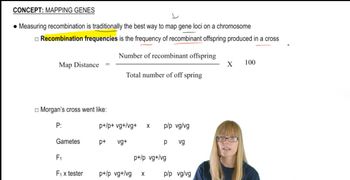
Identifying and Mapping Genes
Developing Tools for Data Analysis and Sharing
How do high-throughput techniques such as computer-automated, next-generation sequencing, and mass spectrometry facilitate research in genomics and proteomics? Explain.
BLAST searches and related applications are essential for analyzing gene and protein sequences. Define BLAST, describe basic features of this bioinformatics tool, and give an example of information provided by a BLAST search.
Describe the human genome in terms of genome size, the percentage of the genome that codes for proteins, how much is composed of repetitive sequences, and how many genes it contains. Describe two other features of the human genome.
Recall that when the HGP was completed, more than 40 percent of the genes identified had unknown functions. The PANTHER database provides access to comprehensive and current functional assignments for human genes (and genes from other species).
Go to http://www.pantherdb.org/data/. In the frame on the left side of the screen locate the 'Quick links' and use the 'Whole genome function views' link to a view of a pie chart of current functional classes for human genes. Mouse over the pie chart to answer these questions. What percentage of human genes encode transcription factors? Cytoskeletal proteins? Transmembrane receptor regulatory/adaptor proteins?

The Human Genome Project has demonstrated that in humans of all races and nationalities approximately 99.9 percent of the genome sequence is the same, yet different individuals can be identified by DNA fingerprinting techniques. What is one primary variation in the human genome that can be used to distinguish different individuals? Briefly explain your answer.