
Pearson+ LogoPearson+ Logo
Ch. 3 - Mendelian Genetics
Klug - Essentials of Genetics 10th Edition
Klug10th EditionEssentials of GeneticsISBN: 9780135588789Not the one you use?Change textbook
Chapter 3, Problem 10

Correlate Mendel’s four postulates with what is now known about homologous chromosomes, genes, alleles, and the process of meiosis.

Verified step by step guidance
1
Identify Mendel's four postulates: (1) Unit factors in pairs, (2) Dominance and recessiveness, (3) Segregation, and (4) Independent assortment.
Explain how the concept of 'unit factors in pairs' corresponds to homologous chromosomes carrying gene pairs, where each chromosome has one allele of a gene.
Relate dominance and recessiveness to the interaction between alleles on homologous chromosomes, where one allele can mask the expression of another.
Describe how Mendel's principle of segregation aligns with the separation of homologous chromosomes during meiosis I, ensuring each gamete receives only one allele of each gene.
Connect independent assortment to the random orientation and separation of different chromosome pairs during meiosis I, leading to the independent inheritance of genes located on different chromosomes.

Key Concepts

Here are the essential concepts you must grasp in order to answer the question correctly.

Mendel’s Four Postulates

Mendel’s four postulates describe how traits are inherited: (1) traits are controlled by discrete factors (genes), (2) organisms have two alleles for each gene, (3) alleles segregate during gamete formation, and (4) alleles of different genes assort independently. These principles laid the foundation for classical genetics.
Recommended video:
Guided course
08:06
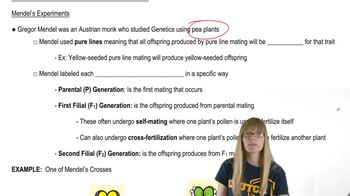
Mendel's Experiments

Homologous Chromosomes and Meiosis

Homologous chromosomes are pairs of chromosomes, one from each parent, that carry the same genes but may have different alleles. During meiosis, these chromosomes segregate into gametes, explaining Mendel’s principle of segregation and independent assortment at the chromosomal level.
Recommended video:
Guided course
05:30
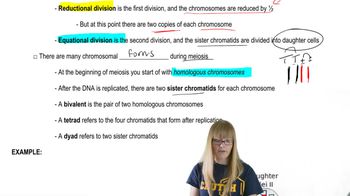
Meiosis Overview

Genes and Alleles

Genes are specific DNA sequences that code for traits, and alleles are different versions of a gene. The presence of two alleles per gene in diploid organisms corresponds to Mendel’s concept of paired factors, with allele segregation during meiosis leading to genetic variation.
Recommended video:
Guided course
03:03
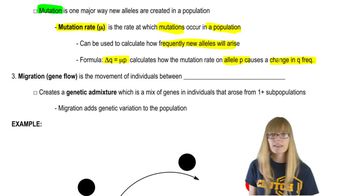
New Alleles and Migration