Pearson+ LogoPearson+ Logo
Ch. 3 - Mendelian Genetics
Klug - Essentials of Genetics 10th Edition
Klug10th EditionEssentials of GeneticsISBN: 9780135588789Not the one you use?Change textbook
Chapter 3, Problem 9

Which of Mendel’s postulates can be demonstrated in the Now Solve This problem 3.2 but not in Problem 3 above? Define this postulate.

Verified step by step guidance
1
Step 1: Identify the Mendel’s postulates involved in both Problem 3 and Problem 3.2 by reviewing the problem statements and the genetic crosses or observations they describe.
Step 2: Recall Mendel’s three main postulates: (1) The Law of Segregation, (2) The Law of Independent Assortment, and (3) The concept of Dominance and Recessiveness.
Step 3: Determine which postulate is demonstrated in Problem 3.2 but not in Problem 3 by comparing the genetic principles illustrated in each problem. For example, if Problem 3.2 involves dihybrid crosses showing independent assortment, while Problem 3 involves only monohybrid crosses, then the Law of Independent Assortment is demonstrated only in Problem 3.2.
Step 4: Define the identified postulate clearly. For instance, if it is the Law of Independent Assortment, explain that it states that alleles of different genes assort independently of one another during gamete formation.
Step 5: Summarize how the problem 3.2 exemplifies this postulate through the genetic crosses or data provided, highlighting the key observations that support the postulate.

Key Concepts

Here are the essential concepts you must grasp in order to answer the question correctly.

Mendel’s Postulates

Mendel’s postulates are foundational principles of inheritance that explain how traits are passed from parents to offspring. They include the concepts of unit factors (genes), segregation, and independent assortment, which together describe the behavior of alleles during reproduction.
Recommended video:
Guided course
08:06
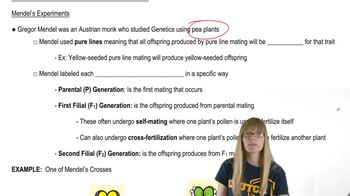
Mendel's Experiments

Law of Segregation

The Law of Segregation states that allele pairs separate during gamete formation, so each gamete carries only one allele for each gene. This explains how offspring inherit one allele from each parent, ensuring genetic variation.
Recommended video:
Guided course
05:48
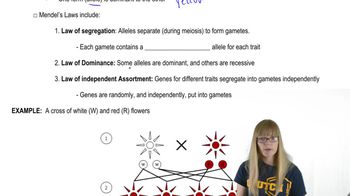
Mendel's Laws

Demonstration of Specific Postulates in Problems

Different genetics problems illustrate different Mendelian principles. Problem 3.2 likely demonstrates a postulate not shown in Problem 3, such as segregation or independent assortment, highlighting how experimental setups reveal distinct genetic laws.
Recommended video:
Guided course
04:58
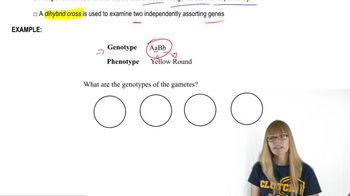
Gamete Genetics and Independent Assortment