Pearson+ LogoPearson+ Logo
Ch. 3 - Mendelian Genetics
Klug - Essentials of Genetics 10th Edition
Klug10th EditionEssentials of GeneticsISBN: 9780135588789Not the one you use?Change textbook
Chapter 3, Problem 23c

Two true-breeding pea plants are crossed. One parent is round, terminal, violet, constricted, while the other expresses the contrasting phenotypes of wrinkled, axial, white, full. The four pairs of contrasting traits are controlled by four genes, each located on a separate chromosome. In the F1 generation, only round, axial, violet, and full are expressed. In the F2 generation, all possible combinations of these traits are expressed in ratios consistent with Mendelian inheritance.
Which F2 phenotype is expected to occur least frequently? Write a mathematical expression that predicts this frequency.

Verified step by step guidance
1
Identify the dominant and recessive alleles for each trait based on the F1 phenotype. Since the F1 generation shows round, axial, violet, and full phenotypes, these are the dominant traits, and wrinkled, terminal, white, and constricted are recessive.
Assign symbols for each gene, for example: R (round) dominant over r (wrinkled), A (axial) dominant over a (terminal), V (violet) dominant over v (white), and F (full) dominant over f (constricted).
Determine the genotype of the F1 plants. Since the parents are true-breeding and contrasting, the F1 will be heterozygous for all four genes: Rr Aa Vv Ff.
Recall that in the F2 generation, the genes assort independently, and the phenotypic ratio for each gene follows Mendelian inheritance: 3 dominant : 1 recessive. The least frequent phenotype will be the one that is recessive for all four traits.
Write the mathematical expression for the frequency of the least frequent phenotype (all recessive traits) as the product of the probabilities of each recessive phenotype: \(\left(\frac{1}{4}\right)^4\).

Key Concepts

Here are the essential concepts you must grasp in order to answer the question correctly.

Mendelian Inheritance and Independent Assortment

Mendelian inheritance describes how traits are passed from parents to offspring through dominant and recessive alleles. Independent assortment states that genes on different chromosomes segregate independently during gamete formation, leading to various combinations of traits in offspring.
Recommended video:
Guided course
04:58
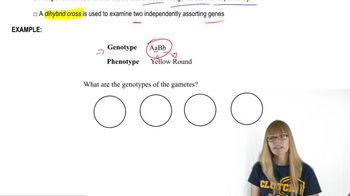
Gamete Genetics and Independent Assortment

Genotype and Phenotype Ratios in Dihybrid and Multihybrid Crosses

In crosses involving multiple gene pairs, phenotype ratios result from combining the probabilities of each trait's expression. For four gene pairs, the F2 generation exhibits a 9:3:3:1-like distribution extended to multiple traits, with dominant and recessive phenotypes appearing in predictable ratios.
Recommended video:
Guided course
06:28
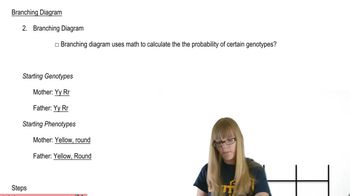
Branch Diagram

Calculating Phenotype Frequencies Using Probability Multiplication

The frequency of a specific phenotype in the F2 generation is found by multiplying the probabilities of each individual trait's phenotype. For traits assorting independently, the overall frequency equals the product of each trait's phenotype probability, allowing prediction of rarest phenotypes.
Recommended video:
Guided course
06:14
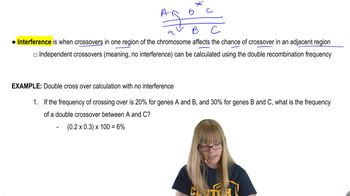
Multiple Cross Overs and Interference