
Pearson+ LogoPearson+ Logo
Ch. 7 - Linkage and Chromosome Mapping in Eukaryotes
Klug - Essentials of Genetics 10th Edition
Klug10th EditionEssentials of GeneticsISBN: 9780135588789Not the one you use?Change textbook
Chapter 7, Problem 21a

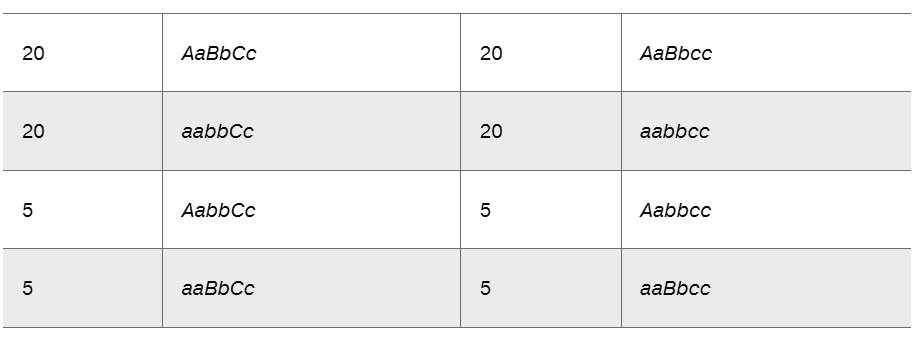
An organism of the genotype AaBbCc was testcrossed to a triply recessive organism (aabbcc). The genotypes of the progeny are presented in the following table.
Table showing progeny genotypes and counts from a testcross of AaBbCc with aabbcc, illustrating genetic variation.
If these three genes were all assorting independently, how many genotypic and phenotypic classes would result in the offspring, and in what proportion, assuming simple dominance and recessiveness in each gene pair?

Verified step by step guidance
1
Step 1: Identify the number of genes and their alleles involved. Here, there are three genes (A, B, and C), each with two alleles: dominant (A, B, C) and recessive (a, b, c). The testcross is between AaBbCc and aabbcc.
Step 2: Determine the number of possible genotypic classes if the genes assort independently. Since each gene has two possible alleles from the heterozygous parent (A or a, B or b, C or c), the total number of genotypic combinations is \$2^3 = 8$.
Step 3: Determine the number of phenotypic classes. Because each gene exhibits simple dominance, each gene locus can produce two phenotypes: dominant (presence of at least one dominant allele) or recessive (homozygous recessive). Therefore, the total number of phenotypic classes is also \$2^3 = 8$.
Step 4: Calculate the expected proportion of each genotypic class in the offspring. Since the testcross parent is homozygous recessive for all genes, the genotype of each offspring depends solely on the allele contributed by the heterozygous parent. Each gene segregates independently with a 1:1 ratio of dominant to recessive alleles, so the expected frequency of each genotype is \(\frac{1}{2} \times \frac{1}{2} \times \frac{1}{2} = \frac{1}{8}\).
Step 5: Calculate the expected proportion of each phenotypic class. Since each gene shows dominance, the phenotype depends on whether the dominant allele is present. The probability of showing the dominant phenotype for each gene is \(\frac{1}{2}\), and recessive is \(\frac{1}{2}\). Thus, the expected frequency of each phenotypic class is also \(\frac{1}{8}\).

Verified video answer for a similar problem:

This video solution was recommended by our tutors as helpful for the problem above.
Video duration:
2m
Was this helpful?

Key Concepts

Here are the essential concepts you must grasp in order to answer the question correctly.

Independent Assortment

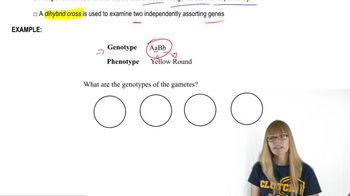
Independent assortment is a principle stating that genes for different traits segregate independently during gamete formation. For three gene pairs, this means each gene's alleles combine randomly, producing offspring with all possible genotype combinations in predictable ratios.
Recommended video:
Guided course
04:58
Gamete Genetics and Independent Assortment

Testcross and Genotypic Classes

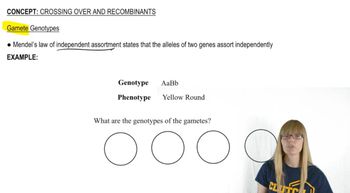
A testcross involves crossing an organism with a homozygous recessive individual to reveal the genotype of the first organism. The number of genotypic classes in offspring reflects the combinations of alleles inherited, which can be counted to determine genetic variation.
Recommended video:
Guided course
07:52
Gamete Genotypes

Phenotypic Ratios and Dominance

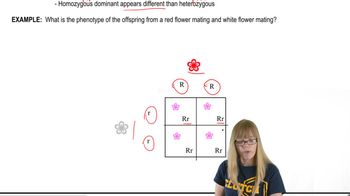
Phenotypic ratios depend on dominant and recessive allele interactions. With simple dominance, heterozygous and homozygous dominant genotypes show the dominant phenotype, while only homozygous recessive shows the recessive phenotype, affecting the number of observable phenotypic classes.
Recommended video:
Guided course
04:37
Variations on Dominance
Related Practice
Textbook Question

In a certain plant, fruit is either red or yellow, and fruit shape is either oval or long. Red and oval are the dominant traits. Two plants, both heterozygous for these traits, were testcrossed, with the following results.

Determine the location of the genes relative to one another and the genotypes of the two parental plants.

711
views
Textbook Question

In Drosophila, Dichaete (D) is a mutation on chromosome III with a dominant effect on wing shape. It is lethal when homozygous. The genes ebony body (e) and pink eye (p) are recessive mutations on chromosome III. Flies from a Dichaete stock were crossed to homozygous ebony, pink flies, and the F₁ progeny, with a Dichaete phenotype, were backcrossed to the ebony, pink homozygotes. Using the results of this backcross shown in the table.

Diagram this cross, showing the genotypes of the parents and offspring of both crosses.

1674
views
Textbook Question

In Drosophila, Dichaete (D) is a mutation on chromosome III with a dominant effect on wing shape. It is lethal when homozygous. The genes ebony body (e) and pink eye (p) are recessive mutations on chromosome III. Flies from a Dichaete stock were crossed to homozygous ebony, pink flies, and the F1 progeny, with a Dichaete phenotype, were backcrossed to the ebony, pink homozygotes. Using the results of this backcross shown in the table,

What is the sequence and interlocus distance between these three genes?

1318
views
Textbook Question

An organism of the genotype AaBbCc was testcrossed to a triply recessive organism (aabbcc). The genotypes of the progeny are presented in the following table.

Answer part (a) again, assuming the three genes are so tightly linked on a single chromosome that no crossover gametes were recovered in the sample of offspring.

1324
views
Textbook Question

An organism of the genotype AaBbCc was testcrossed to a triply recessive organism (aabbcc). The genotypes of the progeny are presented in the following table.

What can you conclude from the actual data about the location of the three genes in relation to one another?

944
views
Textbook Question

Based on our discussion of the potential inaccuracy of mapping, would you revise your answer to Problem 22? If so, how?

635
views