Pearson+ LogoPearson+ Logo
Ch. 10 - Eukaryotic Chromosome Abnormalities and Molecular Organization
Sanders - Genetic Analysis: An Integrated Approach 3rd Edition
Sanders3rd EditionGenetic Analysis: An Integrated ApproachISBN: 9780135564172Not the one you use?Change textbook
Chapter 10, Problem 28b

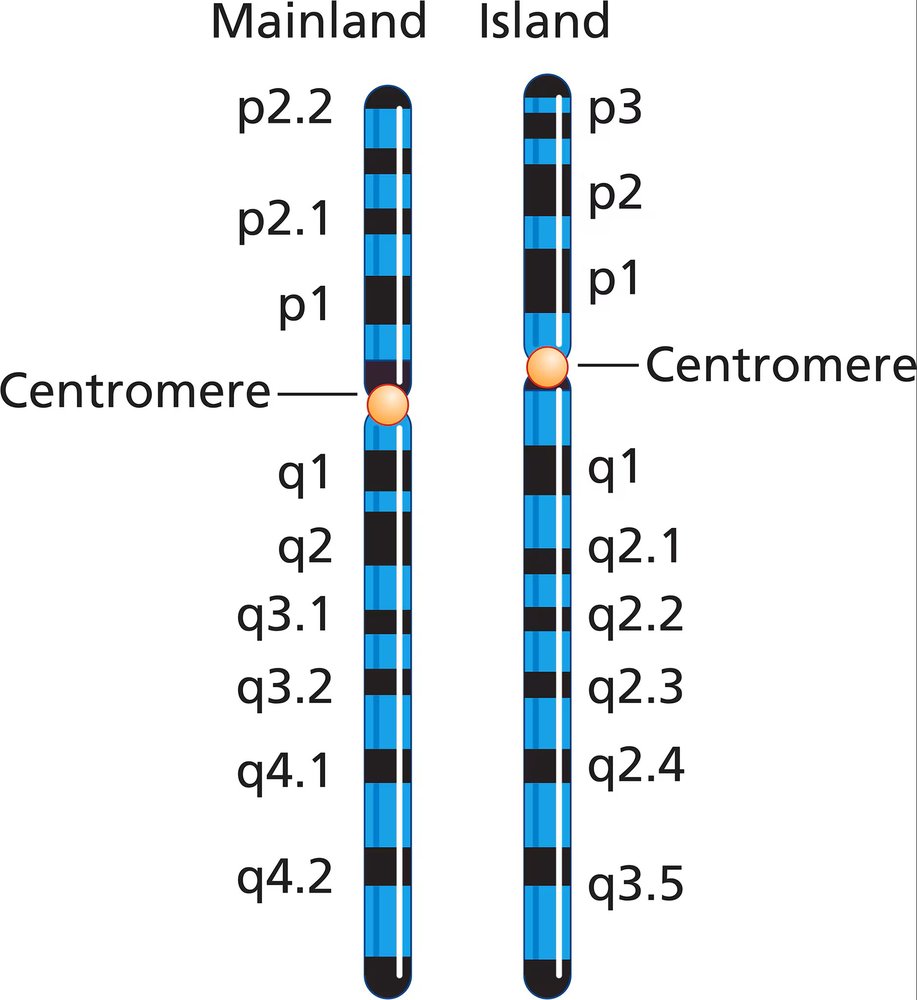
A small population of deer living on an isolated island is separated for many generations from a mainland deer population. The populations retain the same number of chromosomes but hybrids are infertile. One chromosome (shown here) has a different banding pattern in the island population than in the mainland population.
Illustration of homologous chromosomes from mainland and island deer, showing different banding patterns and centromeres.
Draw the synapsis of these homologs during prophase I in hybrids produced from the cross of mainland with island deer.

Verified step by step guidance
1
Understand the context: The problem involves a chromosomal difference between two populations of deer. The island and mainland populations have the same number of chromosomes, but one chromosome has a different banding pattern, indicating structural differences such as inversions, translocations, or other rearrangements.
Recall the process of synapsis during prophase I of meiosis: Homologous chromosomes pair up and align gene by gene. If there are structural differences between homologs, this can lead to the formation of loops or other irregular structures to accommodate the differences.
Identify the structural difference: The banding pattern difference suggests that one chromosome may have undergone an inversion or other rearrangement. This means that during synapsis, the homologs will attempt to align, but the structural difference will cause a misalignment or loop in the affected region.
Draw the synapsis: Represent the homologous chromosomes visually. Show the mainland chromosome with its original banding pattern and the island chromosome with its altered banding pattern. Indicate the loop or misalignment in the region where the structural difference occurs.
Explain the consequences: Highlight that the structural difference can lead to issues during meiosis, such as the production of unbalanced gametes. This explains why hybrids between the two populations are infertile, as the chromosomal differences disrupt proper segregation.

Verified video answer for a similar problem:

This video solution was recommended by our tutors as helpful for the problem above.
Video duration:
1m
Was this helpful?

Key Concepts

Here are the essential concepts you must grasp in order to answer the question correctly.

Homologous Chromosomes

Homologous chromosomes are pairs of chromosomes, one inherited from each parent, that have the same genes at the same loci but may have different alleles. During meiosis, these chromosomes align and can undergo synapsis, where they pair up closely to facilitate genetic recombination. Understanding homologous chromosomes is crucial for analyzing genetic variation and fertility in hybrids.
Recommended video:
Guided course
07:10
Chromosome Structure

Prophase I of Meiosis

Prophase I is the first stage of meiosis where homologous chromosomes pair up and exchange genetic material through a process called crossing over. This stage is essential for genetic diversity, as it allows for the recombination of alleles. In the context of the question, understanding prophase I helps in visualizing how the different banding patterns of chromosomes from the island and mainland populations interact.
Recommended video:
Guided course
09:06
Meiosis Steps

Hybrid Infertility

Hybrid infertility occurs when the offspring produced from two different species or populations are unable to reproduce. This can result from genetic incompatibilities, such as differences in chromosome structure or number, which prevent proper pairing during meiosis. In this scenario, the hybrids between the island and mainland deer are infertile, highlighting the importance of genetic divergence in speciation.
Recommended video:
Guided course
10:35
Human Sex Chromosomes
Related Practice
Textbook Question

Genomic DNA from the nematode worm Caenorhabditis elegans is organized by nucleosomes in the manner typical of eukaryotic genomes, with 145 bp encircling each nucleosome and approximately 55 bp in linker DNA. When C. elegans chromatin is carefully isolated, stripped of nonhistone proteins, and placed in an appropriate buffer, the chromatin decondenses to the 10-nm fiber structure. Suppose researchers mix a sample of 10-nm–fiber chromatin with a large amount of the enzyme DNase I that randomly cleaves DNA in regions not protected by bound protein. Next, they remove the nucleosomes, separate the DNA fragments by gel electrophoresis, and stain all the DNA fragments in the gel.

Explain the origin of DNA fragments seen in the gel.

595
views
Textbook Question

Genomic DNA from the nematode worm Caenorhabditis elegans is organized by nucleosomes in the manner typical of eukaryotic genomes, with 145 bp encircling each nucleosome and approximately 55 bp in linker DNA. When C. elegans chromatin is carefully isolated, stripped of nonhistone proteins, and placed in an appropriate buffer, the chromatin decondenses to the 10-nm fiber structure. Suppose researchers mix a sample of 10-nm–fiber chromatin with a large amount of the enzyme DNase I that randomly cleaves DNA in regions not protected by bound protein. Next, they remove the nucleosomes, separate the DNA fragments by gel electrophoresis, and stain all the DNA fragments in the gel.

How do the expected results support the 10-nm–fiber model of chromatin?

454
views
Textbook Question

A small population of deer living on an isolated island is separated for many generations from a mainland deer population. The populations retain the same number of chromosomes but hybrids are infertile. One chromosome (shown here) has a different banding pattern in the island population than in the mainland population.

Describe how the banding pattern of the island population chromosome most likely evolved from the mainland chromosome. What term or terms describe the difference between these chromosomes?

505
views
Textbook Question

A small population of deer living on an isolated island is separated for many generations from a mainland deer population. The populations retain the same number of chromosomes but hybrids are infertile. One chromosome (shown here) has a different banding pattern in the island population than in the mainland population.

In a mainland–island hybrid deer, recombination takes place in band q1 of the homologous chromosomes. Draw the gametes that result from this event.

506
views
Textbook Question

A small population of deer living on an isolated island is separated for many generations from a mainland deer population. The populations retain the same number of chromosomes but hybrids are infertile. One chromosome (shown here) has a different banding pattern in the island population than in the mainland population.

Suppose that 40% of all meioses in mainland–island hybrids involve recombination somewhere in the chromosome region between q2.1 and p2. What proportion of the gametes of hybrid deer are viable? What is the cause of the decreased proportion of viable gametes in hybrids relative to the parental populations?

552
views
Textbook Question

A eukaryote with a diploid number of 2n=6 carries the chromosomes shown below and labeled (a) to (f).

Carefully examine and redraw these chromosomes in any valid metaphase I alignment. Draw and label the metaphase plate, and label each chromosome with its assigned letter. 

2237
views