Pearson+ LogoPearson+ Logo
Ch. 10 - Eukaryotic Chromosome Abnormalities and Molecular Organization
Sanders - Genetic Analysis: An Integrated Approach 3rd Edition
Sanders3rd EditionGenetic Analysis: An Integrated ApproachISBN: 9780135564172Not the one you use?Change textbook
Chapter 10, Problem 23

In the tomato, Solanum esculentum, tall (D−)(D−) is dominant to dwarf (dd) plant height, smooth fruit (P−) is dominant to peach fruit (pp), and round fruit shape (O−) is dominant to oblate fruit shape (oo). These three genes are linked on chromosome 1 of tomato in the order dwarf–peach–oblate. There are 12 map units between dwarf and peach and 17 map units between peach and oblate. A trihybrid plant (DPO/dpo) is test-crossed to a plant that is homozygous recessive at the three loci (dpo/dpo). The accompanying table shows the progeny plants. Identify the mechanism responsible for the resulting data that do not agree with the established genetic map.
Table showing progeny phenotypes and their counts from a genetic cross in tomatoes.

Verified step by step guidance
1
Step 1: Understand the genetic cross. The trihybrid plant (DPO/dpo) is test-crossed with a homozygous recessive plant (dpo/dpo). This means that the progeny phenotypes will directly reflect the gametes produced by the trihybrid parent. The genes are linked, so recombination frequencies will determine the distribution of progeny phenotypes.
Step 2: Analyze the genetic map. The genes are linked in the order dwarf–peach–oblate, with 12 map units between dwarf and peach, and 17 map units between peach and oblate. This means the recombination frequency between dwarf and peach is 12% (0.12), and between peach and oblate is 17% (0.17). The double crossover frequency is the product of these two values (0.12 × 0.17 = 0.0204 or 2.04%).
Step 3: Identify parental and recombinant phenotypes. The two most frequent phenotypes (Tall, smooth, round and Dwarf, peach, oblate) represent the parental types, as they occur most often. The less frequent phenotypes represent single and double crossover events. Use the progeny counts to categorize the phenotypes into parental, single crossover, and double crossover groups.
Step 4: Compare observed and expected frequencies. Based on the genetic map, calculate the expected frequencies of each phenotype (parental, single crossover, and double crossover) using the recombination frequencies. Compare these expected frequencies to the observed counts in the table to identify any discrepancies.
Step 5: Interpret the mechanism. If the observed data significantly deviate from the expected frequencies, this could indicate interference (a reduction in double crossover events compared to the expected frequency) or other factors affecting recombination. Use statistical tests, such as a chi-square test, to determine if the deviations are statistically significant and to identify the mechanism responsible for the discrepancy.

Verified video answer for a similar problem:

This video solution was recommended by our tutors as helpful for the problem above.
Video duration:
8m
Was this helpful?

Key Concepts

Here are the essential concepts you must grasp in order to answer the question correctly.

Genetic Linkage

Genetic linkage refers to the tendency of genes located close to each other on the same chromosome to be inherited together during meiosis. In this case, the genes for plant height, fruit texture, and fruit shape in tomatoes are linked, which affects the expected ratios of phenotypes in the progeny. Deviations from expected ratios can indicate the presence of linkage and the distances between genes.
Recommended video:
Guided course
07:33
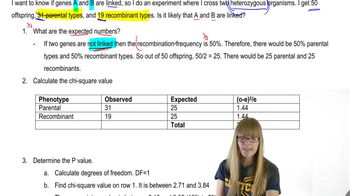
Chi Square and Linkage

Map Units and Recombination Frequency

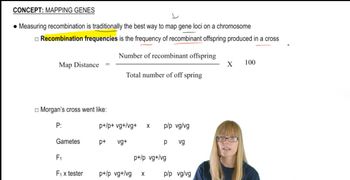
Map units, or centimorgans, are a measure of genetic distance based on recombination frequency between linked genes. One map unit corresponds to a 1% chance of recombination occurring between two genes during gamete formation. The distances provided in the question (12 map units between dwarf and peach, and 17 between peach and oblate) suggest that recombination events can lead to unexpected phenotypic ratios in the progeny.
Recommended video:
Guided course
09:09
Mapping Genes

Test Cross

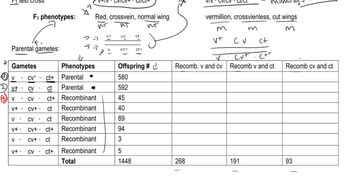
A test cross involves breeding an individual with a dominant phenotype (but unknown genotype) with a homozygous recessive individual. This allows researchers to determine the genotype of the dominant individual based on the phenotypes of the offspring. In this scenario, the trihybrid plant (DPO/dpo) is test-crossed to a homozygous recessive plant (dpo/dpo), which helps reveal the inheritance patterns and any discrepancies from expected ratios due to genetic linkage.
Recommended video:
Guided course
26:08
Trihybrid Cross
Related Practice
Textbook Question

Two experimental varieties of strawberry are produced by crossing a hexaploid line that contains 48 chromosomes and a tetraploid line that contains 32 chromosomes. Experimental variety 1 contains 40 chromosomes, and experimental variety 2 contains 56 chromosomes.

Do you expect both experimental lines to be fertile? Why or why not?

502
views
Textbook Question

Two experimental varieties of strawberry are produced by crossing a hexaploid line that contains 48 chromosomes and a tetraploid line that contains 32 chromosomes. Experimental variety 1 contains 40 chromosomes, and experimental variety 2 contains 56 chromosomes.

How many chromosomes from the hexaploid line are contributed to experimental variety 1? To experimental variety 2?

635
views
Textbook Question

Two experimental varieties of strawberry are produced by crossing a hexaploid line that contains 48 chromosomes and a tetraploid line that contains 32 chromosomes. Experimental variety 1 contains 40 chromosomes, and experimental variety 2 contains 56 chromosomes.

How many chromosomes from the tetraploid lines are contributed to experimental variety 1? To experimental variety 2?

446
views
Textbook Question

A boy with Down syndrome (trisomy 21) has 46 chromosomes. His parents and his two older sisters have a normal phenotype, but each has 45 chromosomes.

Explain how this is possible.

497
views
Textbook Question

A boy with Down syndrome (trisomy 21) has 46 chromosomes. His parents and his two older sisters have a normal phenotype, but each has 45 chromosomes.

How many chromosomes do you expect to see in karyotypes of the parents?

926
views
Textbook Question

A boy with Down syndrome (trisomy 21) has 46 chromosomes. His parents and his two older sisters have a normal phenotype, but each has 45 chromosomes.

What term best describes this kind of chromosome abnormality?

394
views