Pearson+ LogoPearson+ Logo
Ch. 3 - Cell Division and Chromosome Heredity
Sanders - Genetic Analysis: An Integrated Approach 3rd Edition
Sanders3rd EditionGenetic Analysis: An Integrated ApproachISBN: 9780135564172Not the one you use?Change textbook
Chapter 3, Problem 11c

Describe the role of the following structures or proteins in cell division:
Kinetochores

Verified step by step guidance
1
Understand that kinetochores are protein complexes located at the centromere of each chromosome. Their primary role is to facilitate the attachment of spindle microtubules during cell division.
Recognize that kinetochores are essential for ensuring accurate chromosome segregation. They act as a physical connection between the chromosomes and the spindle apparatus.
Learn that kinetochores generate tension by pulling on the microtubules, which helps align chromosomes at the metaphase plate during metaphase of mitosis or meiosis.
Explore how kinetochores play a role in the spindle assembly checkpoint, ensuring that all chromosomes are properly attached to the spindle before progressing to anaphase. This prevents errors in chromosome segregation.
Understand that during anaphase, kinetochores facilitate the movement of chromosomes toward opposite poles of the cell by interacting with depolymerizing microtubules, ensuring the proper distribution of genetic material.

Verified video answer for a similar problem:

This video solution was recommended by our tutors as helpful for the problem above.
Video duration:
2m
Was this helpful?

Key Concepts

Here are the essential concepts you must grasp in order to answer the question correctly.

Kinetochores

Kinetochores are protein complexes that assemble on the centromere of a chromosome during cell division. They serve as attachment points for spindle fibers, which are crucial for the movement of chromosomes. Kinetochores ensure that sister chromatids are pulled apart accurately during mitosis and meiosis, facilitating proper chromosome segregation.
Recommended video:
Guided course
09:46
Mitosis Steps

Spindle Apparatus

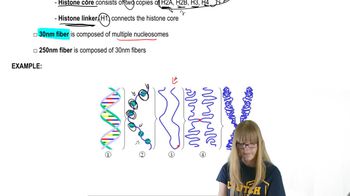
The spindle apparatus is a structure composed of microtubules that orchestrates the separation of chromosomes during cell division. It forms during prophase and is responsible for aligning chromosomes at the metaphase plate and pulling them apart during anaphase. The proper functioning of the spindle apparatus is essential for maintaining genetic stability in daughter cells.
Recommended video:
Guided course
07:10
Chromosome Structure

Cell Division Phases

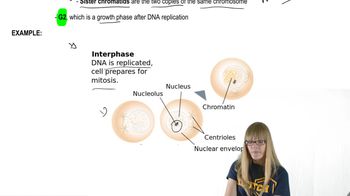
Cell division occurs in distinct phases: prophase, metaphase, anaphase, and telophase, collectively known as mitosis. Each phase has specific events, such as chromosome condensation, alignment, separation, and reformation of the nuclear envelope. Understanding these phases is crucial for comprehending how kinetochores and the spindle apparatus function to ensure accurate cell division.
Recommended video:
Guided course
03:52
Cell-cell interactions