Pearson+ LogoPearson+ Logo
Ch. 3 - Cell Division and Chromosome Heredity
Sanders - Genetic Analysis: An Integrated Approach 3rd Edition
Sanders3rd EditionGenetic Analysis: An Integrated ApproachISBN: 9780135564172Not the one you use?Change textbook
Chapter 3, Problem 1

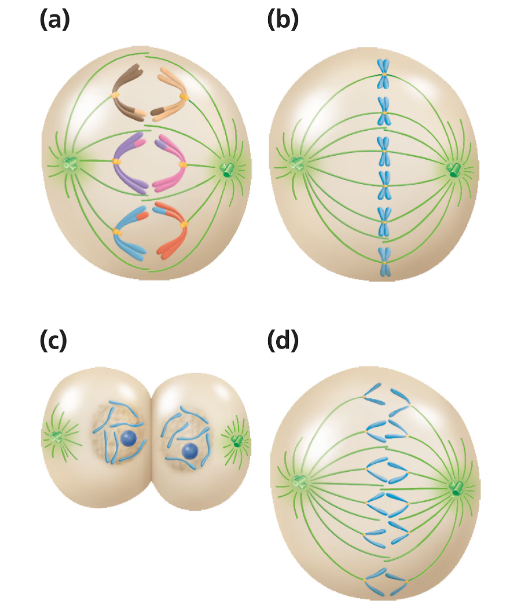
Examine the following diagrams of cells from an organism with diploid number 2n=6, and identify what stage of M phase is represented.

Verified step by step guidance
1
Step 1: Understand the diploid number 2n=6 means the organism has 6 chromosomes arranged in 3 homologous pairs. Each chromosome consists of two sister chromatids during M phase.
Step 2: Identify the key features of each stage of mitosis: (a) chromosomes aligned at the metaphase plate (metaphase), (b) chromosomes condensed but not yet aligned (prometaphase), (c) two daughter cells forming with separated chromosomes (telophase/cytokinesis), (d) chromosomes being pulled apart toward opposite poles (anaphase).
Step 3: Analyze image (a): chromosomes are aligned in the center of the cell, attached to spindle fibers from opposite poles, indicating metaphase.
Step 4: Analyze image (b): chromosomes are condensed and spindle fibers are attached, but chromosomes are not yet aligned at the center, indicating prometaphase.
Step 5: Analyze image (c): two cells are forming with nuclei reappearing, indicating telophase and cytokinesis, and image (d): sister chromatids are being pulled apart toward opposite poles, indicating anaphase.

Verified video answer for a similar problem:

This video solution was recommended by our tutors as helpful for the problem above.
Video duration:
58s
Was this helpful?

Key Concepts

Here are the essential concepts you must grasp in order to answer the question correctly.

Stages of Mitosis

Mitosis is the process of nuclear division in eukaryotic cells, consisting of prophase, metaphase, anaphase, and telophase. Each stage is characterized by specific chromosome arrangements and spindle fiber behaviors, which are critical for accurate chromosome segregation.
Recommended video:
Guided course
09:46
Mitosis Steps

Chromosome Behavior During Mitosis

During mitosis, chromosomes condense and become visible. In metaphase, chromosomes align at the cell's equatorial plate; in anaphase, sister chromatids separate and move to opposite poles; in telophase, chromatids arrive at poles and begin to decondense, signaling the end of nuclear division.
Recommended video:
Guided course
09:46
Mitosis Steps

Role of Spindle Fibers and Centrosomes

Spindle fibers, originating from centrosomes (microtubule organizing centers), attach to chromosomes at kinetochores and facilitate their movement. The organization and dynamics of spindle fibers are essential for proper chromosome alignment and segregation during mitosis.
Recommended video:
Guided course
07:10
Chromosome Structure
Related Practice
Textbook Question

For the retinal cancer retinoblastoma, the inheritance of one mutated copy of RB1 from one of the parents is often referred to as a mutation that produces a 'dominant predisposition to cancer.' This means that the first mutation does not produce cancer but makes it very likely that cancer will develop.

Using RB1⁺ for the normal wild-type allele and RB1⁻ for the mutant allele, identify the genotype of a cell in a retinoblastoma tumor.

458
views
Textbook Question

For the retinal cancer retinoblastoma, the inheritance of one mutated copy of RB1 from one of the parents is often referred to as a mutation that produces a 'dominant predisposition to cancer.' This means that the first mutation does not produce cancer but makes it very likely that cancer will develop.


What is the genotype of a normal cell in the retina in a person who has sporadic retinoblastoma? What is the normal cell genotype if the person has hereditary retinoblastoma? Explain the reason for the difference between the genotypes.

401
views
Textbook Question

From a piece of blank paper, cut out three sets of four cigar-shaped structures (a total of 12 structures). These will represent chromatids. Be sure each member of a set of four chromatids has the same length and girth. In set one, label two chromatids 'A' and two chromatids 'a.' Cut each of these chromatids about halfway across near their midpoint and slide the two 'A' chromatids together at the cuts, to form a single set of attached sister chromatids. Do the same for the 'a' chromatids. In the second set of four chromatids, label two 'B' and two 'b.' Cut and slide these together as you did for the first set, joining the 'B' chromatids together and the 'b' chromatids together. Repeat this process for the third set of chromatids, labeling them as 'D' and 'd.' You now have models for three pairs of homologous chromosomes, for a total of six chromosomes. Align the chromosomes as they might appear at metaphase I of meiosis.

511
views
Textbook Question

Our closest primate relative, the chimpanzee, has a diploid number of 2n = 48. For each of the following stages of M phase, identify the number of chromosomes present in each cell.

End of mitotic telophase

568
views
Textbook Question

Our closest primate relative, the chimpanzee, has a diploid number of 2n = 48. For each of the following stages of M phase, identify the number of chromosomes present in each cell.

Meiotic metaphase I

669
views
Textbook Question

Our closest primate relative, the chimpanzee, has a diploid number of 2n = 48. For each of the following stages of M phase, identify the number of chromosomes present in each cell.

End of meiotic anaphase II

696
views