Pearson+ LogoPearson+ Logo
Ch. 4 - Gene Interaction
Sanders - Genetic Analysis: An Integrated Approach 3rd Edition
Sanders3rd EditionGenetic Analysis: An Integrated ApproachISBN: 9780135564172Not the one you use?Change textbook
Chapter 4, Problem 9a

The ABO blood group assorts independently of the rhesus (Rh) blood group and both assort independently of the MN blood group. Three alleles, IA, IB and i, occur at the ABO locus. Two alleles, R, a dominant allele producing Rh+, and r, a recessive allele for Rh-, are found at the Rh locus, and codominant alleles M and N occur at the MN locus. Each gene is autosomal.
A child with blood types A, Rh−, and M is born to a woman who has blood types O, Rh−, and MN and a man who has blood types A, Rh+, and M. Determine the genotypes of each parent.

Verified step by step guidance
1
Identify the possible genotypes for each blood group system based on the phenotypes given. For the ABO system, blood type A can be either IAIA or IAi, and blood type O is ii. For the Rh system, Rh− is rr and Rh+ can be either RR or Rr. For the MN system, M is either MM or MN, and MN is heterozygous MN.
Analyze the mother's phenotype: blood type O (genotype ii), Rh− (genotype rr), and MN (genotype MN). Since the mother is MN, she must carry one M allele and one N allele.
Analyze the father's phenotype: blood type A (genotype IAIA or IAi), Rh+ (genotype RR or Rr), and M (genotype MM or MN).
Use the child's phenotype (A, Rh−, M) to determine which alleles must have been inherited from each parent. The child has blood type A, so must have at least one IA allele; Rh− means genotype rr; and M means either MM or MN.
Combine the information to deduce the possible genotypes of each parent by considering allele inheritance patterns and the child's genotype, ensuring consistency with Mendelian inheritance and independent assortment.

Verified video answer for a similar problem:

This video solution was recommended by our tutors as helpful for the problem above.
Video duration:
2m
Was this helpful?

Key Concepts

Here are the essential concepts you must grasp in order to answer the question correctly.

Mendelian Inheritance and Independent Assortment

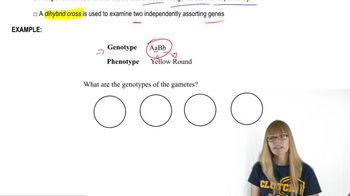
Mendelian inheritance describes how alleles segregate and assort independently during gamete formation. Independent assortment means genes located on different chromosomes are inherited separately, allowing combinations like ABO, Rh, and MN blood groups to be inherited independently. This principle helps predict offspring genotypes from parental genotypes.
Recommended video:
Guided course
04:58
Gamete Genetics and Independent Assortment

Blood Group Genetics and Allele Interactions

The ABO blood group is determined by three alleles (I^A, I^B, i) with I^A and I^B being codominant and i recessive. The Rh blood group involves a dominant Rh+ allele (R) and recessive Rh− allele (r). The MN blood group is controlled by codominant alleles M and N. Understanding dominance and codominance is essential to deduce genotypes from phenotypes.
Recommended video:
Guided course
07:56
Interacting Genes Overview

Genotype Determination from Phenotype

Determining parental genotypes requires analyzing the phenotypes of parents and offspring, considering dominance, recessiveness, and codominance. For example, a Rh− phenotype means homozygous recessive (rr), while Rh+ can be homozygous or heterozygous. Using known phenotypes and inheritance patterns allows inference of possible genotypes.
Recommended video:
Guided course
07:52
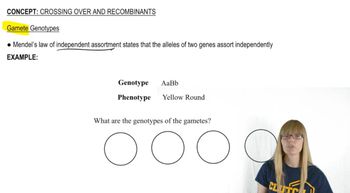
Gamete Genotypes
Related Practice
Textbook Question

Two genes interact to produce various phenotypic ratios among F₂ progeny of a dihybrid cross. Design a different pathway explaining each of the F₂ ratios below, using hypothetical genes R and T and assuming that the dominant allele at each locus catalyzes a different reaction or performs an action leading to pigment production. The recessive allele at each locus is null (loss-of-function). Begin each pathway with a colorless precursor that produces a white or albino phenotype if it is unmodified. The ratios are for F₂ progeny produced by crossing wild-type F₁ organisms with the genotype RrTt.

15/16 black : 1/16 white

377
views
Textbook Question

Two genes interact to produce various phenotypic ratios among F₂ progeny of a dihybrid cross. Design a different pathway explaining each of the F₂ ratios below, using hypothetical genes R and T and assuming that the dominant allele at each locus catalyzes a different reaction or performs an action leading to pigment production. The recessive allele at each locus is null (loss-of-function). Begin each pathway with a colorless precursor that produces a white or albino phenotype if it is unmodified. The ratios are for F₂ progeny produced by crossing wild-type F₁ organisms with the genotype RrTt.

9/16 black : 3/16 gray : 4/16 albino

408
views
Textbook Question

Two genes interact to produce various phenotypic ratios among F₂ progeny of a dihybrid cross. Design a different pathway explaining each of the F₂ ratios below, using hypothetical genes R and T and assuming that the dominant allele at each locus catalyzes a different reaction or performs an action leading to pigment production. The recessive allele at each locus is null (loss-of-function). Begin each pathway with a colorless precursor that produces a white or albino phenotype if it is unmodified. The ratios are for F₂ progeny produced by crossing wild-type F₁ organisms with the genotype RrTt.

13/16 white : 3/16 green

401
views
Textbook Question

The ABO blood group assorts independently of the rhesus (Rh) blood group and both assort independently of the MN blood group. Three alleles, IA, IB and i, occur at the ABO locus. Two alleles, R, a dominant allele producing Rh+, and r, a recessive allele for Rh-, are found at the Rh locus, and codominant alleles M and N occur at the MN locus. Each gene is autosomal.

What proportion of children born to a man with genotype IAIB Rr MN and a woman who is IAi Rr NN will have blood types B, Rh- , and MN? Show your work.

419
views
Textbook Question

The ABO blood group assorts independently of the rhesus (Rh) blood group and both assort independently of the MN blood group. Three alleles, IA, IB, and i, occur at the ABO locus. Two alleles, R, a dominant allele producing Rh+, and r, a recessive allele for Rh-, are found at the Rh locus, and codominant alleles M and N occur at the MN locus. Each gene is autosomal.

A man with blood types B, Rh+, and N says he could not be the father of a child with blood types O, Rh−, and MN. The mother of the child has blood types A, Rh+, and MN. Is the man correct? Explain.

1108
views
Textbook Question

In rats, gene B produces black coat color if the genotype is , but black pigment is not produced if the genotype is bb. At an independent locus, gene D produces yellow pigment if the genotype is D-, but no pigment is produced when the genotype is dd. Production of both pigments results in brown coat color. If neither pigment is produced, coat color is cream. Determine the genotypes of parents of litters with the following phenotype distributions.


4 brown, 4 black, 4 yellow, 4 cream

668
views
1
comments