Pearson+ LogoPearson+ Logo
Ch. 4 - Gene Interaction
Sanders - Genetic Analysis: An Integrated Approach 3rd Edition
Sanders3rd EditionGenetic Analysis: An Integrated ApproachISBN: 9780135564172Not the one you use?Change textbook
Chapter 4, Problem 8e

Two genes interact to produce various phenotypic ratios among F₂ progeny of a dihybrid cross. Design a different pathway explaining each of the F₂ ratios below, using hypothetical genes R and T and assuming that the dominant allele at each locus catalyzes a different reaction or performs an action leading to pigment production. The recessive allele at each locus is null (loss-of-function). Begin each pathway with a colorless precursor that produces a white or albino phenotype if it is unmodified. The ratios are for F₂ progeny produced by crossing wild-type F₁ organisms with the genotype RrTt.
15/16 black : 1/16 white

Verified step by step guidance
1
Step 1: Understand the problem. The F₂ phenotypic ratio of 15/16 black : 1/16 white suggests that two genes (R and T) interact in a way where the presence of at least one dominant allele at either locus (R or T) is sufficient to produce the black phenotype. The white phenotype occurs only when both loci are homozygous recessive (rrtt).
Step 2: Define the pathway. Start with a colorless precursor. The dominant allele at each locus (R or T) catalyzes a reaction leading to the production of black pigment. If both loci are homozygous recessive (rrtt), the precursor remains unmodified, resulting in a white phenotype.
Step 3: Assign roles to the genes. Hypothesize that gene R encodes an enzyme that converts the colorless precursor into an intermediate product, and gene T encodes an enzyme that converts the intermediate product into the final black pigment. Either enzyme alone can complete the pathway to produce black pigment.
Step 4: Explain the genetic interaction. In the F₂ generation, the genotypes R-T-, R-tt, and rrT- all result in black pigment because at least one dominant allele (R or T) is present to catalyze the reaction. Only the rrtt genotype lacks both functional enzymes, leaving the precursor unmodified and resulting in a white phenotype.
Step 5: Verify the ratio. Calculate the expected phenotypic ratio based on the dihybrid cross RrTt x RrTt. Use a Punnett square to determine the genotypic combinations. The phenotypic ratio of 15/16 black (R-T-, R-tt, rrT-) to 1/16 white (rrtt) matches the observed data, confirming the pathway's validity.

Verified video answer for a similar problem:

This video solution was recommended by our tutors as helpful for the problem above.
Video duration:
2m
Was this helpful?

Key Concepts

Here are the essential concepts you must grasp in order to answer the question correctly.

Dihybrid Cross

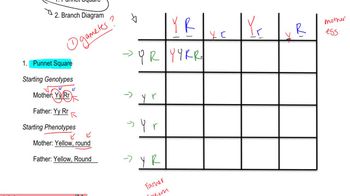
A dihybrid cross involves two traits, each controlled by different genes, typically represented by two pairs of alleles. In this scenario, the genes R and T are being studied, where each gene can have a dominant or recessive allele. The phenotypic ratios observed in the offspring result from the independent assortment of these alleles during gamete formation, leading to a variety of combinations in the F₂ generation.
Recommended video:
Guided course
15:24
Punnet Square

Dominant and Recessive Alleles

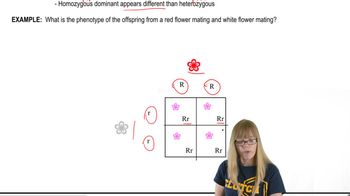
In genetics, dominant alleles are those that express their trait even when only one copy is present, while recessive alleles require two copies to manifest their trait. In this case, the dominant alleles R and T lead to pigment production, while their recessive counterparts are null alleles that do not produce any functional product. Understanding this distinction is crucial for predicting the phenotypic outcomes of the cross.
Recommended video:
Guided course
04:37
Variations on Dominance

Phenotypic Ratios

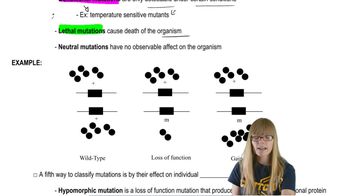
Phenotypic ratios represent the relative frequencies of different phenotypes in the offspring resulting from a genetic cross. In the given scenario, the ratio of 15/16 black to 1/16 white indicates that most offspring exhibit the dominant phenotype due to the presence of at least one dominant allele from either gene. This ratio can be explained through the interaction of the genes R and T in a biochemical pathway that leads to pigment production.
Recommended video:
Guided course
10:48
Mutations and Phenotypes
Related Practice
Textbook Question

Two genes interact to produce various phenotypic ratios among F₂ progeny of a dihybrid cross. Design a different pathway explaining each of the F₂ ratios below, using hypothetical genes R and T and assuming that the dominant allele at each locus catalyzes a different reaction or performs an action leading to pigment production. The recessive allele at each locus is null (loss-of-function). Begin each pathway with a colorless precursor that produces a white or albino phenotype if it is unmodified. The ratios are for F₂ progeny produced by crossing wild-type F₁ organisms with the genotype RrTt.

12/16 white : 3/16 green : 1/16 yellow

381
views
Textbook Question

Two genes interact to produce various phenotypic ratios among F₂ progeny of a dihybrid cross. Design a different pathway explaining each of the F₂ ratios below, using hypothetical genes R and T and assuming that the dominant allele at each locus catalyzes a different reaction or performs an action leading to pigment production. The recessive allele at each locus is null (loss-of-function). Begin each pathway with a colorless precursor that produces a white or albino phenotype if it is unmodified. The ratios are for F₂ progeny produced by crossing wild-type F₁ organisms with the genotype RrTt.

9/16 green : 3/16 yellow : 3/16 blue : 1/16 white

383
views
Textbook Question

Two genes interact to produce various phenotypic ratios among F₂ progeny of a dihybrid cross. Design a different pathway explaining each of the F₂ ratios below, using hypothetical genes R and T and assuming that the dominant allele at each locus catalyzes a different reaction or performs an action leading to pigment production. The recessive allele at each locus is null (loss-of-function). Begin each pathway with a colorless precursor that produces a white or albino phenotype if it is unmodified. The ratios are for F₂ progeny produced by crossing wild-type F₁ organisms with the genotype RrTt.

9/16 red : 7/16 white

432
views
Textbook Question

Two genes interact to produce various phenotypic ratios among F₂ progeny of a dihybrid cross. Design a different pathway explaining each of the F₂ ratios below, using hypothetical genes R and T and assuming that the dominant allele at each locus catalyzes a different reaction or performs an action leading to pigment production. The recessive allele at each locus is null (loss-of-function). Begin each pathway with a colorless precursor that produces a white or albino phenotype if it is unmodified. The ratios are for F₂ progeny produced by crossing wild-type F₁ organisms with the genotype RrTt.

9/16 black : 3/16 gray : 4/16 albino

408
views
Textbook Question

Two genes interact to produce various phenotypic ratios among F₂ progeny of a dihybrid cross. Design a different pathway explaining each of the F₂ ratios below, using hypothetical genes R and T and assuming that the dominant allele at each locus catalyzes a different reaction or performs an action leading to pigment production. The recessive allele at each locus is null (loss-of-function). Begin each pathway with a colorless precursor that produces a white or albino phenotype if it is unmodified. The ratios are for F₂ progeny produced by crossing wild-type F₁ organisms with the genotype RrTt.

13/16 white : 3/16 green

401
views
Textbook Question

The ABO blood group assorts independently of the rhesus (Rh) blood group and both assort independently of the MN blood group. Three alleles, IA, IB and i, occur at the ABO locus. Two alleles, R, a dominant allele producing Rh+, and r, a recessive allele for Rh-, are found at the Rh locus, and codominant alleles M and N occur at the MN locus. Each gene is autosomal.

A child with blood types A, Rh−, and M is born to a woman who has blood types O, Rh−, and MN and a man who has blood types A, Rh+, and M. Determine the genotypes of each parent.

435
views