Pearson+ LogoPearson+ Logo
Ch.4 Atoms and Elements
Timberlake - Chemistry: An Introduction to General, Organic, and Biological Chemistry 14th Edition
Timberlake14thChemistry: An Introduction to General, Organic, and Biological ChemistryISBN: 9781292472249Not the one you use?Change textbook
Chapter 4, Problem 96c

Complete the following statements:
c. Elements that are shiny and conduct heat are called _____.

Verified step by step guidance
1
Understand the question: The problem is asking for the term used to describe elements that are shiny and conduct heat. This is a conceptual question related to the properties of elements in chemistry.
Recall the classification of elements: Elements are broadly categorized into metals, nonmetals, and metalloids based on their physical and chemical properties.
Identify the properties mentioned: The question specifies 'shiny' and 'conduct heat,' which are characteristic properties of metals.
Connect the properties to the correct term: Metals are known for their luster (shiny appearance) and their ability to conduct heat and electricity efficiently.
Conclude the answer: The term that fits the description provided in the question is 'metals.'

Verified video answer for a similar problem:

This video solution was recommended by our tutors as helpful for the problem above.
Video duration:
1m
Was this helpful?

Key Concepts

Here are the essential concepts you must grasp in order to answer the question correctly.

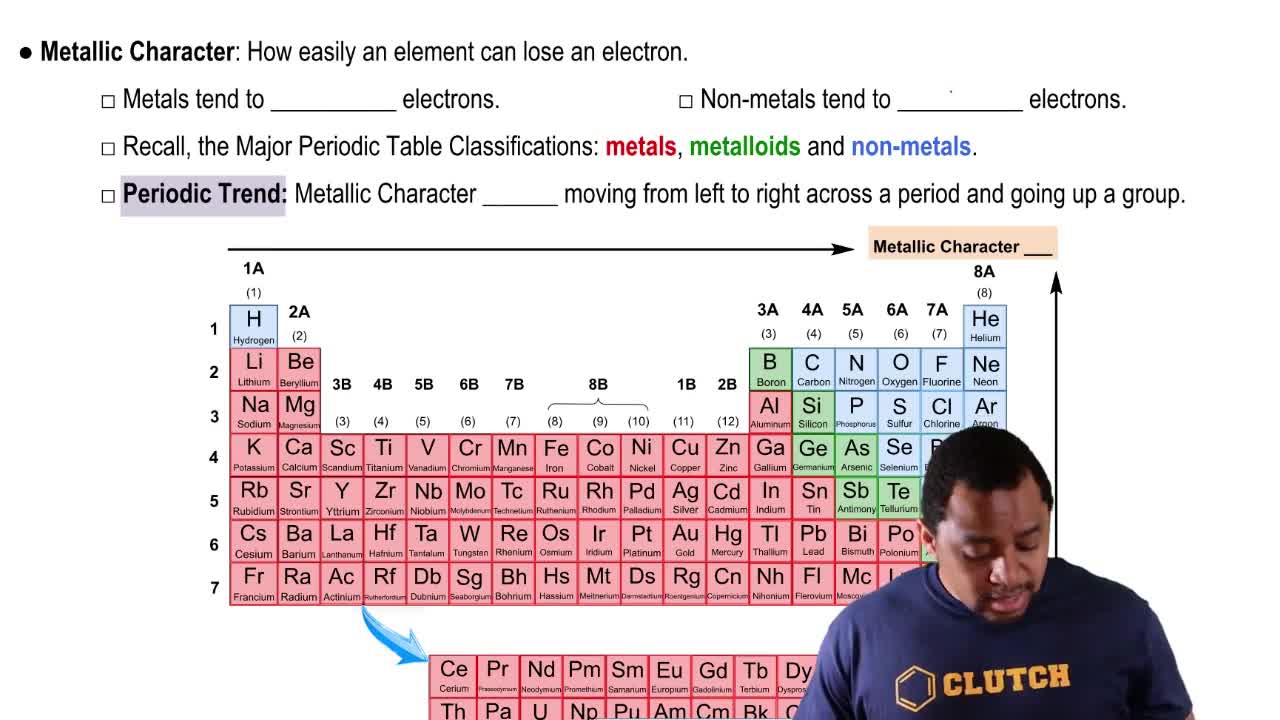
Metals

Metals are a category of elements characterized by their shiny appearance and ability to conduct heat and electricity. They typically have high melting and boiling points, and they are malleable and ductile, allowing them to be shaped into various forms. Common examples include iron, copper, and aluminum.
Recommended video:
Guided course
01:08
Periodic Trend: Metallic Character

Conductivity

Conductivity refers to the ability of a material to allow the flow of electric current or heat. In metals, free-moving electrons facilitate this process, making them excellent conductors. This property is essential in various applications, including electrical wiring and heat exchangers.
Recommended video:
Guided course
01:40
Intensive vs. Extensive Properties Example 2

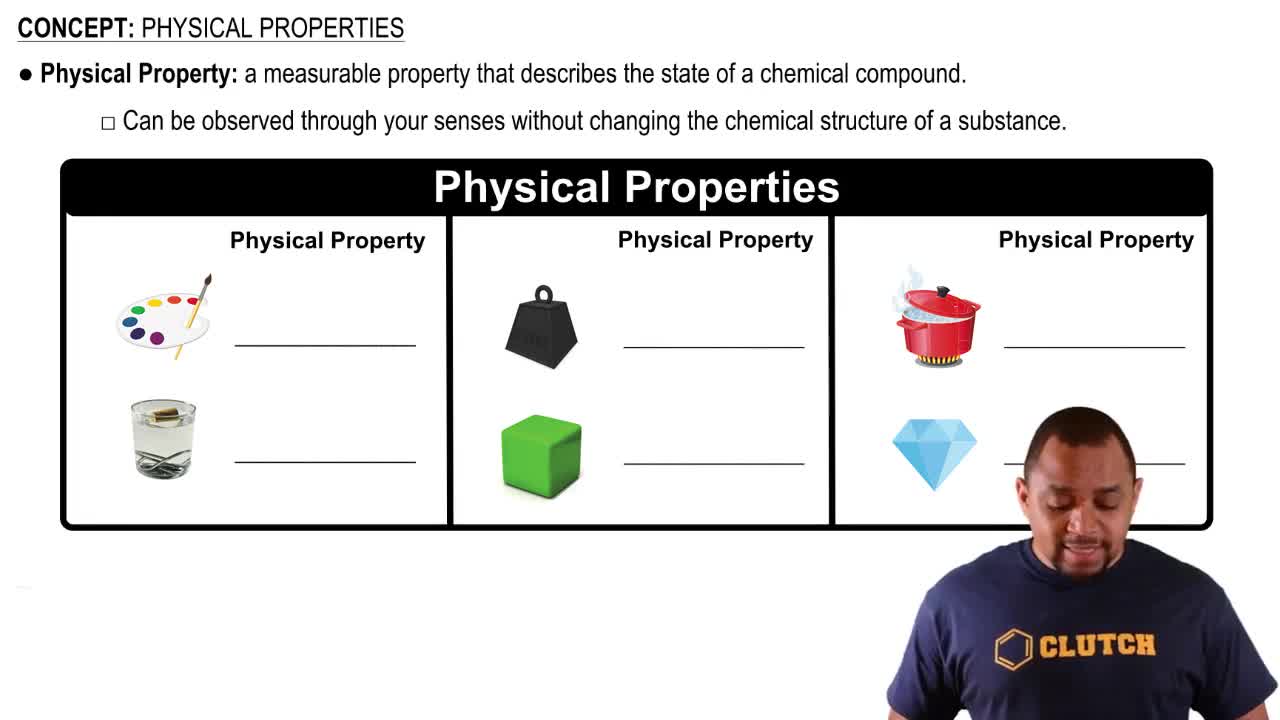
Physical Properties of Elements

Physical properties are characteristics that can be observed or measured without changing the substance's chemical identity. For metals, these properties include luster (shininess), malleability, ductility, and conductivity. Understanding these properties helps in identifying and classifying elements in the periodic table.
Recommended video:
Guided course
02:54
Physical Properties Concept