Pearson+ LogoPearson+ Logo
Ch.18 Metabolic Pathways and ATP Production
Timberlake - Chemistry: An Introduction to General, Organic, and Biological Chemistry 14th Edition
Timberlake14thChemistry: An Introduction to General, Organic, and Biological ChemistryISBN: 9781292472249Not the one you use?Change textbook
Chapter 18, Problem 77

Write the abbreviated equation for the hydrolysis of ADP to AMP. 

Verified step by step guidance
1
Understand the context: Hydrolysis is a chemical reaction where water is used to break a bond in a molecule. In this case, ADP (adenosine diphosphate) is hydrolyzed to form AMP (adenosine monophosphate) and an inorganic phosphate (Pi).
Identify the reactants: The reactants in this reaction are ADP and water (H₂O).
Identify the products: The products of the hydrolysis reaction are AMP and inorganic phosphate (Pi).
Write the abbreviated chemical equation: Combine the reactants and products into a single equation. The abbreviated equation is: ADP+H2OAMP+Pi
Verify the equation: Ensure that the equation is balanced and correctly represents the hydrolysis process, with one molecule of ADP reacting with water to produce AMP and Pi.

Key Concepts

Here are the essential concepts you must grasp in order to answer the question correctly.

Hydrolysis

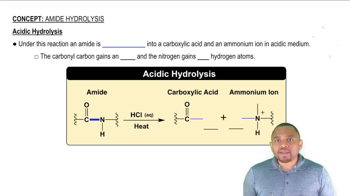
Hydrolysis is a chemical reaction involving the breakdown of a compound by the addition of water. In biological systems, hydrolysis is crucial for energy release, as it helps convert high-energy molecules into lower-energy products. For example, the hydrolysis of ATP to ADP and inorganic phosphate releases energy that cells use for various functions.
Recommended video:
Guided course
1:12
Acidic Hydrolysis Concept 1

ADP and AMP

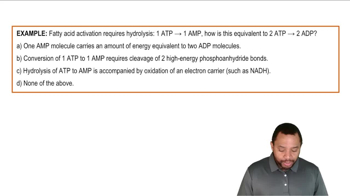
Adenosine diphosphate (ADP) and adenosine monophosphate (AMP) are nucleotides involved in cellular energy transfer. ADP is formed when ATP loses one phosphate group, while AMP is produced when ADP loses another phosphate group. Understanding the conversion between these molecules is essential for grasping energy metabolism in cells.
Recommended video:
Guided course
1:18
Oxidation of Fatty Acids Example 1

Energy Transfer in Cells

Energy transfer in cells primarily occurs through the phosphorylation and dephosphorylation of nucleotides like ATP, ADP, and AMP. The conversion of ADP to AMP through hydrolysis signifies a loss of energy potential, which is important in metabolic pathways. This process is vital for maintaining cellular functions and energy balance.
Recommended video:
Guided course
0:50
Cell Membranes Concept 1