 Back
BackAlcohols, Phenols, Thiols, and Ethers: Structure, Nomenclature, and Reactions
Study Guide - Smart Notes
 Tailored notes based on your materials, expanded with key definitions, examples, and context.
Ch.13 Alcohols, Phenols, Thiols, and Ethers
Concept: Naming Alcohols
Alcohols are organic compounds characterized by the presence of a hydroxyl (–OH) group attached to an sp3 hybridized carbon atom. The systematic naming of alcohols follows IUPAC rules, which are similar to those for alkanes but with modifications to indicate the presence of the alcohol functional group.
Step 1: Identify the longest carbon chain containing the –OH group (parent chain). Name it using the appropriate alkane prefix and modify the ending from -e to -ol (e.g., methane → methanol).
Step 2: Assign names to all substituents attached to the parent chain.
Step 3: Number the parent chain starting from the end nearest the –OH group. If there is a tie, start from the end closest to the next substituent; if still tied, use alphabetical order.
Step 4: Assign the numerical location to the carbon bearing the –OH group.
Step 5-6: Repeat steps for naming substituents and assembling the full name as in previous nomenclature topics.
Example: For a compound with a six-carbon chain and an –OH group on carbon 2, the name would be 2-hexanol.
Practice: Systematic naming exercises involve identifying the parent chain, numbering, and naming substituents for various alcohol structures.
Alcohol Classification
Alcohols are classified based on the number of alkyl groups attached to the carbon bearing the –OH group:
Primary (1°) Alcohol: The –OH group is attached to a carbon bonded to only one other carbon.
Secondary (2°) Alcohol: The –OH group is attached to a carbon bonded to two other carbons.
Tertiary (3°) Alcohol: The –OH group is attached to a carbon bonded to three other carbons.
Example: Ethanol (CH3CH2OH) is a primary alcohol; isopropanol ((CH3)2CHOH) is a secondary alcohol; tert-butanol ((CH3)3COH) is a tertiary alcohol.
Concept: Naming Thiols
Thiols (mercaptans) are organic compounds containing a sulfhydryl (–SH) group attached to a carbon atom. The naming rules for thiols are similar to those for alcohols, with the suffix -thiol added to the parent chain name.
Step 1: Identify the longest carbon chain containing the –SH group.
Step 2: Assign names to all substituents.
Step 3: Number the chain from the end closest to the –SH group. If a tie, use the next substituent or alphabetical order.
Step 4: Assign the numerical location to the carbon with the –SH group.
Example: 2-ethylcyclopentanethiol is a cyclopentane ring with an ethyl group at position 2 and an –SH group.
Concept: Naming Ethers
Ethers are compounds with an oxygen atom connected to two alkyl or aryl groups. Ethers can be named using common or IUPAC nomenclature:
Common Name: Name the two alkyl groups alphabetically, followed by the word "ether." If both groups are identical, use a numerical prefix (e.g., diethyl ether).
IUPAC Name: The smaller alkyl group and the oxygen are named as an alkoxy substituent (e.g., methoxy, ethoxy) on the parent hydrocarbon chain.
Example: CH3CH2OCH3 is called ethyl methyl ether (common) or methoxyethane (IUPAC).
Concept: Alcohol Reactions – Dehydration Reactions
Alcohols can undergo dehydration reactions in the presence of a strong acid (such as H2SO4), resulting in the formation of an alkene and water. The reaction follows Zaitsev’s Rule, which states that the more substituted alkene (the one with more alkyl groups attached to the double bond) is the major product.
General Reaction: Alcohol + H2SO4 → Alkene + H2O
Zaitsev’s Rule: The hydrogen is removed from the neighboring carbon with the fewest hydrogens.
Example: Dehydration of 2-butanol yields 2-butene as the major product.
Concept: Introduction to Redox Reactions
Redox (oxidation-reduction) reactions involve the transfer of electrons. In organic chemistry, oxidation typically increases the number of carbon-oxygen bonds, while reduction increases the number of carbon-hydrogen bonds.
Oxidation: Increase in C–O bonds or decrease in C–H bonds.
Reduction: Increase in C–H bonds or decrease in C–O bonds.
Example: The oxidation of a primary alcohol to an aldehyde or carboxylic acid; the reduction of a ketone to a secondary alcohol.
Concept: Alcohol Reactions – Oxidation Reactions
Alcohols can be oxidized using oxidizing agents such as potassium dichromate (K2Cr2O7) in sulfuric acid. The product depends on the class of alcohol:
Primary alcohols: Oxidize to aldehydes, then to carboxylic acids.
Secondary alcohols: Oxidize to ketones.
Tertiary alcohols: Do not oxidize under normal conditions.
Example: Oxidation of 1-propanol yields propanoic acid; oxidation of 2-propanol yields acetone.
Concept: Reactions of Thiols
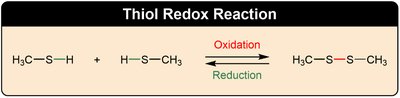
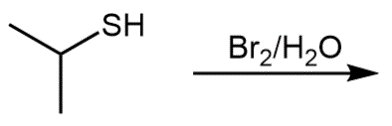
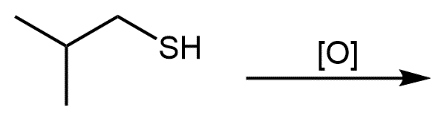
Thiols undergo oxidation to form disulfides. Two thiol molecules react with an oxidizing agent (such as Br2 or H2O2) to produce a disulfide (R–S–S–R) and water. The reverse reaction, reduction, converts disulfides back to thiols.
Oxidation: 2 RSH + [O] → RSSR + H2O
Reduction: RSSR + 2 H+ + 2 e– → 2 RSH
Example: The oxidation of ethanethiol yields diethyl disulfide.
Example: The reaction of isopropyl thiol with Br2/H2O produces a disulfide.
Example: The oxidation of isobutyl thiol yields a disulfide.
Summary Table: Classification of Alcohols
Type | Structure | Oxidation Product |
|---|---|---|
Primary (1°) | RCH2OH | Aldehyde → Carboxylic Acid |
Secondary (2°) | R2CHOH | Ketone |
Tertiary (3°) | R3COH | No reaction |
Key Equations
Alcohol Dehydration:
Alcohol Oxidation (Primary):
Alcohol Oxidation (Secondary):
Thiol Oxidation:
