 Back
BackAtoms and Elements: Structure, Properties, and the Periodic Table
Study Guide - Smart Notes
 Tailored notes based on your materials, expanded with key definitions, examples, and context.
Atoms and Elements
Elements and Symbols
Elements are pure substances consisting of only one type of atom. Each element is represented by a unique chemical symbol, usually derived from its English or Latin name. The periodic table organizes all known elements by their atomic number and properties.
Element: A substance that cannot be broken down into simpler substances by chemical means.
Chemical Symbol: One or two letters representing an element (e.g., Na for sodium).
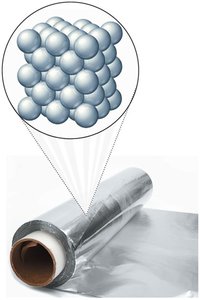
Example: Aluminium foil is made entirely of aluminium atoms.
The Atom
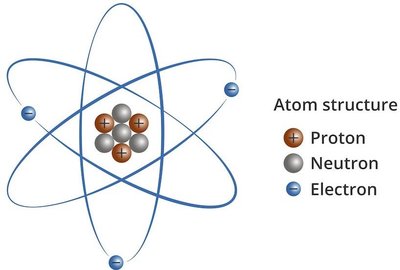
An atom is the smallest unit of an element that retains its chemical properties. Atoms are composed of three primary subatomic particles: protons, neutrons, and electrons.
Proton: Positively charged particle found in the nucleus.
Neutron: Uncharged particle found in the nucleus.
Electron: Negatively charged particle found outside the nucleus.
Nucleus: Small, dense, positively charged center of the atom containing protons and neutrons.
Electron Cloud: Region surrounding the nucleus where electrons are found.
Properties of Subatomic Particles
Subatomic particles have distinct properties, including charge, mass, and location within the atom. Their masses are measured in atomic mass units (amu).
Atomic Mass Unit (amu): A relative unit for measuring atomic and subatomic masses.
Proton: Charge = +1, Mass ≈ 1.007 amu, Location = Nucleus
Neutron: Charge = 0, Mass ≈ 1.008 amu, Location = Nucleus
Electron: Charge = -1, Mass ≈ 0.00055 amu, Location = Outside nucleus
Particle | Symbol | Charge | Mass (amu) | Location in Atom |
|---|---|---|---|---|
Proton | p or p+ | 1+ | 1.007 | Nucleus |
Neutron | n or n0 | 0 | 1.008 | Nucleus |
Electron | e- | 1− | 0.00055 | Outside nucleus |

Symbolic Representation of an Element
Atoms are represented symbolically using their element symbol, atomic number (Z), and mass number (A):
Atomic Number (Z): Number of protons in the atom.
Mass Number (A): Number of protons plus neutrons.
Neutral Atom: Number of electrons equals number of protons.
Example: For sodium (Na), , .
Protons: 11
Neutrons:
Electrons: 11 (neutral atom)
Determining the Composition of an Atom
To find the number of protons, neutrons, and electrons in an atom:
Protons = Atomic Number (Z)
Neutrons = Mass Number (A) − Atomic Number (Z)
Electrons = Number of protons (for neutral atoms)
Example: Boron (B), ,
Protons: 5
Neutrons:
Electrons: 5
Example: Iron (Fe), ,
Neutrons:
Example: Zinc (Zn), ,
Protons: 30
Neutrons:
Electrons: 30
Example: Gold (Au), ,
Neutrons:
Isotopes and Atomic Mass
Isotopes are atoms of the same element with different mass numbers due to varying numbers of neutrons. Isotopes have identical chemical properties but may differ in nuclear stability.
Same atomic number (Z), different mass number (A).
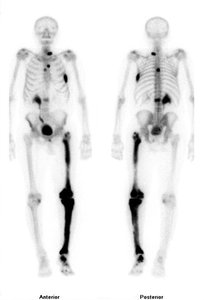
Some isotopes are radioactive and emit energy and particles.
Radioactive isotopes are used in medical diagnostics (e.g., Tc-99 for heart and bone scans).
80 elements have at least one stable isotope.
Example: Carbon isotopes
: 6 protons, 6 neutrons
: 6 protons, 7 neutrons
: 6 protons, 8 neutrons
The Periodic Law and the Periodic Table
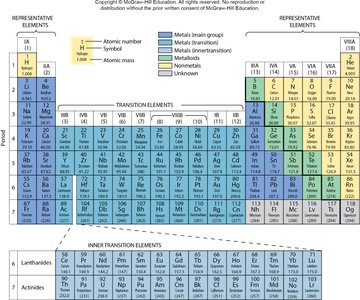
The periodic law states that the physical and chemical properties of elements are periodic functions of their atomic numbers. The periodic table arranges elements in rows (periods) and columns (groups) based on increasing atomic number and similar properties.
Period: Horizontal row in the periodic table.
Group: Vertical column in the periodic table.
Elements in the same group have similar chemical properties.
Groups and Element Properties
Groups in the periodic table are associated with characteristic properties:
Group 1A: Alkali metals (e.g., lithium, sodium, potassium) – highly reactive.
Group 2A: Alkaline earth metals (e.g., beryllium, magnesium, calcium) – reactive, but less than alkali metals.
Group 7A: Halogens (e.g., chlorine, bromine, iodine) – very reactive nonmetals.
Group 8A: Noble gases – least reactive elements.
Example: Potassium (K) is in Group 1A, Silicon (Si) is in Group 4A, Boron (B) is in Group 3A.
Summary Table: Subatomic Particles
Particle | Charge | Mass (amu) | Location |
|---|---|---|---|
Proton | +1 | 1.007 | Nucleus |
Neutron | 0 | 1.008 | Nucleus |
Electron | -1 | 0.00055 | Outside nucleus |
Key Equations
Mass Number:
Number of Neutrons:
Additional info:
Radioactive isotopes are used in medical imaging and diagnostics.
The periodic table is a fundamental tool for understanding chemical behavior and predicting element properties.
