Back
BackCarbohydrates: Structure, Properties, and Biological Significance
Study Guide - Smart Notes
 Tailored notes based on your materials, expanded with key definitions, examples, and context.
Carbohydrates
Introduction to Carbohydrates
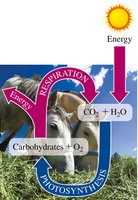
Carbohydrates are a major source of energy in the diet and are composed of carbon, hydrogen, and oxygen. They are also known as saccharides, meaning "sugars." Carbohydrates are produced by photosynthesis in plants and are oxidized in living cells to provide energy.
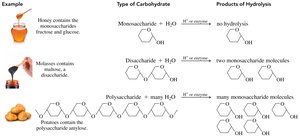
Monosaccharides: Simple sugars with three to seven carbon atoms.
Disaccharides: Composed of two monosaccharides.
Polysaccharides: Contain many monosaccharide units.
Classification of Monosaccharides
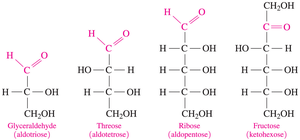
Monosaccharides are classified based on the presence of an aldehyde (aldose) or ketone (ketose) group and the number of carbon atoms.
Aldoses: Monosaccharides with an aldehyde group.
Ketoses: Monosaccharides with a ketone group.
Triose: Three carbon atoms.
Tetrose: Four carbon atoms.
Pentose: Five carbon atoms.
Hexose: Six carbon atoms.
Chiral Molecules
Chirality and Stereoisomers
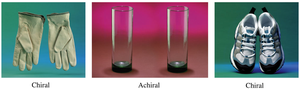
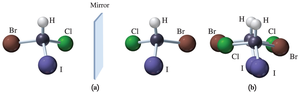
Chirality is a property where a molecule has a non-superimposable mirror image, similar to left and right hands. Chiral molecules have at least one carbon atom bonded to four different groups. Stereoisomers have the same molecular formula and sequence of bonded atoms but differ in spatial arrangement.
Enantiomers: Stereoisomers that are mirror images and cannot be superimposed.
Achiral: Molecules whose mirror images are superimposable.
Identifying Chiral Carbons
A chiral carbon is bonded to four different groups. The presence of chiral carbons leads to the existence of enantiomers.
Fischer Projections of Monosaccharides
Drawing Fischer Projections
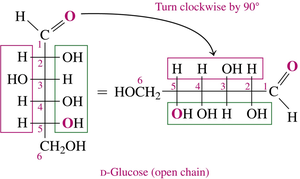
Fischer projections are two-dimensional representations of three-dimensional molecules. The most oxidized carbon is placed at the top, and chiral carbons are shown at the intersection of vertical and horizontal lines.
D and L Notations
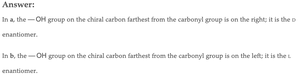
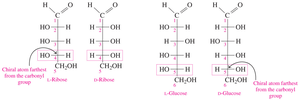
The D or L configuration is determined by the position of the hydroxyl group on the chiral carbon farthest from the carbonyl group.
D isomer: Hydroxyl group on the right.
L isomer: Hydroxyl group on the left.
Haworth Structures of Monosaccharides
Cyclic Structures
Pentose and hexose sugars form stable five- or six-membered rings called Haworth structures. The ring forms when a hydroxyl group reacts with the carbonyl group within the same molecule.
Alpha isomer: New hydroxyl group on carbon 1 below the ring.
Beta isomer: New hydroxyl group on carbon 1 above the ring.

Haworth Structures of Fructose
Fructose, a ketohexose, forms a five-membered ring when the hydroxyl group on carbon 5 reacts with the carbonyl group on carbon 2. 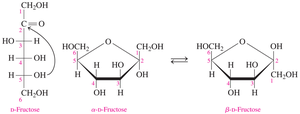
Chemical Properties of Monosaccharides
Oxidation and Reduction
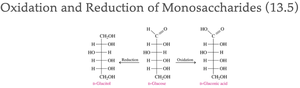
Oxidation: Aldose sugars can be oxidized to carboxylic acids. Ketose sugars can be rearranged and then oxidized.
Reduction: Carbonyl groups can be reduced to form sugar alcohols (alditols).
Reducing sugars: Monosaccharides with an aldehyde group in the open chain form that can be oxidized.
Disaccharides
Formation and Structure
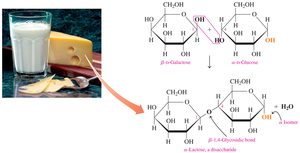
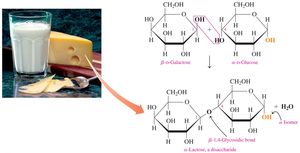
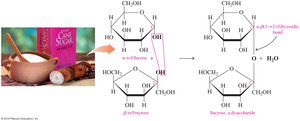
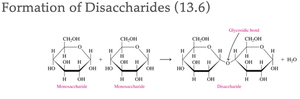
Disaccharides are formed by the linkage of two monosaccharides via a glycosidic bond, which is a dehydration reaction.
Maltose: Two D-glucose units linked by an α(1→4) glycosidic bond.
Lactose: D-galactose and D-glucose linked by a β(1→4) glycosidic bond.
Sucrose: D-glucose and D-fructose linked by an α(1→2) glycosidic bond.
Polysaccharides
Structure and Function
Polysaccharides are polymers of monosaccharide units, primarily glucose.
Amylose: Unbranched chain of glucose with α(1→4) bonds.
Amylopectin: Branched polymer of glucose with α(1→4) and α(1→6) bonds.
Glycogen: Highly branched polymer of glucose, similar to amylopectin but with more frequent branching.
Cellulose: Unbranched polymer of glucose with β(1→4) bonds; provides structural support in plants and is not digestible by humans.
Summary Table: Types of Carbohydrates
Type | Structure | Example | Bond Type |
|---|---|---|---|
Monosaccharide | Single unit | Glucose | None |
Disaccharide | Two units | Maltose, Lactose, Sucrose | Glycosidic |
Polysaccharide | Many units | Amylose, Amylopectin, Glycogen, Cellulose | α(1→4), α(1→6), β(1→4) |
Key Equations
Photosynthesis
Respiration
Oxidation of Aldose
Reduction of Monosaccharide
Summary
Carbohydrates are essential biomolecules with diverse structures and functions. Their classification, stereochemistry, and chemical properties are fundamental to understanding their biological roles and their importance in health and disease.