 Back
BackCarboxylic Acids, Esters, Amines, and Amides: Structure, Properties, and Reactions
Study Guide - Smart Notes
 Tailored notes based on your materials, expanded with key definitions, examples, and context.
Carboxylic Acids, Esters, Amines, and Amides
Introduction
This chapter explores the structure, nomenclature, properties, and reactions of four important classes of organic compounds: carboxylic acids, esters, amines, and amides. These compounds are essential in biological systems and industrial applications, and understanding their chemistry is fundamental for students of general, organic, and biological chemistry.
Carboxylic Acids
Structure and Nomenclature
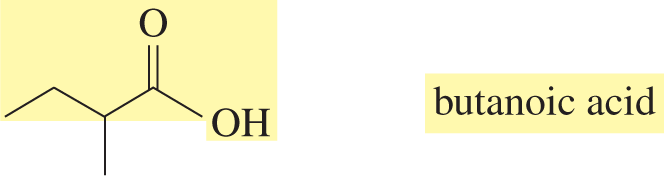
Carboxylic acids contain the carboxyl group (-COOH), which consists of a carbonyl group bonded to a hydroxyl group. The IUPAC naming system replaces the -e ending of the parent alkane with -oic acid. Common names are also widely used, especially for the simplest acids.
Example: Methanoic acid (formic acid), Ethanoic acid (acetic acid), Propanoic acid (propionic acid), Butanoic acid (butyric acid).
Number the carbon chain starting from the carboxyl carbon (always carbon 1).
Substituents are named and numbered as in alkanes.

Properties of Carboxylic Acids
Carboxylic acids are polar due to the presence of both a carbonyl and a hydroxyl group.
They form hydrogen bonds with water, making those with 1–5 carbons highly soluble in water.
They are weak acids, partially ionizing in water to produce carboxylate ions and hydronium ions.
General dissociation equation:

Neutralization of Carboxylic Acids
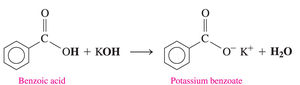
Carboxylic acids react with strong bases (e.g., NaOH, KOH) to form carboxylate salts and water. These salts are often used as preservatives and flavor enhancers.

Esters
Structure and Nomenclature
Esters are derived from carboxylic acids and alcohols. The hydrogen in the carboxyl group is replaced by an alkyl group from the alcohol. Esters are named with two words: the alkyl group from the alcohol and the carboxylate name from the acid (replace -ic acid with -ate).
Example: Ethyl ethanoate (ethyl acetate), Methyl propanoate (methyl propionate).

Preparation of Esters (Esterification)
Esterification is the reaction of a carboxylic acid with an alcohol in the presence of an acid catalyst and heat, producing an ester and water.

Hydrolysis of Esters
Esters can be hydrolyzed by water in the presence of acid (acid hydrolysis) or base (base hydrolysis/saponification):
Acid hydrolysis: Produces a carboxylic acid and an alcohol.
Base hydrolysis (saponification): Produces a carboxylate salt and an alcohol.
Acid hydrolysis:
Base hydrolysis:

Amines
Structure and Classification
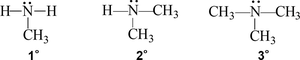
Amines are derivatives of ammonia (NH3) in which one or more hydrogen atoms are replaced by alkyl or aromatic groups. They are classified as:
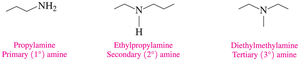
Primary (1°): One carbon group attached to nitrogen
Secondary (2°): Two carbon groups attached to nitrogen
Tertiary (3°): Three carbon groups attached to nitrogen
Naming Amines
Simple amines are named as alkylamines, listing the alkyl groups in alphabetical order followed by "amine".
Aromatic amines are named as derivatives of aniline.
Properties of Amines
Primary and secondary amines with up to six carbons are soluble in water due to hydrogen bonding.
Tertiary amines are less soluble as the hydrocarbon portion increases.
Amines act as Bases in water, accepting a proton to form an ammonium ion and a hydroxide ion:
Reactions of Amines
Amines react with acids to form ammonium salts, which are ionic, water-soluble, and odorless.
Amides
Structure and Nomenclature
Amides are derivatives of carboxylic acids in which the hydroxyl group is replaced by an amino group (NH2, NHR, or NR2). They are named by replacing -oic acid or -ic acid with -amide. Substituents on the nitrogen are indicated with the prefix N-.
Example: Ethanamide (acetamide), N-methylbutanamide


Preparation of Amides (Amidation)
Amides are formed by the reaction of a carboxylic acid with ammonia or a primary/secondary amine, with the elimination of water.
Hydrolysis of Amides
Acid hydrolysis: Produces a carboxylic acid and an ammonium salt.
Base hydrolysis: Produces a carboxylate salt and an amine or ammonia.
Base hydrolysis example:

Summary Table: Key Reactions and Properties
Class | General Formula | Key Reaction | Product(s) |
|---|---|---|---|
Carboxylic Acid | RCOOH | Neutralization with base | Carboxylate salt + H2O |
Ester | RCOOR' | Hydrolysis (acid/base) | Carboxylic acid + Alcohol / Carboxylate salt + Alcohol |
Amine | RNH2, R2NH, R3N | Reaction with acid | Ammonium salt |
Amide | RCONH2 | Hydrolysis (acid/base) | Carboxylic acid + Ammonium salt / Carboxylate salt + Amine |
Practice Problems and Applications
Write IUPAC names for given carboxylic acids and esters.
Draw condensed or line-angle formulas for amines and amides.
Predict products of hydrolysis and neutralization reactions.
Classify amines as primary, secondary, or tertiary based on structure.
