Back
BackComprehensive Study Guide for General Chemistry Final Exam and Lab Practicum
Study Guide - Smart Notes
 Tailored notes based on your materials, expanded with key definitions, examples, and context.
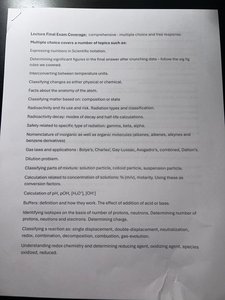
Lecture Final Exam Coverage
Overview of Exam Format
The final exam consists of multiple-choice and short-answer questions, including calculations. It covers a wide range of fundamental chemistry concepts relevant to introductory college chemistry.
Multiple choice: Covers a broad selection of topics.
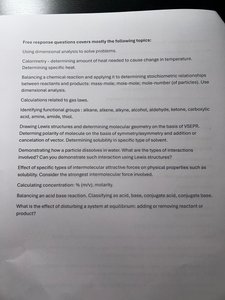
Short answer: Includes calculations and conceptual explanations.
Scientific Method and Measurement
Understanding the scientific method and accurate measurement is foundational in chemistry.
Scientific method: Systematic approach to experimentation and observation.
Measurement: Use of proper units, precision, and significant figures.
Dimensional analysis: Technique for converting between units.
Classification of Matter
Chemistry involves classifying substances based on their physical and chemical properties.
States of matter: Solid, liquid, gas.
Physical vs. chemical changes: Physical changes do not alter chemical identity; chemical changes do.
Classification: Elements, compounds, mixtures.
Energy and Temperature
Energy and temperature are key concepts in understanding chemical reactions and physical changes.
Temperature units: Celsius, Kelvin, Fahrenheit.
Heat: Energy transfer due to temperature difference.
Calorimetry: Measurement of heat changes in reactions.
Atomic Structure and Elements
Atoms are the basic units of matter, composed of protons, neutrons, and electrons.
Atomic number: Number of protons in an atom.
Mass number: Sum of protons and neutrons.
Isotopes: Atoms of the same element with different numbers of neutrons.
Periodic table: Organization of elements by atomic number and properties.
Nuclear Chemistry
Nuclear chemistry studies changes in atomic nuclei, including radioactive decay.
Types of radiation: Alpha, beta, gamma.
Half-life: Time for half of a radioactive sample to decay.
Chemical Bonding and Molecular Geometry
Chemical bonds form between atoms to create molecules and compounds.
Ionic bonds: Transfer of electrons between atoms.
Covalent bonds: Sharing of electrons.
Lewis structures: Diagrams showing electron arrangement.
VSEPR theory: Predicts molecular geometry based on electron pair repulsion.
Chemical Reactions and Stoichiometry
Chemical reactions involve the transformation of substances via breaking and forming bonds.
Balancing equations: Ensures conservation of mass.
Stoichiometry: Calculation of reactant and product quantities.
Mole concept: Relates mass, number of particles, and volume.
Types of reactions: Combination, decomposition, displacement, acid-base, redox.
Acids, Bases, and Equilibrium
Acids and bases are classified by their ability to donate or accept protons.
pH and pOH: Measures of acidity and basicity.
Buffers: Solutions that resist changes in pH.
Equilibrium: State where forward and reverse reactions occur at equal rates.
Organic Chemistry and Functional Groups
Organic chemistry focuses on carbon-containing compounds and their functional groups.
Hydrocarbons: Alkanes, alkenes, alkynes, aromatics.
Functional groups: Alcohols, ethers, aldehydes, ketones, carboxylic acids, amines, amides.
Drawing structures: Lewis structures, molecular geometry.
Biochemistry: Carbohydrates, Lipids, Proteins, Nucleic Acids
Biochemistry examines the structure and function of biological molecules.
Carbohydrates: Sugars and polysaccharides.
Lipids: Fats, oils, phospholipids.
Proteins: Amino acids, enzymes.
Nucleic acids: DNA, RNA, protein synthesis.
Metabolic Pathways and ATP Production
Metabolism involves chemical reactions that sustain life, including energy production.
ATP: Main energy carrier in cells.
Pathways: Glycolysis, citric acid cycle, oxidative phosphorylation.
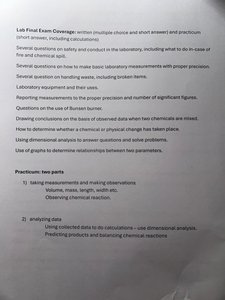
Lab Final Exam Coverage
Lab Skills and Safety
Lab exams assess practical skills, safety, and precision in measurements.
Lab safety: Proper conduct, handling chemicals, broken glass, and equipment.
Measurement: Use of correct units, precision, and significant figures.
Observations: Recording and interpreting data.
Experimental Techniques
Common laboratory techniques include using Bunsen burners, measuring mass and volume, and analyzing chemical reactions.
Dimensional analysis: Used to convert units and analyze data.
Graphing: Determining relationships between variables.
Balancing reactions: Ensuring correct stoichiometry in experiments.
Lab Practicum Structure
The practicum consists of two main parts: making observations and analyzing data.
Taking measurements: Mass, volume, length, and observing chemical reactions.
Analyzing data: Calculations, unit conversions, dimensional analysis, and balancing chemical reactions.
Key Equations and Concepts
Significant Figures
Significant figures reflect the precision of measurements.
Rules: All nonzero digits are significant; zeros between significant digits are significant; trailing zeros in decimals are significant.
Dimensional Analysis
Dimensional analysis is used to convert between units.
Example:
Mole Concept
The mole is a fundamental unit for counting particles in chemistry.
Equation:
Balancing Chemical Equations
Balancing equations ensures conservation of mass.
Example:
pH Calculation
pH measures the acidity of a solution.
Equation:
Calorimetry
Calorimetry measures heat changes in reactions.
Equation: where is heat, is mass, is specific heat, and is temperature change.
Sample HTML Table: Functional Groups
The following table summarizes common organic functional groups:
Functional Group | Structure | Example |
|---|---|---|
Alcohol | R-OH | Ethanol |
Aldehyde | R-CHO | Formaldehyde |
Ketone | R-CO-R' | Acetone |
Carboxylic Acid | R-COOH | Acetic acid |
Amine | R-NH2 | Methylamine |
Amide | R-CONH2 | Acetamide |
Relevant Images
Images are included only when they directly clarify or reinforce the explanation of a paragraph.