 Back
BackElectronegativity, Bond Polarity, Molecular Shape, and Intermolecular Forces
Study Guide - Smart Notes
 Tailored notes based on your materials, expanded with key definitions, examples, and context.
Electronegativity and Bond Polarity
Electronegativity
Electronegativity is a measure of an atom's ability to attract shared electrons in a chemical bond. It is a fundamental property that influences the type and polarity of chemical bonds formed between atoms.
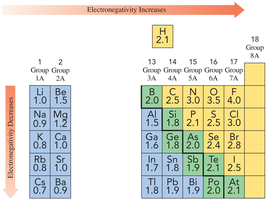
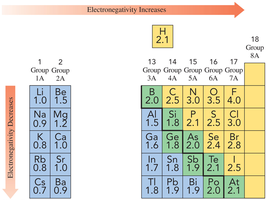
Trends in the Periodic Table: Electronegativity increases from left to right across a period and from bottom to top within a group.
Nonmetals generally have higher electronegativity values, with fluorine being the most electronegative element.
Metals have lower electronegativity values.

Bond Polarity
The polarity of a bond depends on the difference in electronegativity between the two atoms involved:
Nonpolar Covalent Bonds: Electrons are shared equally (e.g., H2, Cl2), typically between identical nonmetals or atoms with very similar electronegativity values.
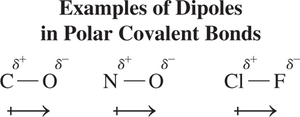
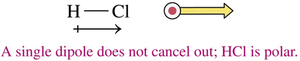
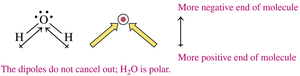
Polar Covalent Bonds: Electrons are shared unequally, resulting in partial charges (δ+ and δ-) on the atoms (e.g., HCl, H2O). The greater the electronegativity difference, the more polar the bond.
Examples of Dipoles in Polar Covalent Bonds
Predicting Bond Type Using Electronegativity Difference
Nonpolar Covalent: Electronegativity difference < 0.5
Polar Covalent: Electronegativity difference between 0.5 and 1.7
Ionic: Electronegativity difference > 1.7
Molecular Geometry: VSEPR Theory
Valence Shell Electron-Pair Repulsion (VSEPR) Theory
VSEPR theory is used to predict the three-dimensional shapes of molecules based on the repulsion between electron groups (bonding and lone pairs) around a central atom.
Electron groups are arranged as far apart as possible to minimize repulsion.
The number of electron groups determines the molecular geometry.
Each of the following counts as one electron group: a lone pair, a single bond, a double bond, or a triple bond.
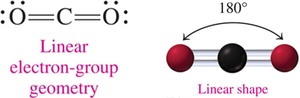
Linear Geometry Example: CO2
Two electron groups around the central atom
Bond angle: 180°
Shape: Linear
Other Common Molecular Shapes
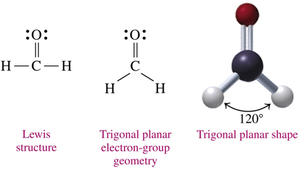
Trigonal Planar: Three electron groups, 120° bond angles (e.g., H2CO)
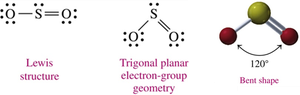
Bent: Two bonds and one or more lone pairs (e.g., SO2)
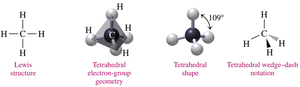
Tetrahedral: Four electron groups, 109° bond angles (e.g., CH4)
Polarity of Molecules
Nonpolar Molecules
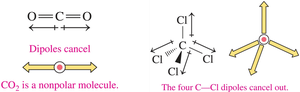
A molecule is nonpolar if it contains only nonpolar bonds or if the dipoles in polar bonds cancel each other out due to the molecule's symmetry.
Examples: CO2, CCl4
Polar Molecules
A molecule is polar if it contains polar bonds and the dipoles do not cancel out, resulting in a molecule with a positive end and a negative end.
Examples: HCl, H2O
Determining Molecular Polarity: Steps
Determine if the bonds are polar covalent or nonpolar covalent using electronegativity values.
If the bonds are polar covalent, draw the Lewis structure and determine if the dipoles cancel.
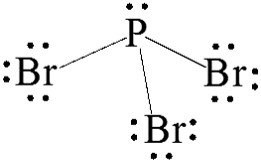
Example: PBr3
P = 2.1, Br = 2.8 (polar covalent)
Shape: Trigonal pyramidal (one lone pair on P)
Result: Polar molecule
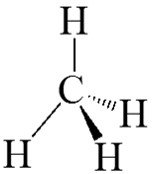
Example: CH4
C = 2.5, H = 2.1 (nonpolar covalent)
Shape: Tetrahedral
Result: Nonpolar molecule (dipoles cancel)
Intermolecular Forces
Types of Attractive Forces
Ionic Bonds: Strongest attractive forces, typically found in ionic compounds (e.g., NaCl). Solids at room temperature.
Dipole-Dipole Attractions: Present in polar covalent compounds; positive end of one molecule is attracted to the negative end of another.
Hydrogen Bonds: Special type of dipole-dipole attraction; occurs when H is bonded to F, O, or N. Strongest force between molecules, important in biological molecules like DNA.
Dispersion Forces: Weak attractions between nonpolar molecules due to temporary dipoles.
Note: Melting point is related to the strength of attractive forces. Compounds with weak forces (dispersion) have lower melting points, while those with strong forces (hydrogen bonds) have higher melting points.
Summary Table: Types of Intermolecular Forces
Type of Force | Occurs Between | Relative Strength | Example |
|---|---|---|---|
Ionic Bonds | Ions | Strongest | KCl |
Hydrogen Bonds | H bonded to F, O, or N | Very Strong (for molecules) | H2O, NH3 |
Dipole-Dipole | Polar molecules | Moderate | HCl |
Dispersion Forces | Nonpolar molecules | Weakest | Br2 |
References
Timberlake, K. (2018). Chemistry: An Introduction to General, Organic and Biological Chemistry (13th ed.). Pearson Education.
