 Back
BackGas Laws and Properties: Kinetic Molecular Theory and Fundamental Gas Laws
Study Guide - Smart Notes
 Tailored notes based on your materials, expanded with key definitions, examples, and context.
Gas Laws and Properties
Kinetic Molecular Theory of Gases
The Kinetic Molecular Theory provides a model for understanding the behavior of gases. It explains how gas particles move and interact, and forms the basis for the gas laws.
Random Motion: Gas consists of small particles that move randomly with high velocity, resulting in no definite shape.
Weak Attractive Forces: The attractive forces between gas particles are minimal, so particles are far apart.
Volume: The actual volume occupied by gas molecules is extremely small compared to the volume the gas occupies; gases fill any container and are easily compressed.
Constant Motion: Gas particles move rapidly in straight paths, exerting pressure on the container walls.
Kinetic Energy and Temperature: The average kinetic energy of gas molecules is proportional to the Kelvin temperature; higher temperature means faster movement and greater pressure.
Pressure: Gas particles colliding with container walls exert pressure.

Properties of Gases
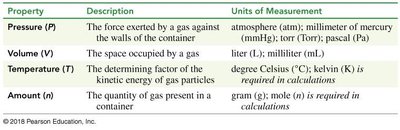
Four basic properties describe gases: Pressure, Volume, Temperature, and Amount. These properties are fundamental to understanding gas behavior and calculations.
Pressure (P): The force exerted by gas particles against the walls of the container. Measured in atmosphere (atm), millimeter of mercury (mmHg), torr (Torr), pascal (Pa), and pounds per square inch (psi).
Volume (V): The space occupied by a gas, equal to the size of the container. Measured in liters (L) and milliliters (mL).
Temperature (T): The determining factor of the kinetic energy of gas particles. Measured in degree Celsius (°C) and Kelvin (K); Kelvin is required for calculations.
Amount (n): The quantity of gas present, measured in grams (g) or moles (n); moles are required for calculations.
Property | Description | Units of Measurement |
|---|---|---|
Pressure (P) | The force exerted by a gas against the walls of the container | atmosphere (atm); millimeter of mercury (mmHg); torr (Torr); pascal (Pa) |
Volume (V) | The space occupied by a gas | liter (L); milliliter (mL) |
Temperature (T) | The determining factor of the kinetic energy of gas particles | degree Celsius (°C); kelvin (K) required in calculations |
Amount (n) | The quantity of gas present in a container | gram (g); mole (n) required in calculations |
Pressure and Atmospheric Pressure
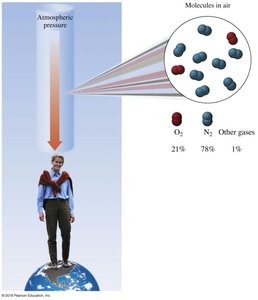
Pressure is created when gas particles collide with the walls of their container. Atmospheric pressure is the pressure exerted by air molecules (mainly O2 and N2) on Earth's surface. Atmospheric pressure decreases with altitude due to fewer air particles.
Standard atmospheric pressure: 1 atm = 760 mmHg = 760 Torr = 101.325 kPa = 14.7 psi
Measurement: Atmospheric pressure is measured with a barometer.
Formula: Pressure is calculated as:
Volume and Temperature
The volume of a gas is determined by the size of its container. Temperature is directly related to the kinetic energy of gas particles; higher temperature means faster movement and greater pressure (if volume and amount are constant).
Volume units: Liters (L), milliliters (mL)
Temperature units: Kelvin (K) is used for all gas law calculations
Kinetic energy: Doubling the temperature in Kelvin doubles the kinetic energy and pressure (if volume and amount are constant)
Amount of Gas (n)
The amount of gas is usually measured by mass (grams), but gas law calculations require the use of moles (n).
Conversion: Grams of gas must be converted to moles for calculations
Gas Laws
Gas laws describe the relationships between pressure, volume, temperature, and amount of gas. When one property changes, others may change as well.
Boyle’s Law: Pressure & Volume
Boyle’s Law states that the volume of a gas is inversely proportional to its pressure, provided temperature and amount of gas remain constant.
Formula:
Application: If pressure increases, volume decreases, and vice versa.
Example: A sample of oxygen gas has a volume of 12.0 L at a pressure of 600 mmHg. What is the final pressure when the volume changes to 36.0 L (at constant T and n)?
Charles’ Law: Temperature & Volume
Charles’s Law states that the volume of a gas is directly proportional to its temperature (in Kelvin), provided pressure and amount of gas remain constant.
Formula:
Application: If temperature increases, volume increases, and vice versa.
Example: A sample of oxygen gas has a volume of 420 mL at a temperature of 18°C. At what temperature (in °C) will the volume be 640 mL (P and n are constant)?
Gay-Lussac’s Law: Temperature & Pressure
Gay-Lussac’s Law states that the pressure of a gas is directly proportional to its temperature (in Kelvin), provided volume and amount of gas remain constant.
Formula:
Application: If temperature increases, pressure increases, and vice versa.
Example: A gas has a pressure of 645 Torr at 128°C. What is the temperature (in °C) if the pressure increases to 824 Torr (V and n remain constant)?
Atmospheric Pressure and Boiling Point
Atmospheric pressure affects the boiling point of water. At higher altitudes, atmospheric pressure is lower, so water boils at a lower temperature than at sea level.
Explanation: Lower atmospheric pressure means less energy is required for water molecules to escape into the gas phase, resulting in a lower boiling point.
References: Timberlake, K. (2018). Chemistry: Introduction to general, organic and biological chemistry (13th ed.). Pearson Education.
