 Back
BackGas Laws: Combined, Avogadro’s, STP, and Dalton’s Law
Study Guide - Smart Notes
 Tailored notes based on your materials, expanded with key definitions, examples, and context.
Gas Laws
Combined Gas Law
The Combined Gas Law integrates the relationships between pressure, volume, and temperature for a fixed amount of gas. It is useful for predicting how changes in two variables affect the third, provided the number of moles remains constant.
Formula:
Variables: P = pressure, V = volume, T = temperature (in Kelvin)
Application: Used to solve problems where two of the three variables change and the amount of gas is constant.
Example: If a sample of helium gas has a volume of 0.180 L, a pressure of 0.800 atm, and a temperature of 29°C, you can use the Combined Gas Law to find the new temperature when the volume and pressure change.
Avogadro’s Law: Volume and Moles
Avogadro’s Law states that the volume of a gas is directly proportional to the number of moles, provided temperature and pressure are constant. This law is fundamental for understanding how adding or removing gas affects its volume.
Formula:
Variables: V = volume, n = number of moles
Application: Used to calculate the new volume when the amount of gas changes.
Example: A weather balloon with a volume of 44 L is filled with 2.0 moles of helium. If 3.0 moles are added (total 5.0 moles), Avogadro’s Law can be used to find the final volume.
Standard Temperature and Pressure (STP)
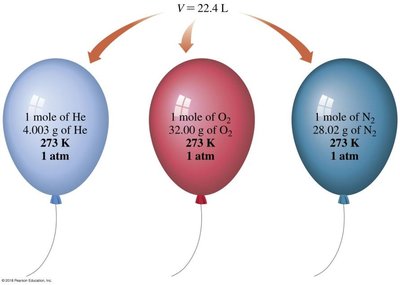
STP is a set of conditions used for comparing gases. At STP, 1 mole of any ideal gas occupies the same volume, regardless of its identity.
STP Conditions:
Temperature: 273 K (0°C)
Pressure: 1 atm (760 mmHg)
Molar Volume: 1 mole of gas = 22.4 L at STP
Conversion Factors:
22.4 L (STP) per 1 mole gas
1 mole gas per 22.4 L (STP)
Example: To find the volume at STP of 4.0 moles of CH4, multiply 4.0 moles by 22.4 L/mole.
Dalton’s Law of Partial Pressures
Dalton’s Law describes the behavior of gas mixtures. Each gas in a mixture exerts its own pressure, called partial pressure, and the total pressure is the sum of all partial pressures.
Formula:
Application: Used to determine the total pressure or the partial pressure of a component in a gas mixture.
Example: In a scuba tank with a total pressure of 8.00 atm, if oxygen has a partial pressure of 1280 mmHg, Dalton’s Law can be used to find the partial pressure of helium.
Key Point: All gas particles behave the same way in a mixture, and their individual pressures add up to the total pressure.
Summary Table: Gas Laws and Their Applications
Law | Formula | Variables | Application |
|---|---|---|---|
Combined Gas Law | P, V, T | Predicts changes in state variables | |
Avogadro’s Law | V, n | Relates volume to moles | |
Dalton’s Law | P (partial pressures) | Calculates total pressure in mixtures | |
STP | 1 mole gas = 22.4 L at STP | n, V | Standard comparison for gases |
