 Back
BackIntroduction to Organic Chemistry: Hydrocarbons – Study Guide
Study Guide - Smart Notes
 Tailored notes based on your materials, expanded with key definitions, examples, and context.
Introduction to Organic Chemistry: Hydrocarbons
Organic Compounds
Organic chemistry is the study of compounds containing carbon, typically bonded with hydrogen and sometimes other elements such as oxygen, nitrogen, sulfur, phosphorus, or halogens. Organic compounds are prevalent in everyday products like fuels, medicines, plastics, and perfumes.
Key Properties: Organic compounds usually have covalent bonds, low melting and boiling points, are flammable, and are not soluble in water.
Formula Convention: Formulas are written with carbon first, then hydrogen, followed by other elements.
Comparison: Inorganic compounds often have high melting/boiling points, are ionic, soluble in water, and do not burn in air.
Example: Vegetable oil is an organic compound, not soluble in water, while table salt (NaCl) is inorganic and soluble.
Hydrocarbons
Hydrocarbons are organic compounds composed only of carbon and hydrogen. Each carbon atom forms four bonds, and hydrocarbons can be classified as saturated (only single bonds) or unsaturated (double or triple bonds).
Saturated Hydrocarbons: Alkanes, containing only single bonds.
Unsaturated Hydrocarbons: Alkenes (double bonds) and alkynes (triple bonds).
Methane (CH4)
Methane is the simplest hydrocarbon, with a tetrahedral geometry and bond angles of 109°.
Representations: Space-filling model, ball-and-stick model, wedge-dash model, expanded structural formula, condensed structural formula.

Ethane (C2H6)
Ethane consists of two tetrahedral carbon atoms, each bonded to three hydrogens and one other carbon.
Alkanes
Alkanes are hydrocarbons with only single bonds, forming continuous chains or rings. They are named using the IUPAC system, with names ending in "-ane" and Greek prefixes for chains with five or more carbons.
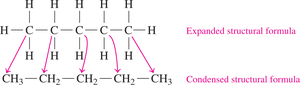
Structural Formulas: Expanded (shows all bonds), condensed (groups hydrogens with carbons), line-angle (zigzag lines for carbon skeleton).
Sample Problem: Drawing Alkane Formulas
To draw pentane:
Draw the carbon chain (five carbons).
Add hydrogen atoms to each carbon (expanded formula).
Combine hydrogens with carbons (condensed formula).
Draw a zigzag line (line-angle formula).


Cycloalkanes
Cycloalkanes are cyclic alkanes with two fewer hydrogens than their open-chain counterparts. They are named with the prefix "cyclo-" before the alkane name.
Structural Isomers
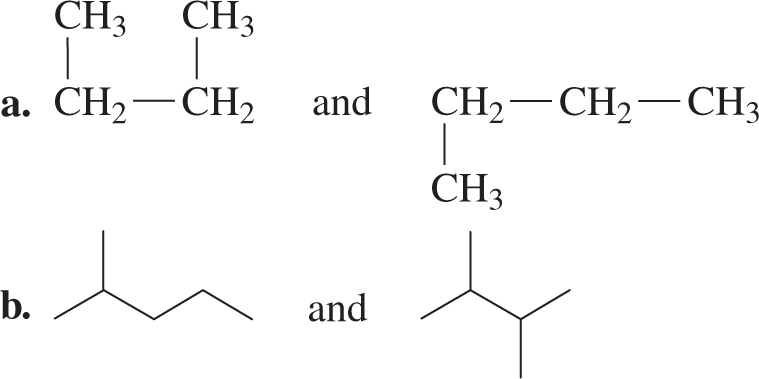
Structural isomers have the same molecular formula but different arrangements of atoms. Isomers differ in the order of bonding, leading to distinct compounds.
Example: C6H14 can have different chain arrangements.
Alkanes with Substituents
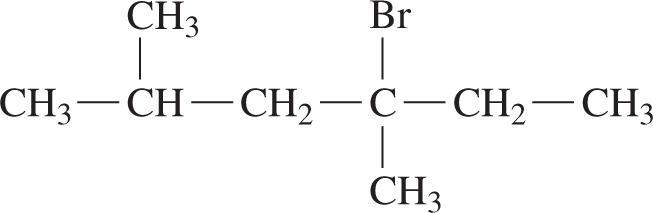
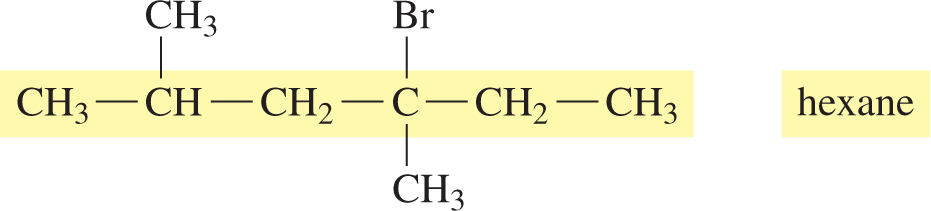
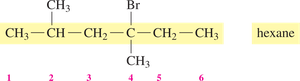
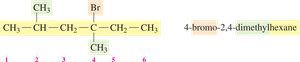
Substituents are groups attached to the main carbon chain, including alkyl groups (named with "-yl") and halogens (fluoro, chloro, bromo, iodo). The IUPAC naming involves identifying the longest chain, numbering from the end nearest a substituent, and listing substituents alphabetically.
Example: 3-bromo-1-chlorobutane
Properties of Alkanes
Alkanes are nonpolar, insoluble in water, less dense than water, and flammable. Their physical properties determine their uses:
1–4 carbons: gases, used as fuels
5–8 carbons: liquids, volatile, used in fuels
9–17 carbons: liquids with higher boiling points, found in oils and fuels
18+ carbons: waxy solids, used in products like petroleum jelly
Combustion of Alkanes
Alkanes react with oxygen in combustion reactions, producing carbon dioxide, water, and energy.
General Equation:
Alkenes and Alkynes
Alkenes contain at least one carbon–carbon double bond, while alkynes contain at least one triple bond. Both are unsaturated hydrocarbons and are more reactive than alkanes.
Naming: Alkenes end with "-ene", alkynes with "-yne". Number the chain from the end nearest the double/triple bond.




Cis–Trans Isomers
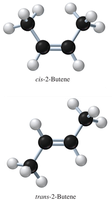
Alkenes can exhibit geometric isomerism (cis–trans) due to the rigidity of the double bond. In cis isomers, similar groups are on the same side; in trans isomers, they are on opposite sides.
Physical and Chemical Properties: Cis–trans isomers have distinct properties.
Addition Reactions
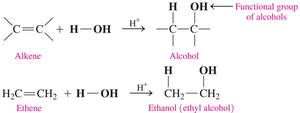
Alkenes and alkynes undergo addition reactions, where small molecules add across the double or triple bond. Common addition reactions include hydrogenation (adding H2) and hydration (adding H2O).
Hydration: Alkenes react with water in the presence of acid to form alcohols.
Aromatic Compounds
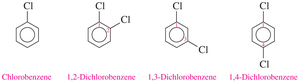
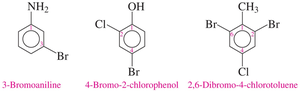
Aromatic compounds contain benzene rings, which are six-carbon rings with alternating double bonds. Benzene is represented as a hexagon with a circle, indicating delocalized electrons.
Naming: Benzene derivatives are named by indicating substituents and their positions. Common names like toluene, aniline, and phenol are retained.
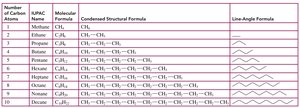
Summary Table: First Ten Alkanes
Number of Carbon Atoms | IUPAC Name | Molecular Formula | Condensed Structural Formula | Line-Angle Formula |
|---|---|---|---|---|
1 | Methane | CH4 | CH4 | — |
2 | Ethane | C2H6 | CH3—CH3 | — |
3 | Propane | C3H8 | CH3—CH2—CH3 | — |
4 | Butane | C4H10 | CH3—CH2—CH2—CH3 | \ |
5 | Pentane | C5H12 | CH3—CH2—CH2—CH2—CH3 | \\ |
6 | Hexane | C6H14 | CH3—(CH2)4—CH3 | \\\ |
7 | Heptane | C7H16 | CH3—(CH2)5—CH3 | \\\\ |
8 | Octane | C8H18 | CH3—(CH2)6—CH3 | \\\\\ |
9 | Nonane | C9H20 | CH3—(CH2)7—CH3 | \\\\\\ |
10 | Decane | C10H22 | CH3—(CH2)8—CH3 | \\\\\\\ |
Additional info: This study guide covers the essential concepts from Chapter 11: Introduction to Organic Chemistry: Hydrocarbons, including definitions, properties, naming conventions, structural representations, isomerism, reactions, and aromatic compounds. All included images directly reinforce the explanations and are strictly relevant to the adjacent content.
