 Back
BackIntroduction to Organic Compounds: Structure, Nomenclature, and Isomerism
Study Guide - Smart Notes
 Tailored notes based on your materials, expanded with key definitions, examples, and context.
Introduction to Organic Compounds
Definition and Characteristics
Organic chemistry is the study of the structure, properties, and reactions of carbon-containing compounds. Organic compounds are defined by the presence of carbon-carbon (C–C) and carbon-hydrogen (C–H) bonds. Many organic compounds also contain other elements such as oxygen (O), nitrogen (N), sulfur (S), and halogens (F, Cl, Br, I).
Hydrocarbons are organic compounds containing only carbon and hydrogen.
Organic compounds are found throughout nature, including in fuels, beverages, and biological molecules.
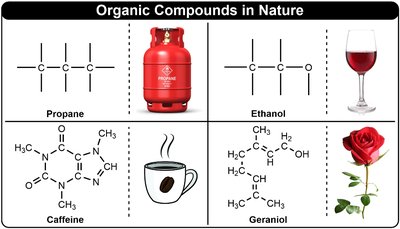
Structural Diversity of Organic Compounds
Bonding and Molecular Architecture
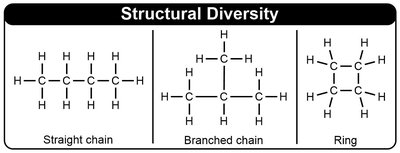
Carbon atoms can form stable bonds with themselves, leading to a wide variety of molecular structures. This structural diversity is due to the high bond strength and small atomic radius of carbon, allowing for strong single, double, and triple bonds.
Organic molecules can be straight chains, branched chains, or rings.
Other elements (O, N, S, halogens) are commonly found in organic compounds, contributing to their diversity.
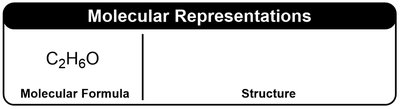
Representations of Organic Molecules
Molecular, Structural, and Condensed Formulas
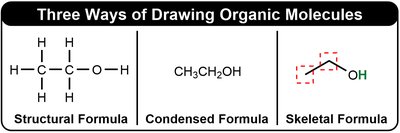
Organic compounds can be represented in several ways to convey different levels of structural information:
Molecular Formula: Shows the number and type of atoms (e.g., C2H6O).
Structural Formula: Shows how atoms are connected (bonds between atoms).
Condensed Formula: Groups atoms together to simplify the structure (e.g., CH3CH2OH).
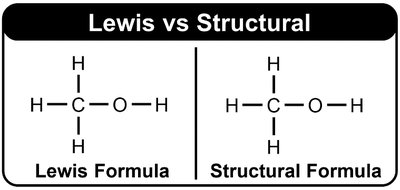
Skeletal Formulas
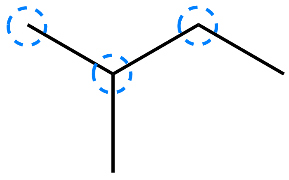
Skeletal (or line-angle) formulas are the fastest way to draw complex organic structures. Each vertex represents a carbon atom, and hydrogen atoms attached to carbon are usually omitted for simplicity. Heteroatoms (O, N, halogens) are shown explicitly.
Functional Groups in Organic Chemistry
Definition and Importance
A functional group is a specific group of atoms within a molecule that is responsible for the characteristic chemical reactions of that molecule. Functional groups determine the reactivity and properties of organic compounds.
Hydrocarbons: Only C and H atoms (alkanes, alkenes, alkynes, aromatics).
Functional groups without carbonyls: Alcohols (–OH), amines (–NH2), ethers (–O–), halides (–X), thiols (–SH).
Functional groups with carbonyls: Aldehydes (–CHO), ketones (–CO–), carboxylic acids (–COOH), esters (–COOR), amides (–CONH2).
Naming Organic Compounds (Nomenclature)
Alkanes
Alkanes are saturated hydrocarbons with only single bonds. The IUPAC system is used for systematic naming. The base name is determined by the number of carbon atoms, using prefixes such as meth-, eth-, prop-, but-, pent-, etc., and the suffix -ane.
# of Carbons | Prefix |
|---|---|
1 | Meth- |
2 | Eth- |
3 | Prop- |
4 | But- |
5 | Pent- |
6 | Hex- |
7 | Hept- |
8 | Oct- |
9 | Non- |
10 | Dec- |
Alkyl Groups
Alkyl groups are derived from alkanes by removing one hydrogen atom. They are named by replacing the -ane suffix with -yl (e.g., methyl, ethyl, propyl).
Naming Alkanes with Substituents
When naming branched alkanes, follow these steps:
Find the longest continuous carbon chain (parent chain).
Identify and name all substituents (alkyl groups, halides, etc.).
Number the parent chain from the end nearest a substituent.
Assign a location (number) to each substituent.
Use prefixes (di-, tri-, tetra-) for multiple identical substituents.
List substituents alphabetically (ignoring prefixes) and use hyphens and commas appropriately.
Naming Cyclic Alkanes
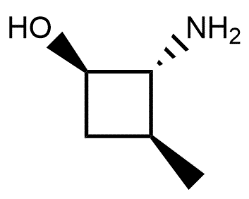
Cyclic alkanes are named by adding the prefix cyclo- to the alkane name. Numbering starts at the substituent that gives the lowest set of numbers.
Naming Alkyl Halides and Other Substituents
Halogens are named as substituents: fluoro-, chloro-, bromo-, iodo-. The same rules for numbering and alphabetizing apply.
Naming Alkenes and Alkynes
Alkenes contain at least one C=C double bond (suffix -ene), and alkynes contain at least one C≡C triple bond (suffix -yne). Number the chain to give the double or triple bond the lowest possible number. For alkenes, indicate cis/trans (or E/Z) if geometric isomerism is possible.
Naming Benzene Derivatives
Benzene is an aromatic ring. Monosubstituted benzenes are named by the substituent (e.g., chlorobenzene). Disubstituted benzenes use ortho- (1,2-), meta- (1,3-), and para- (1,4-) prefixes or numbers. Polysubstituted benzenes are numbered to give the lowest possible set of numbers, with common names used when applicable (e.g., toluene, xylene).
Hydrocarbons: Classification and Properties
Types of Hydrocarbons
Class | Bond Type | Example | Hybridization | Generic Formula |
|---|---|---|---|---|
Alkanes | C–C | Ethane | sp3 | CnH2n+2 |
Alkenes | C=C | Ethene | sp2 | CnH2n |
Alkynes | C≡C | Ethyne | sp | CnH2n-2 |
Cycloalkanes | C–C (ring) | Cyclohexane | sp3 | CnH2n |
Aromatics | Conjugated C=C | Benzene | sp2 | CnHn |
Saturated vs Unsaturated Hydrocarbons
Saturated hydrocarbons (alkanes) contain only single bonds and have the maximum number of hydrogen atoms. Unsaturated hydrocarbons (alkenes, alkynes) contain double or triple bonds and have fewer hydrogens.
Isomerism in Organic Compounds
Types of Isomers
Isomers are compounds with the same molecular formula but different structures or spatial arrangements.
Structural (Constitutional) Isomers: Different connectivity of atoms.
Stereoisomers: Same connectivity, different spatial orientation.
Geometric (cis/trans) Isomers: Different arrangement around a double bond.
Optical Isomers (Enantiomers): Nonsuperimposable mirror images due to chiral centers.

Chirality and Optical Activity
Chiral Centers and Enantiomers
A molecule is chiral if it is not superimposable on its mirror image. Chirality arises when a carbon atom (chiral center) is bonded to four different groups. Chiral molecules rotate plane-polarized light and exist as pairs of enantiomers.
Enantiomers: Non-superimposable mirror images.
Achiral: Superimposable on its mirror image.
Drawing Enantiomers
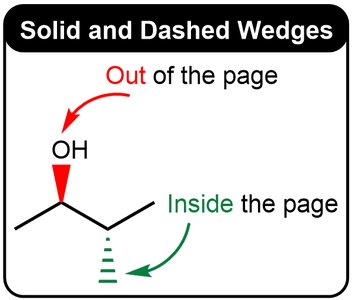
Enantiomers can be drawn by either reflecting the molecule in a mirror or by switching the positions of two groups at the chiral center (solid wedge to dashed wedge and vice versa).
Spatial Orientation and Bond Rotation
Bond Rotation
Single bonds (sigma bonds) in alkanes can rotate freely, while double bonds (pi bonds) in alkenes cannot, leading to geometric isomerism. The spatial arrangement of groups can be depicted using solid and dashed wedges to indicate bonds coming out of or going into the plane of the page.
Summary Table: Key Organic Chemistry Concepts
Concept | Definition/Key Point |
|---|---|
Organic Compound | Contains C–C and C–H bonds |
Hydrocarbon | Contains only C and H |
Functional Group | Group of atoms responsible for chemical reactivity |
Isomer | Same formula, different structure or orientation |
Chirality | Molecule not superimposable on its mirror image |
Saturated | Only single bonds |
Unsaturated | Contains double or triple bonds |
Additional info: This guide covers the foundational concepts of organic chemistry, including molecular structure, nomenclature, functional groups, isomerism, and chirality, as relevant to a general, organic, and biological chemistry course.
